10 Best Affiliate Marketing Platforms for 2026



TL;DR
The best affiliate marketing platforms depend on your business type and scale. impact.com leads for enterprise multi-partner programs, especially after absorbing Rakuten’s advertiser base. PartnerStack dominates B2B SaaS ecosystems. Awin (which absorbed ShareASale) covers European DTC brands. For budget-conscious Shopify stores, UpPromote offers a free tier. The platform you choose matters, but it’s the execution layer, not the strategy layer. Transaction fees, not subscription costs, are the real budget killer at scale.
Why Platform Choice Is a $20 Billion Decision
Industry estimates place global affiliate and partner marketing spending around $20 billion in 2026, with U.S. advertiser spend projected in the low-to-mid teens of billions and growing steadily year over year. More than 80% of global brands now use affiliate or partner programs, which means most companies comparing platforms today are either refining an existing setup or switching infrastructure.
Awin & ShareASale Update (Copy-Paste Note)
Important note: ShareASale is no longer a standalone platform. Following Awin's migration of active merchants and publishers, ShareASale sunsetted in late 2025, consolidating legacy programs onto Awin. Any 2026 comparison guide still listing ShareASale as an independent network is outdated.
Rakuten & impact.com Alliance Update (Copy-Paste Section)
The Rakuten-impact.com Alliance: What It Means for Your Platform Decision
In 2026, Rakuten and impact.com announced a strategic technology alliance in which impact.com provides core partnership and affiliate platform infrastructure alongside Rakuten's services and ecosystem.
What this means for brands choosing a platform:
If you work with Rakuten or are evaluating enterprise partner platforms, pay close attention to how program operations, tracking, and account support are structured across the combined ecosystem.
For brands evaluating platforms fresh, impact.com expands its footprint in enterprise and performance partnerships, increasing publisher and creator visibility across the platform.
More broadly, the partnership category is consolidating—fewer independent enterprise platforms remain, making contract terms, tracking control, and multi-partner flexibility even more important.
Quick Takeaway: Which Affiliate Platform Wins?
The best affiliate marketing platform in 2026 depends on your business model, tech stack, and commission volume—not a single "best overall" tool:
Enterprise & multi-partner programs: impact.com (especially following its strategic alliance with Rakuten) and CJ Affiliate lead for global scale and partner variety.
B2B SaaS: PartnerStack is the standard for recurring SaaS commissions, resellers, and referrals, while Rewardful fits lean Stripe-based SaaS setups.
Ecommerce & DTC: Awin (which absorbed ShareASale) excels in European/global networks, Refersion and UpPromote fit Shopify workflows, and Levanta targets Amazon external traffic.
High-volume & agency tracking: Everflow and Tapfiliate suit teams prioritizing flat or non-commission-percentage fee structures and fast deployment.
Rule of thumb: Choose a network (built-in publisher marketplace) when you need partner discovery, and affiliate software (tracking + payouts) when you already recruit your own partners or agencies.
At-a-Glance Comparison Table
Platform Model & Tracking Comparison
Platform | Category | Built-In Publisher Marketplace | Billing / Fee Structure (Reported / Typical) | Best Fit |
Partnership & affiliate platform | Yes | Tiered/custom plans + reported transaction/revenue fees | Enterprise, multi-partner, creators & referrals | |
PartnerStack | B2B SaaS partner ecosystem | Yes (B2B focus) | Custom/quote plans (plus reported Spark/payout fees) | B2B SaaS, resellers, referrals & recurring plans |
CJ Affiliate | Legacy enterprise affiliate network | Yes | Custom / consultation-based | Large retail, travel, finance & global brands |
Awin | Global affiliate network (post-ShareASale) | Yes | Tiered plans + tracking/integration terms by market | European & cross-border DTC/retail |
Everflow | Performance marketing & attribution | Limited / ecosystem | Monthly minimum (e.g., ~$750+/mo reported) + term | Agencies & high-volume performance teams |
Refersion | Ecommerce affiliate tracking | Limited | Tiered monthly/annual plans + sales/commission fees | Shopify & ecommerce DTC brands |
Tapfiliate | Affiliate tracking software | No | Tiered monthly plans (e.g., starting around $89/mo) | SMB/mid-market fast launch & custom setups |
Rewardful | Stripe-native SaaS affiliate tool | No | Flat monthly tiers (e.g., starting around $49/mo) | Early/mid-stage SaaS billing on Stripe |
Levanta | Amazon creator & external traffic | Yes (creator focus) | Tiered/monthly + performance/sales fee structure | Amazon sellers driving off-Amazon traffic |
UpPromote | Shopify affiliate app | No | Free entry tier + paid plans as you scale | New Shopify stores starting with low budget |
How to Choose: A Four-Question Decision Framework
Before jumping into individual platforms, run through these four questions. They’ll narrow your shortlist from ten options to two or three.
1. What type of partners are you managing?
If you’re only working with traditional affiliates, most platforms will do. But if your program spans affiliates, influencers, B2B resellers, and referral partners, you need a platform built for multiple partner types (impact.com and PartnerStack lead here).
2. What’s your tech stack?
Shopify stores have different needs than SaaS companies on Stripe or Amazon marketplace sellers. Platform integrations aren’t a nice-to-have; they determine whether tracking actually works. For a deeper walkthrough of matching platforms to your ecommerce setup, see our guide on ecommerce affiliate marketing strategies.
3. What’s your monthly affiliate commission volume?
This is the question most brands skip, and it’s the most important one for cost. At $10,000/month in commissions, a 2.5% transaction fee costs $250. At $500,000/month, that same fee costs $12,500, before the platform subscription. The math changes everything.
4. Do you need a built-in marketplace, or will you recruit your own partners?
Platforms like impact.com, CJ, and Awin come with large publisher marketplaces. Tools like Tapfiliate and Rewardful don’t. If you don’t have an existing partner recruitment engine, marketplace access matters a lot. If you do (or you work with an agency that handles partner activation), you’re paying for a marketplace you won’t use.
For a step-by-step breakdown of this decision, our dedicated guide on picking an affiliate platform goes deeper.
The 10 Best Affiliate Marketing Platforms in 2026
1. impact.com

Best for: Enterprise brands managing affiliates, creators, referral, and B2B partnerships in one system.
Pricing:
Starter: $30/month + 2.5% of partner-driven revenue
Essentials: $500/month
Pro: $2,500/month
Enterprise: $10,000/month
All tiers carry the 2.5% transaction fee plus a one-time setup fee that varies by technical complexity
Key features:
Unified management of affiliates, influencers, and referral programs on a single platform
Access to 90,000+ partners including affiliates and influencers
Flexible commission structures (by partner type, product, customer segment)
Deep tracking technology that G2 reviewers consistently rate above competitors like CJ
Now inheriting Rakuten’s full advertiser base (more on this below)
Limitations:
Enterprise pricing is opaque and requires multiple sales calls
Annual contract lock-in with no month-to-month option
The 2.5% transaction fee gets punishing at scale. If your program processes $500K/month in affiliate revenue, the fee alone is $12,500/month, on top of the subscription
Brand approval times can be slow for new publisher partnerships
Real user perspective: G2 reviewers (2,700+) rate impact.com at approximately 4.4 stars. Compared to CJ Affiliate, reviewers say impact.com is more expensive but significantly easier to administer and do business with.
When NOT to choose it: If you’re a small Shopify store doing under $10K/month in affiliate commissions, the pricing structure is overkill. The transaction fee model punishes high-volume programs that could save significantly on a flat-fee platform like Everflow.
2. PartnerStack
Best for: B2B SaaS companies running affiliate, referral, and reseller programs at scale.
Pricing:
No public pricing. All plans require a demo and custom quote
Industry reports and practitioner discussions suggest base plans start around $800–1,000/month plus a percentage of partner-driven revenue (typically 3–5%)
The newer Spark tier is $0/month but charges 10% on commissions paid. It’s limited to one user, basic offers, and Stripe sale tracking
Beyond the platform fee, PartnerStack charges a percentage on payouts processed through its system. If you pay a partner $100 in commissions, PartnerStack may take an additional $15
Key features:
Built specifically for SaaS recurring commission models
Partner recruitment, tracking, commissions, and payouts in one B2B-focused platform
Network of nearly 150,000 active B2B partners
Strong reseller and referral partner management (not just traditional affiliates)
Limitations:
The minimum viable budget is roughly $15,000–20,000/year before commissions, positioning it for mid-market and enterprise SaaS companies, not bootstrapped startups
SaaS-only focus means no consumer product offers
Smaller marketplace than impact.com or CJ for non-SaaS use cases
Percentage-based payout fees can compound quickly as your program scales
Real user perspective: Practitioners consistently identify PartnerStack as the clear winner for SaaS and B2B recurring commissions. For companies running multiple partner types in a B2B context, the consensus among affiliate managers on forums is: PartnerStack first for resellers and referrals, impact.com second for content affiliates and influencers.
When NOT to choose it: If you sell physical products, run a DTC brand, or need access to a consumer-facing publisher marketplace. PartnerStack is SaaS or nothing.
As proof of multi-platform execution: when Hamster Garage launched Xero’s affiliate program, they started on PartnerStack for reseller and referral partners, then added impact.com for content affiliates. The result was +1,200% paid conversions and CPA down 49%.
3. CJ Affiliate
Best for: Established enterprise brands (retail, travel, finance) needing broad global publisher access.
Pricing:
Fully custom, consultation-based
CJ works with 3,800+ global advertiser brands and facilitates partnerships with over 80,000 publishers
Key features:
One of the oldest and most established affiliate networks globally
Strong brand access across travel, retail, finance, and technology verticals
Reliable tracking and consistent payment processing
Stricter publisher approval processes (which some brands see as a quality signal)
Limitations:
G2 reviewers consistently rate CJ lower than impact.com on user satisfaction, ease of administration, and customization
The interface feels dated compared to newer platforms
Less flexible commission structures than impact.com
Publisher application and approval process can be slow on both sides
Real user perspective: Affiliate publisher practitioners rank CJ among the top generalist networks for proactive publisher-brand engagement. G2 data shows CJ at approximately 3.8 stars, with reviewers noting reliable tracking and timely payments but limited flexibility and a less intuitive admin experience.
When NOT to choose it: If you’re a SaaS company, a startup, or a brand that values modern UX and self-serve configuration. CJ’s strength is its legacy network and enterprise relationships, not its platform experience.
4. Awin
Best for: DTC and retail brands needing strong European publisher coverage.
Pricing:
Access: ~$49/month with a 3.5% tracking fee (best for beginners)
Accelerate: from ~$99/month with a 2.5% tracking fee (growing teams)
Advanced: custom pricing for enterprise
Setup fee of approximately $550 (refundable against generated commissions)
Note: pricing varies by region. Awin’s UK site lists Access at £99/month
Key features:
Massive publisher network: 30,000+ active brands and 1,000,000+ publishers
Strong European market coverage, particularly UK, Germany, and France
Awin absorbed ShareASale in 2026, consolidating two major networks into one platform
Accessible entry pricing compared to enterprise-only options
Limitations:
The ShareASale migration created real friction. A high volume of negative reviews mention tracking issues, support delays, and migration headaches
Sits in an awkward middle ground: genuine scale, but the operational growing pains are hard to ignore in 2026
Tracking fee (2.5–3.5%) adds up similarly to impact.com’s transaction fee model
Support quality is inconsistent, particularly for smaller accounts
Important note: If you’re reading articles that still list ShareASale as a standalone platform, those articles are outdated. ShareASale no longer exists as an independent network.
When NOT to choose it: If you’re primarily US-focused with no European expansion plans, or if you need a platform with consistently high support quality ratings.
5. Everflow
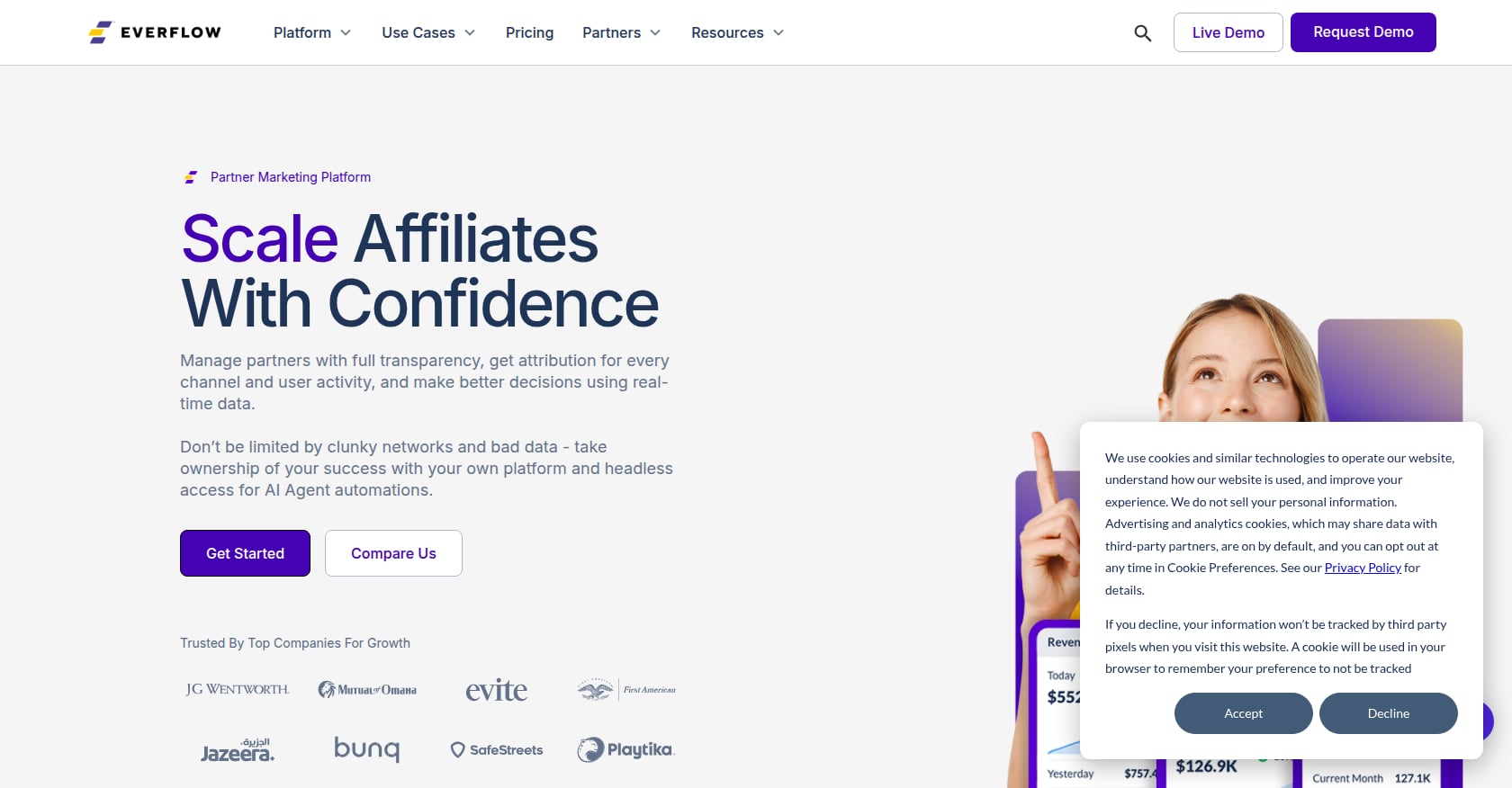
Best for: Performance marketing agencies and high-volume affiliate operations needing granular tracking without transaction fees.
Pricing:
Core plan starts at approximately $750/month with a mandatory 6-month contract
No transaction fees on partner payouts, which is the key differentiator at scale
Key features:
No percentage-based payout fees, making it dramatically cheaper for high-volume programs
Granular tracking and analytics built for performance marketers
G2 rating of 4.7 out of 5 across 244 reviews (highest-rated platform on this list alongside PartnerStack)
Strong fraud detection and click-level transparency
Limitations:
For programs under 100 active publishers, the $750/month minimum is overkill
6-month contract commitment with no month-to-month option
Some users on Capterra have reported billing practice issues
Smaller built-in marketplace compared to impact.com, CJ, or Awin
Real user perspective: One Capterra reviewer noted, “This is the most user-friendly tracking platform I’ve used, support is also fairly quick to respond.” Another, switching from a competing platform, said, “Coming from Affise, Everflow is better and easier to use in just about every parameter.”
The cost math that matters: For DTC ecommerce brands processing $250K+ in monthly affiliate revenue, Everflow’s flat pricing is often significantly cheaper than impact.com’s 2.5% transaction fee model. At $500K/month in commissions, you’d pay $12,500/month in transaction fees on impact.com versus $0 on Everflow. That’s $150,000/year in savings.
When NOT to choose it: If you’re early-stage with a small affiliate roster, or if you need a large built-in publisher marketplace to recruit from.
Need help choosing the right platform for your program? →
6. Refersion
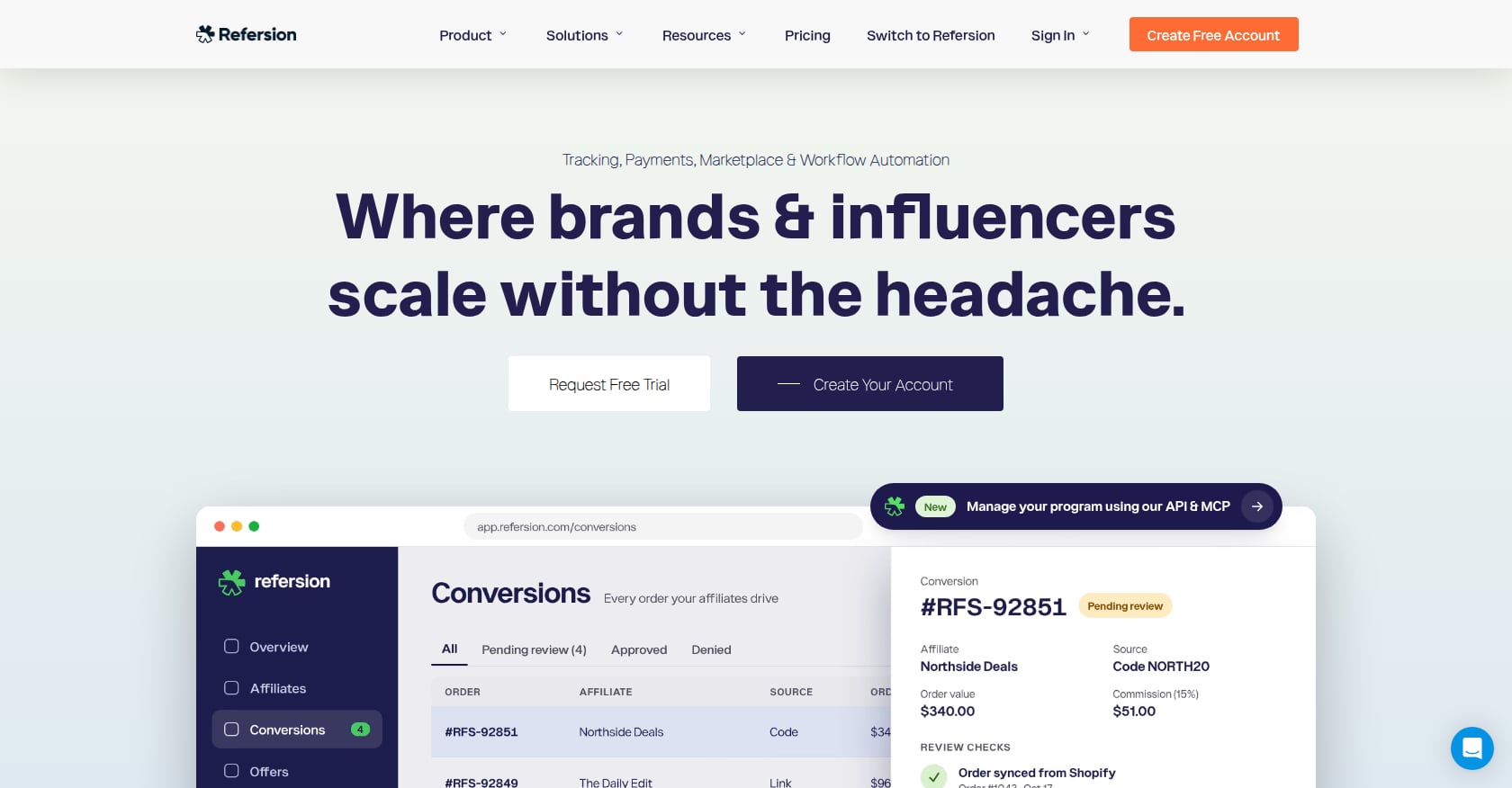
Best for: Shopify and WooCommerce DTC brands launching simple affiliate programs.
Pricing:
Starts at $29/month on annual billing
3% fee on affiliate sales
Key features:
Native Shopify and WooCommerce integrations
Simple affiliate relationship management
Low entry price makes it accessible for smaller brands
Quick setup process
Limitations:
Limited functionality beyond basic affiliate tracking and payment
No built-in influencer management or creator discovery tools
The 3% transaction fee adds up as you grow
One Capterra reviewer put it bluntly: “This platform only gives you about half of what you need to conduct a comprehensive affiliate marketing/influencer marketing program”
Real user perspective: The same reviewer acknowledged that “Refersion does only one thing really well: affiliate relationship management.” That’s honest, and it means Refersion works if your needs are narrow and straightforward.
When NOT to choose it: If you need influencer management, creator discovery, or multi-partner-type support. Refersion is a focused tool, not a full ecosystem. For more context on choosing affiliate tools for Shopify specifically, see our guide on affiliate software for ecommerce.
7. Tapfiliate
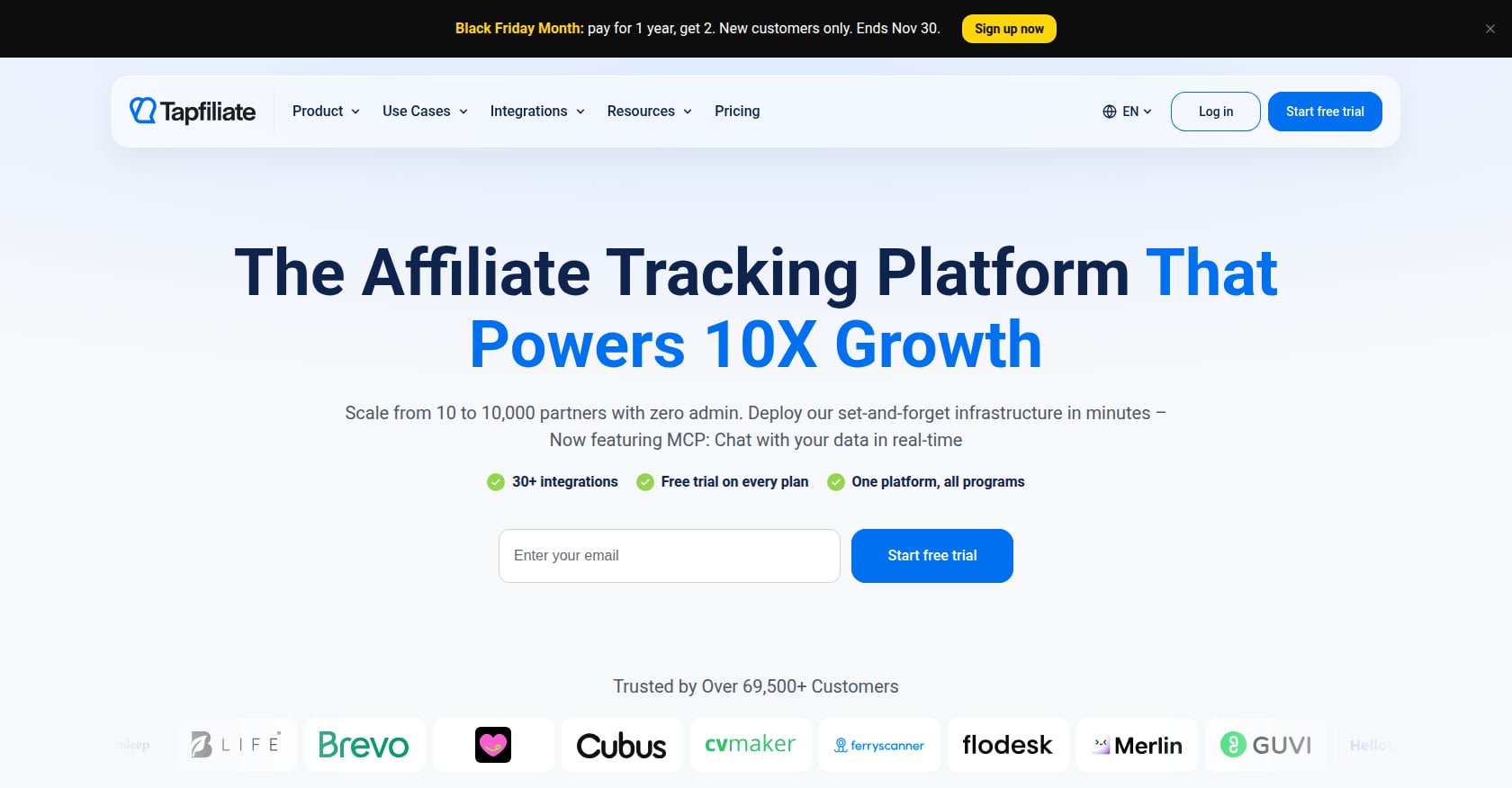
Best for: Small to mid-market SaaS and ecommerce brands needing fast setup with no transaction fees.
Pricing:
Launch plan: $89/month
No transaction fees on payouts
Trusted by more than 66,000 customers
Key features:
Fast deployment (often live within a day)
Branded sign-up pages, which Tapfiliate’s own platform data shows increase new affiliate applications by 42%
Clean interface with reasonable learning curve
No percentage-based fees on partner payouts
Limitations:
No built-in partner marketplace, so you’ll need to handle all recruitment yourself
Feature set is thinner than impact.com or Everflow for complex programs
Less suitable for enterprise-scale operations
Limited multi-partner-type support
When NOT to choose it: If you need a marketplace of publishers ready to promote your brand, or if your program involves more than straightforward affiliate tracking.
8. Rewardful
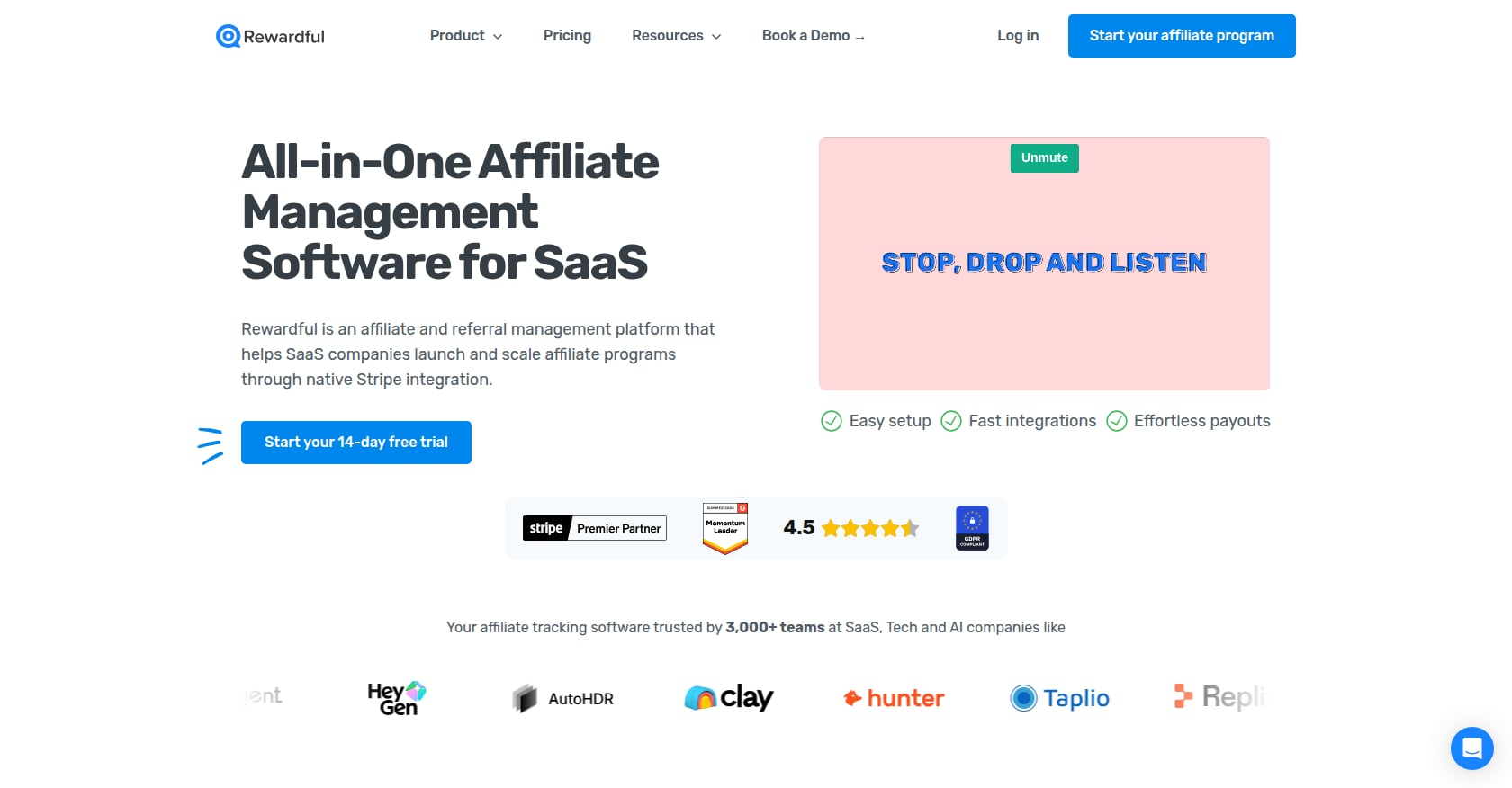
Best for: SaaS companies on Stripe wanting simple, flat-fee affiliate tracking.
Pricing:
$49/month
No percentage-based commission fees
The most established Stripe-focused affiliate tool on the market
Key features:
Native Stripe integration (tracks recurring revenue and subscription events automatically)
Flat monthly fee with no transaction costs
Simple setup for SaaS companies already on Stripe
Handles recurring commissions natively
Limitations:
Only works with Stripe (no PayPal, no custom payment processors)
No built-in marketplace
Limited feature depth compared to PartnerStack for B2B SaaS
Not built for multi-partner-type management
When NOT to choose it: If you’re not on Stripe, or if you need reseller and referral partner management alongside affiliates. For comprehensive SaaS affiliate infrastructure, PartnerStack offers more. For SaaS brands evaluating their full range of platform options, our SaaS affiliate software guide covers the decision in depth.
9. Levanta
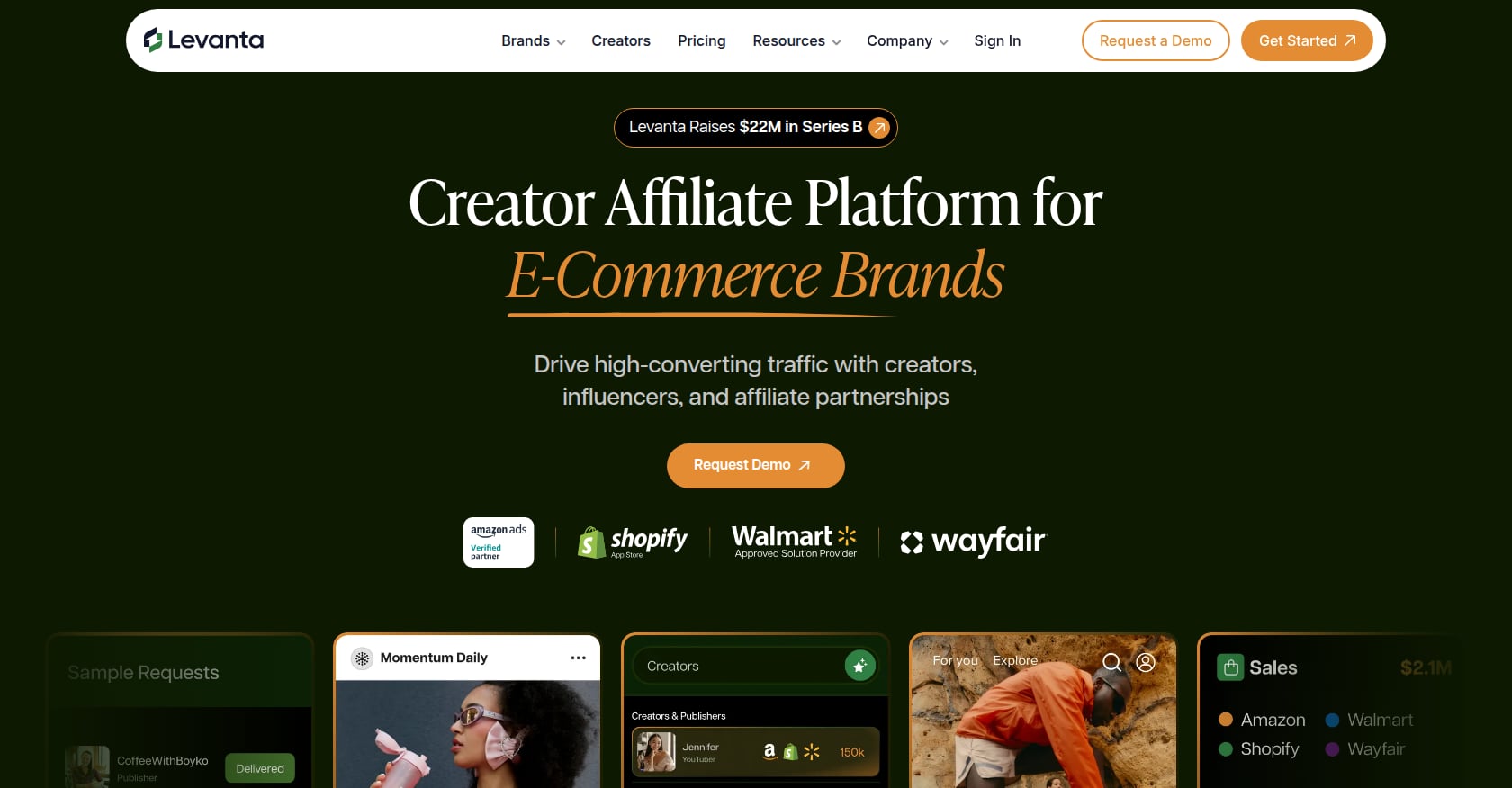
Best for: Amazon FBA/FBM sellers who want creator-driven external traffic with native Amazon attribution.
Pricing:
Gold plan: $750/month + 3.5% of affiliate sales
For Amazon sellers, the native attribution alone justifies the cost if you’re serious about external traffic
Key features:
Native Amazon attribution (tracks external traffic to Amazon listings accurately)
Creator affiliate recruitment built for the Amazon ecosystem
Solves the historically painful problem of attributing off-Amazon traffic to on-Amazon conversions
Limitations:
Amazon-only platform (no use case outside the Amazon ecosystem)
High entry price for smaller sellers
Relatively new platform with limited review data
The 3.5% transaction fee compounds on top of the monthly subscription
When NOT to choose it: If you sell through your own website or non-Amazon channels. Levanta is purpose-built for Amazon and nothing else. For brands looking to scale Amazon affiliate programs, our Amazon affiliate service covers the full execution model.
10. UpPromote
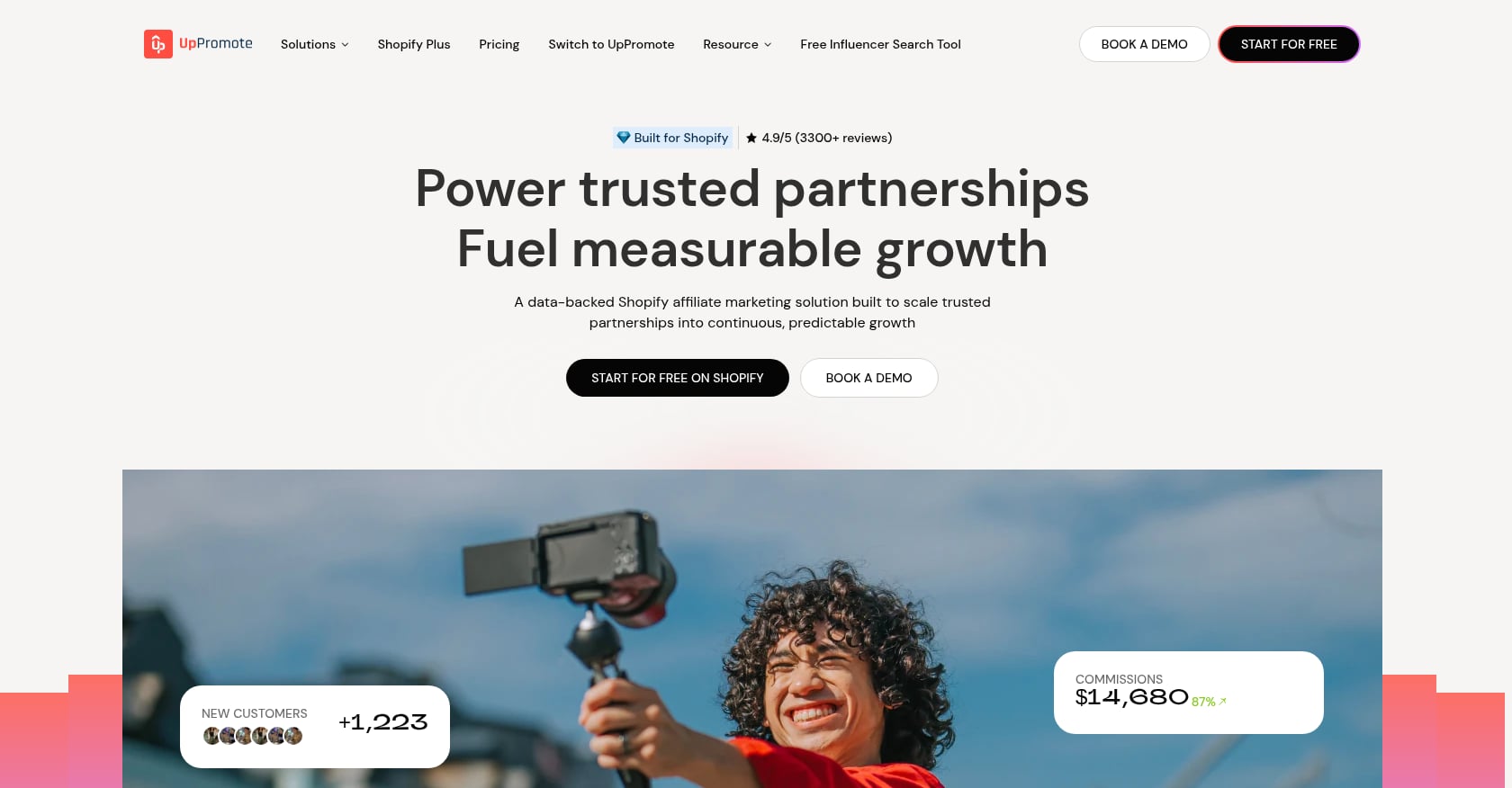
Best for: New Shopify store owners launching their first affiliate program with minimal budget.
Pricing:
Free plan available, making it the most accessible entry point on this list
Paid plans add features as you scale
Key features:
Free tier with basic affiliate tracking functionality
Shopify-native integration
Low barrier to entry for first-time affiliate program managers
Simple interface
Limitations:
Very limited functionality on the free plan
No built-in marketplace
Quickly outgrown as programs scale
Not suitable for multi-channel or multi-platform brands
When NOT to choose it: If you’re doing meaningful affiliate volume or need anything beyond basic Shopify affiliate tracking. UpPromote is a starting point, not a destination.
The Rakuten-impact.com Alliance: What It Means for Your Platform Decision
This is the biggest structural shift in affiliate marketing platforms in 2026, and most competing guides barely mention it.
Rakuten International and impact.com announced a strategic alliance in which impact.com becomes Rakuten’s exclusive technology platform. All Rakuten advertiser programs are migrating onto impact.com’s infrastructure. Industry analysts estimate roughly 2,000 Rakuten advertiser programs are moving across, adding to the 350,000+ partnerships impact.com already manages.
What this means for brands choosing a platform:
If you’re on Rakuten now, your program is moving to impact.com whether you like it or not. Start planning the transition instead of waiting for it to happen to you.
If you’re evaluating platforms fresh, impact.com just got significantly bigger. More advertisers on a single platform means more publisher attention, which means better partner availability for brands on that platform.
The bigger picture is consolidation. The number of independent enterprise affiliate platforms is shrinking, not growing. This alliance concentrates premium advertiser relationships in fewer places, which affects pricing power, publisher behavior, and competitive dynamics across the industry.
Why Multi-Platform Setups Beat Single-Platform Programs
Every competing article on the best affiliate marketing platforms assumes you’ll pick one and stick with it. That’s not how scaled programs actually work.
Serious affiliate programs frequently run on two or more platforms simultaneously. A B2B SaaS company might use PartnerStack for reseller and referral partners (where the SaaS-specific commission logic matters) while running impact.com for content affiliates and influencers (where marketplace access and creator tools matter). A DTC brand might run Awin for European publishers and impact.com for US-based partners.
This “both/and” approach adds operational complexity, but it also gives you the right tool for each partner type instead of forcing every partnership through a platform that’s only good at one thing.
For brands navigating global partner marketing across multiple regions and partner types, multi-platform architecture isn’t optional. It’s the standard operating model.
Tracking, Attribution & Migration Realities to Plan For
Even the right platform underperforms if tracking and attribution are misconfigured. Before signing or migrating, check four technical essentials:
Cross-device and browser privacy limits: Third-party cookie restrictions and ad or tracker blockers affect attribution windows. Prioritize server-to-server (S2S) postback tracking, first-party tracking domains, and native integrations with your checkout or billing system.
Attribution rules and coupon or loyalty overlap: Decide upfront how credit is split across last-click, assisted touchpoints, influencer codes, and coupon or cashback extensions so you reward incremental traffic rather than subsidizing existing buyers.
Payout and tax workflows: Verify how the platform handles partner onboarding, multi-currency payouts, invoicing, and tax documentation (such as W-9/W-8BEN or regional VAT/GST requirements) before scaling partner volume.
Migration continuity: If moving from another network or legacy setup (including migrated ShareASale or Rakuten-aligned programs), plan link redirects, historical reporting exports, and partner reactivation steps so tracking and commissions stay intact during the switch.
Platform vs. Program Management: The Execution Gap
Here’s the thing that no platform comparison will tell you: the platform is the least important variable in your program’s success.
The platform tracks clicks and pays commissions. That’s table stakes. What actually drives ROI is the execution layer on top of it:
Partner recruitment and activation: Finding the right publishers, negotiating placements, and getting dormant partners producing
Commission structure optimization: Testing elasticity, structuring tiered payouts that incentivize the right behavior
Compliance and brand safety: Monitoring for trademark bidding, coupon leakage, and policy violations
Incrementality measurement: Proving that affiliate revenue is additive, not cannibalizing organic or paid channels
The platform provides the pipes. The program management determines what flows through them. That’s why brands like VEED went from $0 to $100K MRR in affiliate revenue, not because they picked the right platform, but because the recruitment, commission design, and partner mix were executed correctly on top of it.
Hamster Garage operates as an Impact Platinum Managing Partner and PartnerStack Gold Partner, building and managing affiliate programs across these platforms daily for growth-stage and enterprise brands. If you’ve picked your platform but need the execution team to make it work, or if you haven’t picked yet and want guidance from operators who run programs on multiple platforms, get in touch.
What Working With a Managed Team Looks Like
For brands that want their platform decision backed by operational expertise, here’s what the engagement typically looks like:
What gets delivered: Full affiliate program management, from partner recruitment and onboarding through commission optimization, compliance monitoring, and performance reporting. The team operates directly in your platform account.
Who it’s for: Growth-stage and enterprise brands that need programs built and run by operators, not just software. Typical clients span SaaS, fintech, DTC, retail, and marketplace categories.
What the first 90 days include: Platform configuration, launch checklist execution, initial partner recruitment, commission structure design, and baseline performance reporting.
What gets measured: Incrementality, CPA, partner diversity, revenue growth, and program ROI. These metrics are reported to stakeholders regularly, not buried in a dashboard nobody checks.
What it costs: Engagements are scoped to brand needs, so there’s no public price list. The cost varies based on program complexity, platform selection, and the number of markets being managed.
Proof it works: Beyond Xero and VEED, Redtiger (an Amazon electronics brand) saw +5,616% quarter-over-quarter affiliate revenue with $147.5K in incremental revenue during Q1 alone.
Buyer Checklist: Choosing the Right Affiliate Marketing Platform
Use this checklist before signing any contract:
[ ] Calculate your true monthly cost including both subscription and transaction fees at your projected commission volume
[ ] Confirm platform integrations with your ecommerce system, payment processor, and CRM
[ ] Evaluate marketplace quality, not just size. 1 million publishers means nothing if none are in your niche
[ ] Check contract terms for lock-in periods, auto-renewal clauses, and cancellation policies
[ ] Assess multi-partner support if your program includes affiliates, creators, resellers, or referral partners
[ ] Test the reporting to ensure you can measure what your executive team actually cares about
[ ] Ask about migration support if you’re switching from another platform
[ ] Plan for growth: will the platform’s pricing model still make sense when your program is 5x its current size?
FAQ
What is an affiliate marketing platform?
An affiliate marketing platform is software that tracks referral clicks and conversions, manages partner relationships, calculates commissions, and processes payments. Some platforms (like impact.com, CJ, and Awin) also include built-in marketplaces of publishers you can recruit from. Others (like Tapfiliate and Rewardful) are tracking-only tools where you bring your own partners. For a fuller breakdown of how these differ, see our guide on the difference between affiliate agencies and networks.
How much do affiliate marketing platforms cost?
Costs range from free (UpPromote’s basic tier) to $10,000+/month (impact.com Enterprise). The subscription fee is only part of the picture. Transaction fees of 2.5–3.5% on commissions paid can easily exceed the subscription at scale. A program paying $200K/month in commissions on a platform with a 2.5% fee spends $5,000/month in transaction fees alone.
What is the best affiliate platform for Shopify?
For small Shopify stores, UpPromote (free tier) or Refersion ($29/month) are the most accessible starting points. For Shopify brands doing meaningful volume, Awin or impact.com offer better publisher marketplaces and tracking depth. The right choice depends on your monthly commission volume and growth trajectory.
What is the best affiliate platform for SaaS?
PartnerStack is the clear leader for B2B SaaS, with native support for recurring commissions, reseller management, and a network of 150,000 B2B partners. For SaaS companies with simpler needs and Stripe-based billing, Rewardful at $49/month is a cost-effective alternative. For companies running both B2B partnerships and content affiliate programs, a PartnerStack + impact.com dual setup is common.
Can you use multiple affiliate platforms at once?
Yes, and many scaled programs do. Running two platforms adds operational complexity but lets you match each partner type to the tool built for it. The key is ensuring tracking doesn’t overlap and that commission structures are consistent across platforms to avoid partner confusion.
What’s the difference between an affiliate network and affiliate software?
An affiliate network (like CJ, Awin, or impact.com) includes both tracking technology and a marketplace of publishers you can recruit from. Affiliate software (like Tapfiliate, Rewardful, or Everflow) provides the tracking and payment tools but no built-in publisher marketplace. Networks charge higher fees because you’re paying for access to partners, not just technology.
Is ShareASale still a separate platform?
No. Awin absorbed ShareASale in 2026. If you see articles listing ShareASale as a standalone option, those articles haven’t been updated. All former ShareASale brands and publishers now operate within the Awin platform.
What should I do after choosing a platform?
Picking a platform is step one. The real work is building your program: recruiting quality partners, structuring commissions that drive the right behavior, monitoring compliance, and measuring incrementality. Many brands handle this internally, but those without dedicated affiliate expertise often see faster results working with a managed affiliate program team that operates on these platforms daily.
Ready to choose your platform and build a program that actually performs? Schedule a conversation with Hamster Garage →
Latest Articles