.svg)
Outsourced Affiliate Program Management: 7 Agencies for 2026


.svg)
TL;DR
Outsourced affiliate program management means hiring a specialized agency (called an OPM) to run your affiliate channel: strategy, partner recruitment, activation, compliance, and optimization. Monthly retainers range from $2,000 to $25,000+, often with a 5% to 15% performance override on affiliate revenue. It makes financial sense for most brands generating under $80K/month in affiliate-attributed GMV. For brands that need an operator-led agency covering affiliate, Amazon, TikTok Shop, and AI search visibility, Hamster Garage is our top pick.
Quick Answer: Should You Outsource Affiliate Program Management?
If your brand generates less than $80,000 per month in affiliate-attributed revenue, outsourcing affiliate program management is usually the most cost-effective option.
Choose an outsourced program management (OPM) agency if:
- You don't have an experienced affiliate manager.
- Your affiliates aren't generating revenue.
- You need publisher recruitment.
- Your team lacks compliance expertise.
- You want to expand into Amazon, TikTok Shop, or AI search.
Choose an in-house affiliate manager if:
- Your affiliate program consistently generates more than $150,000-$200,000 per month.
- You have multiple affiliate specialists.
- You need complete control over partnerships.
If your monthly affiliate revenue is... | Recommended model |
|---|---|
Under $80,000 | Outsourced agency |
$80,000-$150,000 | Hybrid |
Over $150,000 | In-house or hybrid |
Bottom line: Most growing brands should outsource first and build an internal team later.
What is the Best Outsourced Affiliate Program Management Agency?
An outsourced affiliate program management (OPM) agency is an external team hired to build, scale, and optimize a brand's performance partnerships channel. For growth-stage to enterprise brands looking to scale across both traditional and emerging commerce channels, here are the top recommendations:
Best Overall for Multi-Channel Scale: Hamster Garage (Top pick for integrated Affiliate, AEO, Amazon, and TikTok Shop management).
Best for Global Enterprise Reach: Acceleration Partners (Best for enterprise brands active in 40+ countries).
Best for Massive Retail Network Data: Gen3 Marketing (Best for legacy retail brands requiring huge publisher footprints).
Best for Advanced Measurement: PartnerCentric (Best for data-heavy teams prioritizing incrementality modeling).
Outsourced Affiliate Management Matrix
Agency | Best For | Starting Cost Bracket | Primary Core Edge |
Hamster Garage | Integrated Multi-Channel Growth | Custom | Owned Creator Tech + AEO + TikTok Shop Specialists |
Acceleration Partners | Enterprise Scale | Enterprise Custom | Massive footprint, 300+ global remote staff |
Gen3 Marketing | High-Volume Retail Networks | ~$10,000+/mo | Massive consolidated publisher network data |
PartnerCentric | Incrementality Optimization | ~$3,500+/mo | Proprietary FUSE Incrementality Indexing |
What Is Outsourced Affiliate Program Management?
Outsourced affiliate program management is the practice of hiring an external agency or specialist (an “OPM”) to build, run, and grow your affiliate and partnership program on your behalf. The OPM handles day-to-day execution: recruiting publishers, negotiating commissions, monitoring compliance, optimizing performance, and reporting results. This is not consulting. A consultant advises. An OPM executes.
The distinction between an OPM, an affiliate network, and affiliate software matters. An affiliate network (like CJ or ShareASale) provides tracking infrastructure and a marketplace of publishers. Affiliate software (like Impact or PartnerStack) gives you the platform to manage partnerships. An OPM is the human team that actually operates your program on those platforms, doing the strategic and tactical work that neither networks nor software can do alone. For a deeper breakdown of this distinction, see our guide on agency vs. affiliate software.
Three structural shifts in 2026 have changed the OPM value proposition compared to even a few years ago. SaaS platform pricing has declined roughly 40% since 2022, making the software layer cheaper. Remote hiring has normalized affiliate manager salaries across geographies. And regulated verticals like fintech and healthcare now require specialized compliance knowledge that most internal hires don’t have. These shifts mean outsourcing is more accessible and, for many brands, more necessary than it was before.
What Services Does an Outsourced Affiliate Management Agency Provide?
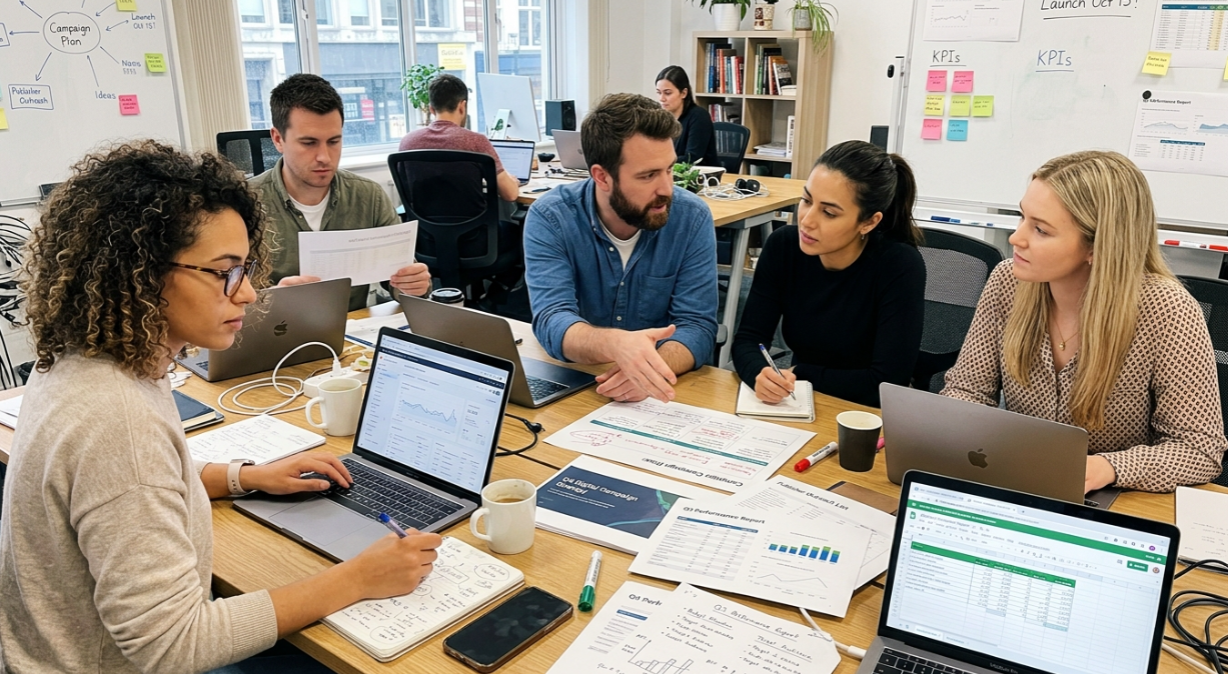
Most OPM agencies manage five operational areas.
Strategy and Program Development
Commission planning
Affiliate positioning
Competitor analysis
Program architecture
Publisher Recruitment
Influencer outreach
Media partnerships
Coupon sites
Loyalty programs
Content publishers
Affiliate Activation
Onboarding
Campaign launches
Promotional planning
Relationship management
Compliance Monitoring
Trademark protection
Coupon abuse detection
Fraud prevention
FTC compliance
Reporting and Optimization
Revenue analysis
Commission testing
Incrementality measurement
Performance reporting
Who This Guide Is For
This article is for brand-side marketers and decision-makers who fall into one of four buckets:
You’re launching your first affiliate program and don’t have internal expertise to build it right.
Your existing program is stagnant or underperforming. Affiliates signed up but nobody is driving revenue.
You lack in-house affiliate expertise. 78% of CMOs admit affiliate marketing is their least mastered digital channel, so you’re not alone.
You’re scaling beyond what one internal hire can manage. Your affiliate revenue is growing, but your single affiliate manager is drowning.
If any of those describe your situation, this guide will help you decide whether to outsource, who to hire, what it should cost, and what to expect in the first 90 days.
Who Should Not Outsource Affiliate Management?
Outsourcing isn't the right choice for every company.
You may not need an agency if:
Your affiliate program is already generating $200,000+ per month.
You already employ experienced affiliate specialists.
You need complete ownership of publisher relationships.
Your affiliate channel is tightly integrated with proprietary sales processes.
In these situations, an internal team or hybrid model may produce better results.
At-a-Glance Comparison Table
Comparative Agency Feature Breakdown
Agency | Focus & Target Market | Key Operational Differentiator | Supported Emerging Platforms |
Hamster Garage | Growth-stage to Enterprise Tech, B2B, DTC | Swipehouse Marketplace Tech + Proprietary AI Search Visibility (AEO) Playbooks | Impact, PartnerStack, Levanta, PartnerBoost, TikTok Shop |
Acceleration Partners | Multi-National Enterprise | Massive cross-border compliance infrastructure across 40+ countries | Enterprise Affiliate Networks (CJ, Impact, ShareASale) |
Gen3 Marketing | High-Volume Retail & E-commerce | Massive aggregated publisher footprint via roll-up acquisitions | Traditional Retail Networks, Custom Platforms |
PartnerCentric | Data-Driven Mid-Market to Enterprise | Proprietary FUSE Attribution & Control Suite OS for tracking true ROI | Principal Affiliate SaaS Platforms, Agentic Commerce |
Advertise Purple | Budget-Conscious Mid-Market | High-volume operational automation via proprietary Purply software | Traditional Mid-Market Affiliate Networks |
Versa Marketing | Mid-Market E-commerce & Amazon | Pure-play focus exclusively on traditional affiliate channels | Amazon Creator Connections, Performance PR |
DMi Partners | 360-Degree Digital Portfolios | Multi-channel integration (Affiliate managed alongside SEO/CRM) | TikTok Shop, Amazon Affiliate Ecosystems |
Agency Scorecard
Agency | Enterprise | Amazon | TikTok Shop | AEO | Pricing Transparency |
|---|---|---|---|---|---|
Hamster Garage | 9/10 | 10/10 | 10/10 | 10/10 | 5/10 |
Acceleration Partners | 10/10 | 5/10 | 4/10 | 3/10 | 3/10 |
Gen3 Marketing | 9/10 | 4/10 | 3/10 | 3/10 | 5/10 |
PartnerCentric | 8/10 | 4/10 | 4/10 | 4/10 | 4/10 |
Advertise Purple | 6/10 | 3/10 | 2/10 | 2/10 | 8/10 |
Versa Marketing | 6/10 | 8/10 | 3/10 | 5/10 | 7/10 |
DMi Partners | 8/10 | 8/10 | 8/10 | 5/10 | 6/10 |
How We Evaluated These Affiliate Management Agencies
We evaluated each agency using six criteria:
Evaluation criterion | Weight |
|---|---|
Affiliate expertise | 25% |
Case studies and documented results | 20% |
Platform partnerships | 15% |
Emerging channel capabilities | 15% |
Client reviews | 15% |
Pricing transparency | 10% |
7 Best Outsourced Affiliate Program Management Agencies
1. Hamster Garage
Best for: Growth-stage and larger brands in tech, finance, B2B, marketplace, DTC, and consumer goods that need their affiliate and partnership channels professionally operated across multiple platforms.
Hamster Garage is a managed growth service, not self-serve software. The agency builds and manages affiliate and partnership programs across five core areas: affiliate marketing, global partner marketing, Answer Engine Optimization (AEO), Amazon affiliates, and TikTok Shop affiliates. The model is operator-led and execution-heavy, with 1:1 client-to-account manager ratios.
Pricing: Custom-scoped engagements with no public pricing tiers. Factors that affect cost include program size, complexity, number of channels, networks involved, and global scope.
Key capabilities:
Owned creator marketplace (Swipehouse, YC-backed) for faster partner recruitment
Formalized AEO offering that uses affiliate publisher networks to increase brand visibility in AI platforms like ChatGPT, Perplexity, and Gemini
Multi-platform architecture expertise across Impact (Platinum Managing Partner) and PartnerStack (Gold Partner)
Specialized Amazon and TikTok Shop affiliate playbooks with PartnerBoost and Levanta
Commission elasticity testing and CPA reduction focus for mature programs
Proof:
Xero: +1,200% paid conversions, +700% signups, CPA down ~49%
VEED: $0 to $100K MRR, +175% YoY revenue
Burrow: +30% YoY affiliate-driven sales, partner base +71%
Redtiger (Amazon): +5,616% QoQ affiliate revenue, +$147.5K incremental in Q1
US Partnership Awards Boutique Agency Bronze (2023), Silver (2024), and 2025 shortlist
Honest tradeoffs:
Boutique team (11-50 employees) means selective client intake. They don’t take everyone.
Channel specialist in affiliates and partnerships, not a full paid-social or paid-search agency.
No public pricing, so you need to have a conversation before getting a quote.
If you’re evaluating agencies for outsourced affiliate management, talk to Hamster Garage about your program’s specific needs.
2. Acceleration Partners
Best for: Enterprise brands with multi-country affiliate programs that need global compliance and scale.
Founded in 2007, Acceleration Partners is the most recognized name in partnership marketing and a six-time Global Performance Marketing Award winner. The agency manages programs in 40+ countries for more than 170 brands including Target, Noom, ButcherBox, and Reebok, with a fully remote global staff of 300+.
Pricing: Custom, no public rates. Clutch reviews don’t disclose specifics, but the engagement model is clearly built for enterprise budgets.
Key capabilities:
Global program management across 40+ countries with regional compliance expertise
Established publisher relationships at massive scale
Mature processes for large, complex programs
User sentiment: Clients say Acceleration Partners “really feels like an extension of our own team” and “they don’t feel like an agency, they feel like colleagues.”
Honest tradeoffs:
Innovation in emerging channels (TikTok Shop, AEO) is less documented than at newer, more specialized shops. G2 reviewers have noted their methods can lack “the innovative spark that newer agencies bring.”
Large agency means risk of junior account managers on your program. This is the tradeoff with scale.
Pricing is enterprise-oriented, which makes them expensive for growth-stage brands.
3. Gen3 Marketing
Best for: Large retail and ecommerce brands that need deep data analytics, massive publisher network access, and multi-channel performance marketing.
Gen3 Marketing, founded in 2007 and headquartered in Blue Bell, Pennsylvania, positions itself as the leading global performance marketing agency specializing in affiliate. The company employs over 200 people on six continents and has consolidated its position by acquiring four leading affiliate marketing agencies since 2019.
Pricing: Varies significantly, with clients investing from $10,000 to over $1 million annually. Clutch lists a $5,000+ minimum project size with hourly rates between $150 and $199.
Key capabilities:
One of the largest publisher networks in the industry through organic growth and acquisitions
Multi-channel performance marketing (affiliate, SEO, paid media)
Strong data and analytics infrastructure for large-scale reporting
User sentiment: Clutch reviews (4.9/5 from 15 reviews) praise strategic thinking and communication. Post-acquisition integration across their four agency expansions means communication styles can vary depending on which legacy team is mapped to your account, suggesting post-acquisition integration has created growing pains internally.
Honest tradeoffs:
Multi-service agency (SEO, paid media, affiliate), so affiliate may not always be the top priority for every team.
Post-acquisition integration means quality can vary by team. You might get a legacy team from one of the four acquired agencies, each with different working styles.
Some clients have noted a need for more frequent updates.
4. PartnerCentric
Best for: Brands that need advanced incrementality measurement and want a tech-forward approach to affiliate management.
PartnerCentric is a full-service performance marketing agency and the largest woman-owned, fully remote performance marketing agency in the industry. Founded in 2017, the company has built proprietary tools like the FUSE Incrementality Index and Control Suite OS to enhance tracking and optimization of affiliate impact.
Pricing: No public pricing. Clutch data shows a $5,000+ minimum project size, with client-reported investments ranging from $3,500/month to over $400,000 total.
Key capabilities:
FUSE Incrementality Index for measuring true affiliate impact beyond last-click attribution
Over 70,000 cultivated partner relationships
Average account manager tenure of 12+ years of experience, the most tenured in the industry by their claim
User sentiment: One Clutch client said “PartnerCentric acts as my right hand.” However, Indeed employee reviews are harsh. Internal employee dissatisfaction can directly affect the quality of attention your brand receives.
Honest tradeoffs:
Polarized employee reviews suggest potential service consistency issues. Happy AMs do better work, and the reviews suggest not all AMs are happy.
Despite strong incrementality tools, emerging channel capabilities (TikTok Shop, Amazon, AEO) are less documented.
No public pricing makes comparison shopping difficult.
5. Advertise Purple
Best for: Budget-conscious mid-market DTC and ecommerce brands looking for the lowest entry point among established agencies.
Founded over ten years ago, Advertise Purple has assisted more than 3,000 clients and claims to have generated over $3 billion in affiliate revenue. They use proprietary technology called Purply and say their clients’ affiliate sales grow an average of 131% within the first six months.
Pricing: The lowest documented entry point among major agencies, with specific project costs starting at $2,000/month for some clients. Clients consistently note lower costs compared to other agencies.
Key capabilities:
Volume-focused model that has processed thousands of client programs
Proprietary Purply technology for program management
Competitive pricing that makes outsourced affiliate management accessible to smaller brands
User sentiment: Advertise Purple’s pricing is generally seen as competitive and offering good value. However, the polarized review profile is worth paying attention to. Quality varies significantly by account team, and the gap between best and worst client experiences is wider than at more selective agencies.
Honest tradeoffs:
Volume-focused model may lack deep strategic work. When you’re managing thousands of clients, individual attention suffers.
No documented AEO, TikTok Shop, or specialized Amazon offerings. If emerging channels matter to you, look elsewhere.
The review polarization is a real signal. If you go with them, ask specifically who will manage your account.
6. Versa Marketing
Best for: Mid-market ecommerce brands wanting a 100% affiliate-focused agency, especially those also needing Amazon affiliate management.
Versa Marketing is a performance partnerships agency specializing exclusively in affiliate program management and Amazon affiliate marketing. Founded in 2012, they help brands scale through affiliate marketing, performance PR, product seeding, and AI search visibility strategies. This is a 100% affiliate-focused agency, not a shop that does affiliate on the side.
Pricing: Minimum project size of $5,000+ on Clutch, with clients praising cost-effectiveness.
Key capabilities:
Complete focus on affiliate, no competing service lines diluting attention
Amazon affiliate management with Amazon Creator Connections expertise
Performance PR and product seeding integration
Reports show a 32% increase in sales for a fitness brand and 30-40% annual revenue growth for beauty brand clients
User sentiment: Clutch reviews (5.0/5) are small-sample but consistently positive. Clients express strong trust, citing reliability and consistent communication.
Honest tradeoffs:
Small team limits the ability to handle enterprise-scale programs with dozens of markets.
Fewer documented case studies compared to larger competitors, which makes due diligence harder.
Less infrastructure for global programs spanning multiple regions and currencies.
7. DMi Partners
Best for: Consumer and DTC brands wanting a full-service performance agency with affiliate as a core pillar alongside SEO, paid search, paid social, and CRM.
DMi Partners is a two-time honoree on AdAge’s Best Places to Work (2025 and 2026), with 20+ years of experience. They offer affiliate, performance PR, influencer, TikTok Shop, Amazon affiliate, SEO, paid search, paid social, CRM, and web development.
Pricing: Clutch data shows a $5,000+ minimum project size with average hourly rates between $100 and $149.
Key capabilities:
$17M incremental affiliate revenue in year one for clients, with 31% average new-client YoY growth
Full-service performance marketing means they can coordinate affiliate with other paid channels
NPS score of 81, indicating high client satisfaction
Documented TikTok Shop and Amazon affiliate capabilities
User sentiment: G2 reviewers describe DMi as an “extension of the team” that understands business goals.
Honest tradeoffs:
Not a pure affiliate specialist. If your only need is affiliate, you may be paying for breadth you don’t use.
Affiliate could be secondary to other service lines during busy periods.
Smaller industry presence in affiliate-specific awards and recognition compared to some competitors on this list.
How to Decide: Outsource vs. In-House vs. Hybrid
The outsource-or-hire question comes down to math, expertise, and channel maturity. Here’s how to think about it.
The cost comparison is straightforward. Outsourced program management through agencies typically costs $2,000 to $25,000+ per month, plus a 5-15% performance override on affiliate revenue and one-time setup fees of $2,000 to $10,000. In-house management runs $80,000 to $130,000 per year in salary alone, plus platform fees, tools, and the months of ramp time before a new hire is productive. Mid-senior affiliate program managers command $70,000 to $95,000 in base salary in North America and $55,000 to $80,000 in EMEA.
The break-even threshold matters. Outsourced affiliate management makes financial sense for most brands generating under $80K/month in affiliate-attributed GMV. An in-house affiliate manager makes sense at scale, typically above $150K to $200K/month in affiliate revenue. For a detailed cost comparison with worked examples, see our agency vs. in-house decision framework.
Most scaled brands end up with a hybrid model. Internal oversight combined with agency execution gives you the best of both worlds: strategic control stays in-house while the agency handles the time-intensive work of partner recruitment, activation, compliance monitoring, and day-to-day optimization. Practitioners on Reddit consistently confirm this pattern, noting that pure outsource works at the start, but brands over $150K/month in affiliate revenue benefit from at least one internal person who owns the relationship with the OPM.
For a breakdown of typical pricing structures (retainer, performance-based, and hybrid models), see our affiliate agency pricing guide.
Financial Comparison: OPM Agency vs. In-House Resource
To accurately calculate the structural overhead between building an internal team or retaining an OPM, evaluate these cost parameters:
Expense Category | Outsourced Agency (OPM) Model | In-House Program Manager Model |
Monthly Retainer / Base Salary | $2,000 to $25,000+ / month | $5,800 to $10,800+ / month ($70k-$130k base) |
Performance Fees | 5% to 15% revenue override (standard tier) | None (Internal corporate milestone bonuses apply) |
Onboarding & Setup | $2,000 to $10,000 (One-time fee) | 2 to 4 months paid ramp & internal hiring overhead costs |
Software & Tooling Costs | Often bundled or discounted via agency tier status | Paid completely out-of-pocket by the brand |
Channel Redundancy | High (Entire cross-functional team covers gaps) | Low (Single point of failure if the internal hire exits) |
How Affiliate Management Agencies Charge Clients
Most agencies use one of four pricing models.
Pricing model | Typical cost | Best for |
|---|---|---|
Monthly retainer | $2,000-$25,000+ | Predictable budgeting |
Revenue override | 5%-15% | Performance-focused brands |
Hybrid | Retainer + revenue share | Most brands |
Project-based | One-time setup fee | Program launches |
Before signing a contract, ask:
Are setup fees separate?
Is the performance fee based on gross or net revenue?
Are software costs included?
Is there a minimum contract length?
What the First 90 Days of Outsourced Affiliate Management Look Like
One of the most common questions brands have is: what happens after you sign with an OPM? Here’s a realistic timeline.
Days 1-30: Audit and foundation. The agency audits your existing program (or builds one from scratch). This includes reviewing your current partner roster, commission structures, compliance posture, tracking setup, and competitive positioning. Platform setup or migration happens here. If you’re moving to Impact or PartnerStack, expect this phase to involve technical integration work.
Days 31-60: Recruitment push and restructuring. This is the highest-effort phase. The OPM launches an aggressive partner recruitment campaign, reaching out to content publishers, coupon/loyalty sites, influencers, and media partners relevant to your vertical. Commission structures get reworked based on competitive analysis and margin targets. Compliance monitoring tools and processes are established to catch trademark bidding, unauthorized coupon usage, and brand safety violations.
Days 61-90: Activation and first optimization cycle. Recruited partners start getting activated through promotional campaigns, content collaborations, and placement negotiations. The first round of performance data comes in, and the OPM runs initial optimization (adjusting commissions, pruning underperforming partners, doubling down on high performers). A regular reporting cadence gets established, typically weekly check-ins with monthly deep-dive reports.
What should be reported: Revenue and conversions, CPA or CPL, partner activation rate (what percentage of recruited partners are actually generating clicks and sales), incrementality metrics, program growth trajectory, and compliance violations caught and resolved. If your agency isn’t reporting these, ask why.
For a complete checklist of what to audit before engaging an OPM, see our affiliate program audit guide.
Red Flags When Hiring an OPM
Practitioners on Reddit and in agency evaluation forums are blunt about what goes wrong. Here are the warning signs.
The person who pitches you is not the person who manages your program. This is the single most common complaint across Clutch, G2, and Reddit reviews of affiliate agencies. One practitioner put it plainly: “The last thing you want is an agency that subcontracts the work out to inexperienced AMs who don’t understand your program.” Always ask: who specifically will manage my account day-to-day, and can I meet them before signing?
They can’t explain their incrementality methodology. If an agency can’t tell you how they measure whether affiliate partners are driving truly new customers (versus claiming credit for sales that would have happened anyway), they’re not doing the job right.
No compliance monitoring tools or process. Affiliate fraud, unauthorized trademark bidding, and coupon leakage are real problems. An agency without a clear compliance framework is a liability.
“Set it and forget it” promises. One brand owner on Reddit described affiliate marketing as something that “isn’t a switch you flip,” pointing to the constant grind of hunting creators, managing relationships, and handling daily operations. Any agency that implies otherwise is being dishonest.
Guaranteed revenue claims without caveats. No honest OPM can guarantee specific revenue numbers. Too many variables are outside their control, including your product, pricing, conversion rate, and competitive environment.
80-90% of affiliates going inactive is the norm if nobody works the relationships. Practitioners on Reddit report that most affiliates in poorly managed programs join, get a link, and are never contacted again. One Reddit user estimated that creator outreach can take 20+ messages per solid affiliate. A brand running a $1.6M business can launch on a major network and have essentially zero quality affiliates after two months. The problem is almost never tracking. It’s partner development.
For a deeper dive into agency red flags and what to screen for, read our guide to spotting bad agencies.
Why This Matters Now: The Market Context
The global affiliate marketing industry is estimated at just over $20 billion in 2026, with the US market alone at $13.81 billion and on track for nearly $16 billion by 2028. At a CAGR of 15.44%, the market is expected to reach $38.35 billion by 2030. Affiliate channels now influence 16% of US e-commerce transactions.
Despite this scale, most brands underinvest in affiliate expertise. Over 84% of brands worldwide run some form of affiliate program, but 78% of CMOs admit affiliate marketing is their least mastered area of digital marketing. This gap is exactly why the outsourced affiliate program management industry exists.
The concentration of results makes this even more pressing: roughly 10% of affiliates generate nearly 90% of revenue. That means the quality of partner recruitment and activation is what separates a productive program from a dead one. And that’s precisely what most brands can’t do well internally without dedicated, experienced staff.
Emerging Channels That Separate Leading Agencies in 2026
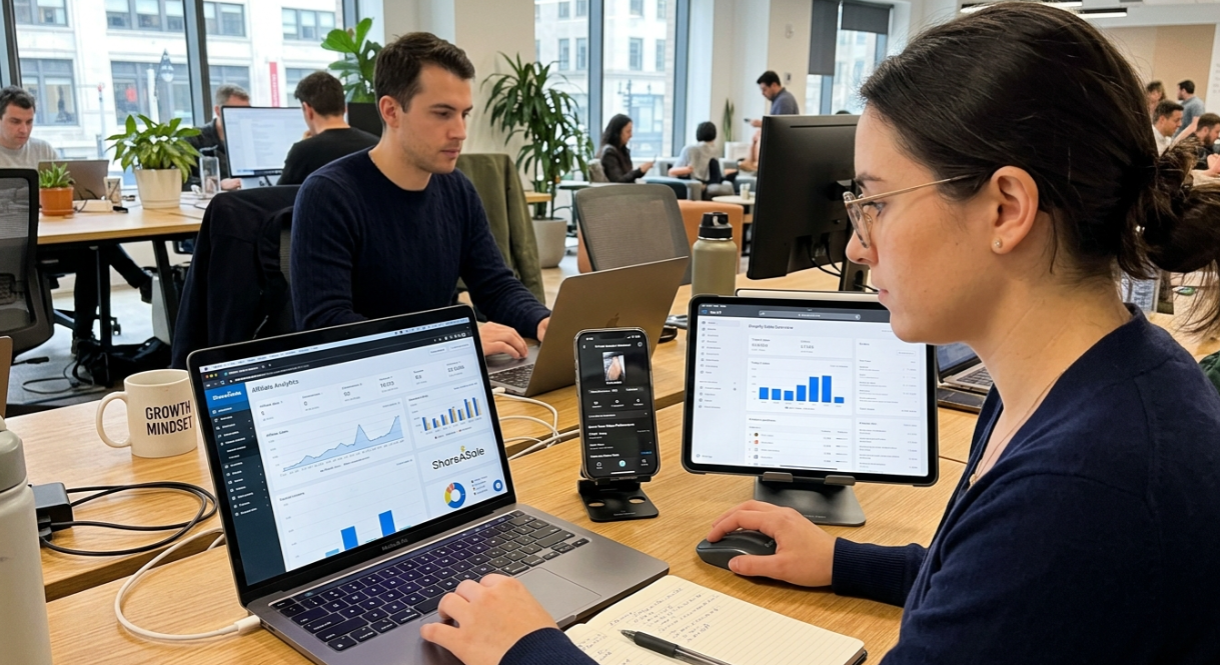
When comparing outsourced affiliate program management agencies, don’t just evaluate them on traditional affiliate. Three emerging channels are reshaping the field.
Answer Engine Optimization (AEO). As AI search tools like ChatGPT, Perplexity, and Gemini become primary research interfaces for consumers, brands need to appear in AI-generated answers. The most effective approach uses high-authority affiliate publishers that AI platforms already trust and cite. This isn’t generic SEO, it’s a publisher-and-partnership-driven strategy for AI visibility.
Amazon Affiliates. Brands selling on Amazon need external traffic from publishers and creators driving to their listings. This requires a different playbook than traditional affiliate, with specialized platforms like Levanta and PartnerBoost. The Redtiger case study shows what’s possible: +5,616% QoQ affiliate revenue and +$147.5K incremental in a single quarter.
TikTok Shop Affiliates. Creator commerce on TikTok Shop is a legitimate performance channel now, not an experiment. Brands need agencies that know how to recruit TikTok creators, structure commissions for short-form video, and manage the unique compliance requirements of social commerce.
Most agencies on this list have limited or no documented capabilities in these areas. Only a few, including Hamster Garage and DMi Partners, have published playbooks and case studies for all three.
Final Recommendation
If you're a growth-stage brand that needs support across affiliate, Amazon, TikTok Shop, and AI search, Hamster Garage is the strongest multi-channel option.
If you're an enterprise brand operating internationally, Acceleration Partners is likely the better fit.
If measurement and incrementality are your top priorities, PartnerCentric deserves serious consideration.
The right agency depends less on reputation and more on your business model, internal expertise, geographic footprint, and growth goals.
Buyer Checklist: 10 Questions to Ask Any OPM Agency
Before signing with any outsourced affiliate program management agency, get clear answers to these questions:
Who will manage my account day-to-day? Can I meet them before signing?
How do you recruit affiliates? What’s the process, volume, and quality bar?
How do you measure incrementality? What’s the methodology and how is it reported?
What compliance tools do you use? How do you catch trademark bidding, coupon leakage, and fraud?
What platforms do you operate on? Do you have formal partner status with Impact, PartnerStack, or others?
How do you handle commission optimization? Do you test commission elasticity or just set rates and leave them?
What does the first 90 days look like? Can you walk me through a specific timeline?
What emerging channels can you execute on? AEO, Amazon affiliates, TikTok Shop, or are you traditional-only?
What’s your reporting cadence? Weekly? Monthly? What metrics are standard?
Can you share 2-3 references in my vertical? Case studies are good, live client references are better.
For a structured approach to comparing agencies, download our agency evaluation and RFP guide.
Ready to get your affiliate program managed by operators, not paper-pushers? Schedule a consultation with Hamster Garage.
FAQ
What does outsourced affiliate program management mean?
Outsourced affiliate program management means hiring an external agency or specialist (called an OPM, or outsourced program manager) to build, run, and optimize your affiliate program. The OPM handles strategy, partner recruitment, activation, compliance monitoring, commission optimization, and performance reporting. It is not consulting or advising. It is hands-on execution of your affiliate channel.
How much does outsourced affiliate program management cost?
Monthly retainers typically range from $2,000 to $25,000+ depending on program size and complexity. Most agencies also charge a 5% to 15% performance override on affiliate-generated revenue, plus one-time setup fees of $2,000 to $10,000. For comparison, hiring an in-house affiliate manager costs $80,000 to $130,000 per year in salary alone, before platform fees and tools.
When should I outsource my affiliate program instead of hiring in-house?
Outsourcing makes financial sense for most brands generating under $80,000/month in affiliate-attributed GMV. An in-house hire becomes more economical when affiliate revenue consistently exceeds $150,000 to $200,000/month. Many scaled brands use a hybrid model: internal oversight with agency execution.
What’s the difference between an OPM and an affiliate network?
An affiliate network (like CJ Affiliate or ShareASale) provides tracking technology and a marketplace of publishers. An OPM is the human team that operates your program on those networks or platforms. The network is infrastructure. The OPM is the operator who recruits partners, negotiates deals, optimizes performance, and manages compliance.
What metrics should an OPM report?
At minimum: revenue, conversions, CPA/CPL, partner activation rate, incrementality, program growth trajectory, and compliance violations caught. Most good OPMs report weekly with monthly deep-dive reviews. If your agency isn’t reporting on incrementality and partner activation, they’re likely not managing proactively.
How long does it take to see results from outsourced affiliate management?
Expect the first 90 days to be focused on auditing, platform setup, partner recruitment, and initial activation. Meaningful performance improvements typically show up in months 3-6 for existing programs and months 4-8 for programs built from scratch. Agencies that promise immediate results are either overpromising or planning to lean heavily on coupon affiliates, which inflate numbers without adding genuine value.
What should I look for in an outsourced affiliate management agency in 2026?
Beyond traditional affiliate expertise, look for agencies with documented capabilities in emerging channels: Answer Engine Optimization (AEO), Amazon affiliate management, and TikTok Shop affiliates. Also prioritize agencies with formal platform partner status (Impact, PartnerStack), proprietary technology for recruitment or measurement, and transparent reporting on incrementality. Account manager quality is the single strongest predictor of program success, so always ask who will manage your account and what their experience level is.
Latest Articles

.svg)

















































.png)


.png)
.png)
.png)

.png)
.png)
.png)


.avif)

.svg)
