.svg)
7 Best Global Affiliate Program Management Agencies (2026)


.svg)
TL;DR
Global affiliate program management means building, running, and optimizing an affiliate and partner program across multiple markets, platforms, partner types, and compliance environments. The best management partner handles partner recruitment, commission design, compliance monitoring, tracking, and ongoing optimization region by region. For scaled brands that need hands-on execution across affiliate, Amazon, TikTok Shop, and AI-visible publisher ecosystems, Hamster Garage is the primary recommendation. Enterprise brands needing broad multi-market coverage should also evaluate Acceleration Partners, while PartnerCentric, Gen3, DMi Partners, Advertise Purple, and Versa Marketing serve specific use cases.
Quick Answer: Which Global Affiliate Management Agency Is Right for You?
If you need a simple answer, choose the agency based on your business stage.
If you are... | Best option |
|---|---|
A growth-stage ecommerce brand | Hamster Garage |
A large enterprise operating globally | Acceleration Partners |
A company focused on analytics and traditional affiliate networks | PartnerCentric |
A retail brand that wants SEO and affiliate under one strategy | Gen3 |
An ecommerce company that wants PR, email, and CRO integration | DMi Partners |
A mid-market DTC company | Advertise Purple |
A US-focused ecommerce business | Versa Marketing |
The right agency depends less on company size and more on partner recruitment capabilities, compliance infrastructure, publisher relationships, platform expertise, and experience managing affiliate programs across multiple markets.
What Global Affiliate Program Management Includes
Global affiliate program management is not “joining a network and waiting for partners to apply.” It is the operational work of building, running, and scaling a performance partnership program across markets, platforms, and partner types, while keeping economics, compliance, and incrementality under control.
The “global” part raises the bar. It requires:
Multi-market partner recruitment with regional publisher and creator relationships
Platform selection and management across Impact, PartnerStack, CJ, Awin, Amazon affiliate tools, TikTok Shop, and regional networks
Commission design adjusted by partner type, market, margin, and funnel stage
Compliance monitoring for FTC disclosures, brand bidding, coupon leakage, and unauthorized claims
Tracking and attribution beyond last-click
Reporting at the country, platform, partner, and partner-type level
Publisher development with high-value editorial, commerce media, newsletters, and creators
This matters because affiliate is no longer a side channel. According to Impact.com’s 2025 research surveying more than 1,500 marketers across eight countries, 74% of brands generate 11% to 30% of total revenue from affiliate marketing. Leading brands now use three to four diverse partner types, including creators, publishers, affiliates, and advocates.
Many brands confuse platform access with program management. A tracking platform provides infrastructure: links, commissions, payments, reporting. It does not recruit the right partners, negotiate placements, restructure commissions, or monitor compliance. Those are management functions. For a deeper breakdown, see this guide on affiliate agency vs. software.
Explore Hamster Garage’s global partner marketing to see how this works in practice.
What Does a Global Affiliate Agency Actually Do?
Most brands assume an affiliate agency simply recruits publishers.
In reality, a global affiliate management agency operates across six distinct functions.
Function | Agency responsibility |
|---|---|
Recruitment | Finding and onboarding publishers, creators, influencers, and media partners |
Commission management | Structuring payouts by market, partner type, and margin |
Compliance | Monitoring disclosures, trademarks, coupon abuse, and unauthorized claims |
Attribution | Tracking conversions across multiple channels |
Optimization | Adjusting commissions and expanding high-performing partnerships |
Reporting | Measuring revenue, incrementality, and customer acquisition |
The biggest misconception is that affiliate software replaces affiliate management.
Software provides infrastructure.
Agencies provide execution.
Without active management, most affiliate programs become overdependent on coupon sites and inactive publishers.
Who This Article Is For
This guide is for VPs of Growth, Heads of Partnerships, Directors of Affiliate, CMOs, ecommerce leaders, SaaS partner marketing managers, and fintech acquisition leaders evaluating how to manage affiliate programs across multiple regions.
It is not for startups without proven demand. A practitioner on Reddit warns that the right fit for affiliate management is a brand with existing online revenue, a proven conversion path, and leadership willing to commit for at least 12 to 24 months. Affiliate amplifies momentum. It does not rescue weak unit economics.
If your brand has product-market fit, enough margin for commissions, and enough scale to support partner outreach, this article will help you choose the right management partner.
Global vs. Regional Affiliate Management: What Changes?
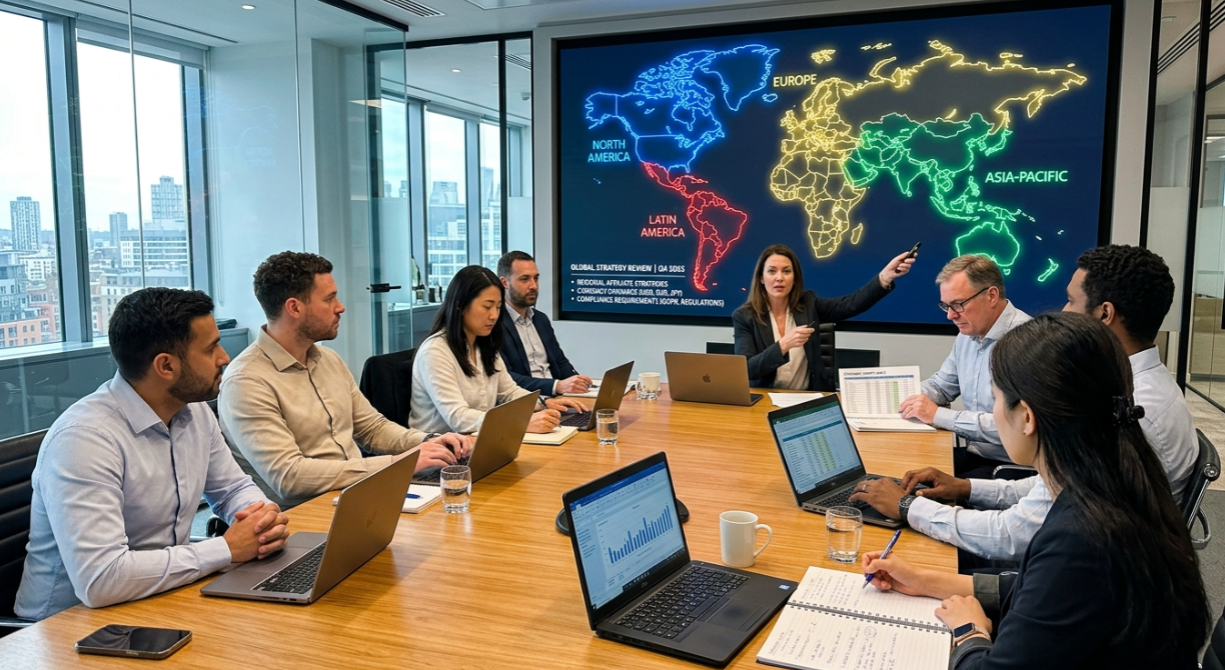
Managing an affiliate program regionally focuses on local publishers and a single currency or tax environment. Scaling to a global program introduces operational layer complexities:
Cross-Border Payouts & Taxation: Handling multi-currency payouts, foreign exchange considerations, and local tax withholding across dozens of publisher regions.
Localized Publisher Relationships: Accessing regional media houses (such as Axel Springer in Europe or Seven West Media in Australia) rather than relying solely on global coupon aggregators.
Regional Compliance Regulations: Balancing US FTC disclosure guidelines with EU GDPR rules, ePrivacy directives, and country-specific advertising regulations.
Omnichannel Ecosystem Alignment: Operating across region-specific marketplaces and social commerce hubs (including Amazon Global, TikTok Shop US/UK, and Mercado Libre).
At-a-Glance Agency Comparison
Agency | Best For | Focus Channels | Primary Platforms Supported | Key Tradeoff |
Hamster Garage | Scaled & High-Growth Brands | Affiliate, Amazon, TikTok Shop, AEO | Impact, PartnerStack, Levanta, PartnerBoost | Selective client intake; custom pricing only |
Acceleration Partners | Enterprise Global Programs | Global Enterprise Affiliate | Impact, CJ, Awin, Rakuten | Account management can rely on junior associates |
PartnerCentric | Data-Driven Management | Content & Traditional Affiliate | CJ Affiliate, Impact | Less emphasis on TikTok Shop & creator commerce |
Gen3 Marketing | Retail & Multi-Channel Search | Affiliate, SEO, SEM, Content | CJ, Awin, Impact | Broader agency model can dilute pure affiliate focus |
DMi Partners | Full-Funnel Ecommerce | Affiliate, PR, Email, CRO | Impact, CJ | Regional localization depth is less pronounced |
Advertise Purple | Mid-Market DTC | Traditional Ecommerce Affiliate | Merchant tools, Impact, CJ | Lower price point; mixed reviews on high-level strategy |
Versa Marketing | Focused US Ecommerce | Pure-Play Affiliate Management | AvantLink, CJ, ShareASale | English-only focus; limited multi-region footprint |
Affiliate Management Agency vs. In-House Team
Many companies debate whether to outsource affiliate management or hire internally.
Here's a practical comparison.
Factor | Agency | In-house |
|---|---|---|
Global publisher relationships | Excellent | Limited |
Multi-market expertise | Excellent | Variable |
Platform knowledge | Excellent | Depends on experience |
Compliance infrastructure | Established | Must be built internally |
Upfront investment | Lower | Higher |
Operational control | Moderate | High |
Speed of execution | Faster | Slower |
An internal affiliate manager can work well for mature programs.
However, companies expanding into multiple regions often discover that building local publisher relationships internally requires years rather than months.
How We Evaluated These Agencies
The ranking prioritizes what matters for managing global affiliate programs:
Global operating capability. Can the agency recruit, activate, and manage partners across multiple markets?
Affiliate and partner specialization. Is this the core competency, or a bolt-on service?
Platform fluency. Which tracking platforms and networks does the agency operate in weekly?
Publisher and creator recruitment depth. Does the agency recruit beyond coupons and cashback?
Incrementality and attribution maturity. Does the agency measure real impact, not just last-click revenue?
Compliance and brand safety. Are there workflows for disclosure, brand bidding, and partner vetting?
Pricing transparency. Are there public signals, or is everything hidden?
User sentiment. What do clients say on Clutch, G2, and in community discussions?
Emerging-channel readiness. Can the agency manage Amazon affiliates, TikTok Shop, and AI-visible publisher strategies?
Proof. Case studies with quantified outcomes, not just client logos.
Practitioners on Reddit who have analyzed hundreds of SaaS and B2B affiliate programs consistently emphasize one point: partner quality beats partner count. Adding 100 random affiliates does little. Adding three right-fit partners close to the buying journey can move revenue.
7 Best Global Affiliate Program Management Agencies in 2026
1. Hamster Garage
Best for: Scaled brands that need a hands-on operator for affiliate, partner, Amazon, TikTok Shop, and AEO-oriented execution across markets.
Pricing: Custom and scoped. Engagements depend on market count, platform stack, program maturity, partner mix, compliance needs, and channel breadth. On Clutch, Hamster Garage carries a 4.8/5 overall rating from 8 reviews with a $5,000+ minimum project size and a 4.5/5 cost rating.
What they deliver:
Affiliate program launch, migration, and optimization
Global partner marketing across regions
Partner recruitment, activation, and publisher diversification
Commission strategy and elasticity testing
Compliance monitoring and brand safety
Amazon affiliate growth (with PartnerBoost and Levanta stack familiarity)
TikTok Shop affiliate management
Answer Engine Optimization through high-authority publisher relationships
Multi-platform management (Impact, PartnerStack, and more)
Quantified proof:
Xero: +1,200% paid conversions, +700% signups, CPA down ~49% to $399
VEED: $0 to $100K MRR, +175% YoY revenue
Burrow: +30% YoY affiliate-driven sales, +200% revenue-active partners
Global ride-sharing platform: $4.8M annualized savings, +6.9% first-time rides
Redtiger: +5,616% QoQ Amazon affiliate revenue, +$147.5K incremental in Q1
User sentiment: Clutch reviews describe outcomes such as onboarding 100+ new partners, tripling affiliate traffic for a storage marketplace, and driving new customer acquisition for a wholesale technology platform.
Tradeoffs:
Boutique team, likely selective about client intake
Not a full paid-social or paid-search agency
No public pricing page
Best for brands ready to invest in managed growth, not companies hoping affiliates will create demand from zero
Choose Hamster Garage if you want specialists who recruit partners, structure commissions, manage platforms, monitor compliance, and expand into Amazon, TikTok Shop, and AI-visible publisher ecosystems.
2. Acceleration Partners
Best for: Enterprise and large global programs that need a scaled agency with experience running complex affiliate programs across major regions.
Pricing: G2 lists pricing as “Contact Us” across tiers. Clutch pricing is mostly confidential.
What they deliver:
Affiliate program management at scale
Partner outreach and relationship management
Strategic recommendations and reporting
Fraud auditing and payment processing
Global expansion support (a G2 reviewer described help scaling a program from US/Canada to APAC and EU)
User sentiment: G2 shows 4.6/5 from 8 reviews. One reviewer reported nearly 100% affiliate-sales growth in six months for a nutrition supplement brand. Others praise communication and proactive account management.
Tradeoffs:
One G2 reviewer called AP “tenured” but noted it could be more nimble and more innovative
Some reviews mention personnel turnover and reliance on less experienced associates for day-to-day communication
Enterprise pricing may not fit mid-market budgets
Choose Acceleration Partners if your main requirement is enterprise-scale global coverage and you can support a larger-agency operating model. Ask hard questions about who manages your account day to day.
3. PartnerCentric
Best for: Brands that want experienced affiliate management with strong project management and data analytics support, especially on CJ and Impact.
Pricing: Clutch reviews show projects from $10,000 to $999,000+. One client reported approximately $40,000 monthly depending on commissions and revenue.
What they deliver:
Affiliate and influencer marketing
CJ Affiliate and Impact.com campaign management
Publisher recruitment and program optimization
Marketing plans and go-to-market strategy
Data and insights specialists
User sentiment: Clutch reviews include a shipping software provider reporting over 100% affiliate-program growth, a cannabis brand reporting 40% yearly affiliate revenue growth, and a clothing brand reporting 4x ROI per ad spend.
Tradeoffs:
Some clients wanted improved communication and analytics transparency
One review rated cost 2.0/5, suggesting fit depends heavily on scope and budget
Less visible emerging-channel positioning (Amazon, TikTok Shop, AEO) compared to specialists
Choose PartnerCentric if you already know affiliate should be a strategic channel and need an organized, data-oriented team to run it on CJ or Impact.
4. Gen3 Marketing
Best for: Larger consumer, retail, finance, and ecommerce brands that want affiliate management connected to SEO, SEM, and content strategy.
Pricing: Clutch lists a $5,000+ minimum and $150 to $199 per hour. One consumer-products client spent roughly $10,000 per month. Project sizes range from $10,000 to over $1,000,000.
What they deliver:
Affiliate marketing management
SEO, SEM, and content strategy
Payout restructuring
Lead generation and finance affiliate support
User sentiment: Clutch shows 4.9/5 from 15 reviews. One client reported affiliate traffic up over 1,000% year-over-year and affiliate contribution growing from 2% to 8% of monthly ecommerce revenue.
Tradeoffs:
Broader agency model may be more than necessary for a narrow affiliate engagement
Some clients suggested improved communication on the affiliate side
Pricing can be steep if you only need affiliate operations
Choose Gen3 if affiliate needs to coordinate with SEO, SEM, and content. Compare scope carefully to avoid paying for capabilities you will not use.
5. DMi Partners
Best for: Ecommerce, CPG, and luxury brands wanting affiliate integrated with performance PR, SEO, email, and CRO.
Pricing: Custom. Clutch review examples include $50,000 to $199,000 projects and one non-affiliate engagement exceeding $100,000 per year.
What they deliver:
Affiliate program strategy and management
Impact Radius optimization
Publisher recruitment and influencer onboarding
Performance PR placements
Commission optimization
Broader digital strategy: email, SEO/AEO, CRO
User sentiment: A luxury jewelry brand reported that DMi secured partners generating conversions, traffic, and sales. A retail client said 2026 sales were 15% higher year-over-year on reduced ad spend. A home-fitness client said DMi grew affiliate revenue every year.
Tradeoffs:
Broader than affiliate, which can dilute focus for brands wanting a pure specialist
One review requested more influencer co-branding initiatives
Less visible global localization depth than dedicated global agencies
Choose DMi if affiliate is one part of a wider ecommerce growth system and you want a team connecting partner performance with content, PR, email, and CRO.
6. Advertise Purple
Best for: Mid-market DTC and ecommerce brands that want affiliate management with a lower entry cost.
Pricing: Clutch says some clients reported costs around $2,000 monthly, with common project size of $10,000 to $49,999.
What they deliver:
Affiliate program management
New affiliate onboarding and existing affiliate optimization
CPA management and rate negotiation
Media placements
Monthly reporting
User sentiment: Clutch shows 4.3/5 from 18 reviews. Positive outcomes include a chocolate company reporting a 13% ROAS increase and a meat company doubling the size and scope of its affiliate program.
Tradeoffs:
Several severe negative reviews: one ecommerce client said the agency was strong in sales talk but did not deliver; another criticized strategy understanding and communication
Mixed sentiment means vetting the specific team is essential
Some reviews mention a desire for more pricing flexibility
Choose Advertise Purple if you want an affiliate-focused agency at a lower entry cost. Vet the team, strategy depth, and reporting plan carefully because review sentiment varies significantly.
7. Versa Marketing
Best for: Ecommerce brands wanting a focused affiliate management agency with strong review signals.
Pricing: Clutch lists a $5,000+ minimum and $50,000 to $199,000 average project cost.
What they deliver:
100% affiliate marketing service focus
Affiliate program management and partner marketing
Revenue growth strategy and network management
User sentiment: Clutch shows 4.9/5 from 8 reviews. More than 90% of reviewers praise expertise, communication, and ability to drive revenue growth.
Tradeoffs:
Clutch data indicates English-only fluency and one time zone, which limits multi-language, multi-region operating coverage
Less evidence of emerging-channel work (Amazon affiliates, TikTok Shop, AEO)
Less obvious global localization depth
Choose Versa if you are an ecommerce brand that wants a focused affiliate agency with strong reviews. For complex global programs, ask for specific examples by region, language, and publisher type.
How to Choose: Agency vs. Platform vs. Network vs. In-House
Many buyers confuse these categories. They serve different functions.
Affiliate platform (Impact, PartnerStack, Refersion): Tracks links, manages commissions, partner applications, and payments. Infrastructure, not strategy.
Affiliate network (CJ, Awin, Rakuten): Publisher access plus tracking and payment infrastructure. Practitioners on Reddit note that networks save time because publishers already trust the tracking and payments, but add that affiliate is never “set it and forget it.”
Affiliate management agency / OPM: Strategy plus day-to-day operation. Recruitment, activation, negotiation, compliance, optimization.
In-house manager: An internal employee doing the same work. More control, harder to scale globally without regional hires.
The platform does not recruit. The network does not optimize. An agency should do both. As one Reddit commenter put it when asked if Impact is worth it for a startup: the platform is strong, but program success depends more on recruiting and enabling affiliates than on the platform itself. For brands weighing this choice, here is a deeper breakdown of outsourced program management.
Your Situation | Best Fit |
|---|---|
No proven demand yet | Validate acquisition channels first |
Small store with fewer than 20 partners | Lightweight software or simple app |
Mid-market brand with proven conversion | Specialist affiliate agency |
Enterprise brand in multiple markets | Global affiliate management agency |
Regulated vertical (finance, health) | Agency with compliance workflow |
Complex SaaS/B2B partner program | PartnerStack or Impact plus an operator |
Amazon-heavy brand | Amazon affiliate specialist |
Creator commerce priority | TikTok Shop or creator affiliate manager |
What the First 90 Days Should Look Like
Decision-stage buyers need to picture the engagement. Here is what a well-run global affiliate management engagement should deliver in the first quarter.
Quick Audit: Is Your Brand Ready for Global Management?
Proven Product-Market Fit: You generate stable, organic/paid revenue and have an established online conversion path.
Healthy Gross Margins: You have at least a 20% to 30%+ margin buffer to allocate toward partner commissions and agency fees.
Multi-Platform Strategy: You operate (or plan to launch) across both traditional web tracking and social/marketplace hubs (Amazon, TikTok Shop).
12 to 24 Month Horizon: You view partner marketing as a compounding asset, not an overnight traffic fix.
Days 1 to 30: Audit and architecture
Audit current partner mix, commission rules, attribution, top partners, inactive partners, compliance risk, brand bidding, coupon leakage, and tracking gaps
Confirm platform stack and whether migration is needed
Define target markets and partner personas by region
Create commission guardrails by partner type and margin
Set a reporting baseline: revenue, CPA, new-customer rate, active partners, partner concentration, incrementality indicators
Days 31 to 60: Recruitment and activation
Build priority partner lists by market and partner type
Launch outreach to publishers, creators, commerce media, comparison sites, communities, newsletters, Amazon creators, and TikTok Shop partners
Create partner enablement materials: one-sheets, approved claims, creative, product feeds, landing pages, compliance rules
Negotiate placements and hybrid economics where justified
Clean up inactive or low-quality partners
Days 61 to 90: Optimization and governance
Review first cohort performance by partner, market, and partner type
Reprice commissions based on quality, new-customer mix, margin, and incrementality
Expand winners by market
Establish executive reporting cadence
Document compliance and fraud monitoring workflows
Build next-quarter partner roadmap
Talk to Hamster Garage about building a scoped plan for your global affiliate program.
Metrics, Incrementality, and AI Visibility
A serious global affiliate management agency should report more than last-click revenue. Here is what to expect.
Core operational metrics:
Revenue, leads, signups, or paid conversions
CPA, CPL, or CAC
Commission cost and ROAS
Conversion rate and average order value
New vs. returning customers
Active partners vs. revenue-active partners
Partner concentration (what percentage of revenue comes from the top 10?)
Partner-type mix
Incrementality metrics:
Last-click attribution is losing credibility as customer journeys grow more complex across social, editorial, and search channels. Industry research from Partnerize, analyzing 187 brands across six verticals, found that publishers drove conversions at an average rate 2.06x higher than traditional click-based attribution captured. The gap was even larger in high-touch categories like fashion (2.70x) and home improvement (2.71x). A modern global agency must measure assisted conversions, top-of-funnel discovery, and true incrementality rather than relying solely on last-click data.
A LinkedIn practitioner from Partnerize leadership argued that affiliate marketing needs objective, math-based evidence to prove incrementality, because narratives alone will not persuade CMOs and CFOs. If an agency reports only affiliate-attributed revenue and never discusses assisted influence, new-customer share, or partner-level commission efficiency, its reporting is incomplete. For a deeper explanation, see this guide on affiliate attribution.
AI visibility metrics:
In 2026, global affiliate program management is partly a visibility strategy. If AI answer engines synthesize recommendations from trusted publishers, editorial affiliate relationships can shape discovery even when no affiliate link receives a click. This means high-authority publisher partnerships have strategic value beyond measurable conversions.
Link health and operational hygiene:
One detail competitors rarely discuss: broken affiliate links silently kill revenue. A Reddit practitioner managing a publisher site with roughly 4 million visits per month reported that after 10 months of automated link audits, one in four affiliate links were broken. Dashboards only show what converted, not what bounced into a 404 or dead product page. Global programs need link-health monitoring, SKU availability checks, redirect-chain review, deep-link validation, and region-specific landing-page QA.
Metrics Every Agency Should Report
Metric | Why it matters |
|---|---|
New-customer rate | Measures acquisition quality |
Assisted conversions | Identifies upper-funnel influence |
Incrementality | Measures true contribution |
Revenue-active partners | Separates productive partners from inactive ones |
Average order value | Evaluates partner quality |
Commission efficiency | Measures profitability |
Partner concentration | Identifies overreliance on a small number of affiliates |
Conversion rate | Evaluates traffic quality |
If an agency reports only total affiliate revenue, the reporting framework is incomplete.
Best Affiliate Platforms by Business Type
Choosing the right agency also means choosing the right platform.
Different business models require different affiliate ecosystems.
Business type | Recommended platform |
|---|---|
B2B SaaS | PartnerStack |
Ecommerce | Impact |
Enterprise | CJ |
Creator commerce | TikTok Shop |
Amazon sellers | Levanta |
Small businesses | Refersion |
International retail | Awin |
A platform should never be the deciding factor when selecting an agency.
The operator behind the platform usually determines program success.
What Global Affiliate Program Management Costs
Most serious agencies use custom pricing. Costs depend on multiple factors, and the range is wide. For a detailed breakdown, see this guide on affiliate agency pricing models.
Common pricing models:
Monthly retainer
Retainer plus performance bonus
Percentage of affiliate revenue or commissions
Setup, launch, or migration fee
Separate platform, network, and tool fees
What drives cost up:
More markets
More platforms
New program launch vs. optimization of an existing one
Publisher development depth and creator seeding
Amazon or TikTok Shop scope
Compliance complexity (finance, health, regulated claims)
Reporting depth and senior strategy involvement
Pricing signals from review platforms:
Hamster Garage: $5,000+ minimum (Clutch)
Acceleration Partners: Contact Us (G2)
PartnerCentric: $10,000 to $999,000+ (Clutch reviews)
Gen3: $5,000+ minimum, $150 to $199/hr, projects from $10K/month to seven figures (Clutch)
DMi Partners: Custom, with $50K to $199K project examples (Clutch)
Advertise Purple: ~$2K/month reported by some clients (Clutch)
Versa: $5,000+ minimum, $50K to $199K average project (Clutch)
No brand should choose a management partner based on price alone. The cheapest agency may fill the program with coupon sites and claim credit for non-incremental sales. The most expensive one may assign junior account managers who lack regional publisher relationships. Evaluate the operator, not the rate card.
Why Global Programs Need Compliance Infrastructure

Compliance risk multiplies with scale. Every new market, creator, and publisher type introduces potential violations.
The FTC’s Endorsement Guides require clear disclosure when a material connection exists between an endorser and a brand. A 2026 study published on arXiv analyzed 2 million YouTube videos from nearly 540,000 creators and found that over 65% of affiliate-containing videos were non-compliant with disclosure requirements.
Global affiliate management must cover:
FTC and regional disclosure rules for affiliates, creators, and publishers
Paid search trademark bidding controls
Coupon-code poaching and browser extension abuse
Unauthorized claims in publisher content
Fraudulent leads and bot traffic
Creator compliance on TikTok, YouTube, Instagram, newsletters, and podcasts
Partner vetting for paid placements and hybrid flat-fee deals
Practitioners on Reddit warn about another compliance angle: “affiliates” who request $3,000 to $12,000 upfront for directory listings, articles, or guaranteed traffic are often ad sellers or scams, not commission-based partners. A global program needs a vetting process that separates legitimate partners from paid-placement vendors. For a structured approach, see this affiliate compliance guide.
How Hamster Garage Solves the Problem
Hamster Garage is not selling software. It is an operator for performance partnership growth. For brands that need global affiliate program management, the value is execution, not advice.
What Hamster Garage delivers:
Program strategy, launch, migration, and optimization
Partner recruitment and publisher diversification across markets
Commission economics: elasticity testing, partner-type pricing, new-customer bonuses
Multi-platform management: Impact, PartnerStack, Amazon affiliate tools, TikTok Shop
Compliance monitoring and brand safety
Answer Engine Optimization through relationships with high-authority publishers AI already trusts and cites
Reporting on CPA, CPL, CAC, conversions, partner activity, revenue, incrementality, and efficiency
Who it is for: Growth-stage and larger brands in consumer, tech, finance, B2B, marketplace, and DTC. Companies that already have scale and need a partnership channel run professionally. Brands that want global reach without losing control, compliance, or incrementality.
Proof at scale:
Xero (fintech): launched on PartnerStack, then added Impact. +1,200% paid conversions, +700% signups, CPA down ~49% to $399.
VEED (SaaS): program built from zero. $0 to $100K MRR, +175% YoY revenue, +150% YoY recurring subscriptions.
Burrow (DTC furniture): diversified partners beyond lower funnel. +30% YoY affiliate-driven sales, partner base +71%, revenue-active partners +200%.
Global ride-sharing platform: commission elasticity testing. $4.8M annualized savings, +7% program growth, +6.9% first-time rides.
Redtiger (Amazon electronics): PartnerBoost-driven recruitment and mass media outreach. +5,616% QoQ Amazon affiliate revenue, +$147.5K incremental in Q1. For brands exploring this channel, see this guide on Amazon affiliate strategy.
Oars + Alps (beauty): addressed dangerous revenue concentration and fraud risk. +309% sales, +144% conversions, +112% AOV in four months.
See the full range of Hamster Garage services across affiliate, global partner marketing, Amazon, TikTok Shop, and AEO.
Buyer Checklist and Red Flags
Before signing with any global affiliate management agency, use these questions.
Ask every agency:
Which markets have you actually managed programs in?
Which platforms do you operate in every week?
Who will manage the account day to day, and what is their experience level?
What happens in the first 30, 60, and 90 days?
How do you recruit partners beyond coupons and cashback?
How do you evaluate partner relevance by market?
How do you prevent brand bidding and coupon leakage?
How do you measure incrementality and assisted influence?
How do you handle creator disclosures and FTC compliance?
How do you monitor broken links and tracking issues?
What percentage of revenue usually comes from the top 10 partners?
How do you adjust commissions by partner type?
What platform fees, media fees, and tool costs are separate from your retainer?
Red flags:
“We’ll blast your offer to our affiliate database” with no partner relevance explanation. Practitioners on Reddit consistently warn against agencies that lead with database size but cannot describe your ideal partner profile by market, funnel stage, and audience.
No 90-day plan.
No compliance workflow.
Reports only last-click revenue with no incrementality discussion.
Overconcentration on coupon sites.
No clear account owner.
No explanation of platform fees.
Promises guaranteed revenue before auditing the program.
Explore Hamster Garage’s affiliate marketing to see how an operator-led approach works for global programs.
Frequently Asked Questions
What is global affiliate program management?
Global affiliate program management is the day-to-day operation of an affiliate or partner program across multiple markets, platforms, and partner types. It covers partner recruitment, onboarding, commission design, tracking, compliance, reporting, and ongoing optimization, all managed with regional awareness of publisher ecosystems, currencies, regulations, and market dynamics.
What is the difference between affiliate software and affiliate program management?
Affiliate software tracks links, commissions, partner applications, and payments. Affiliate program management is the human operating work: recruiting partners, negotiating placements, activating publishers, monitoring compliance, restructuring commissions, and reporting performance. A platform is infrastructure. A management agency turns that infrastructure into a growth channel.
How much does global affiliate program management cost?
Most agencies use custom pricing. Costs depend on market count, platform stack, program maturity, partner mix, compliance needs, reporting depth, and whether the scope includes launch, migration, Amazon, TikTok Shop, or creator commerce. Public review-platform data shows engagements ranging from a few thousand dollars per month to six-figure and seven-figure annual programs.
Which platforms are used for global affiliate programs?
Common platforms and networks include Impact, PartnerStack, CJ, Awin, Rakuten, Refersion, Amazon affiliate ecosystems, TikTok Shop affiliate tools, Levanta, and PartnerBoost. The right stack depends on business model, region, partner type, and reporting needs.
How long does it take to see results from a managed affiliate program?
A program can show early recruitment, activation, and placement progress in the first 90 days, but durable growth usually takes longer. Partner relationships, editorial placements, creator content, and commission optimization compound over time. Experienced operators advise planning for a 12 to 24 month horizon, not expecting a quick rescue channel.
How should affiliate incrementality be measured?
Look beyond last-click revenue. Track new-customer share, assisted conversions, first-click influence, conversion lift, partner-type performance, and commission efficiency. Industry research shows publisher influence can be much larger than click-based attribution captures.
Is affiliate program management a good fit for startups?
Not always. Startups should first prove demand, conversion, unit economics, and a compelling partner offer. Affiliate scales proven momentum far better than it creates it. Enterprise platforms like Impact can also be overkill for programs with fewer than 20 active partners, where simpler tools and focused recruitment produce better returns.
Why does compliance matter in global affiliate marketing?
Affiliates, publishers, and creators can make claims, bid on branded keywords, publish misleading reviews, and promote offers in ways that create legal and brand risk. The FTC requires clear disclosure of material connections, and research shows widespread non-compliance among creators with affiliate links. Every new market and partner type adds compliance surface area that must be actively monitored.
How many affiliates should a company recruit?
There is no ideal number.
Most successful programs generate the majority of revenue from a relatively small group of highly relevant partners. Partner quality usually matters more than partner quantity.
Which countries have the strongest affiliate ecosystems?
The United States, the United Kingdom, Germany, Australia, Canada, and Japan have some of the most mature affiliate ecosystems. However, emerging creator economies in Latin America and Southeast Asia are rapidly expanding.
Should brands pay affiliates a flat fee or a commission?
Most programs use commission-based compensation. However, hybrid models that combine fixed payments with performance incentives are increasingly common for creators, publishers, and media companies.
Latest Articles

.svg)


















































.png)


.png)
.png)
.png)

.png)
.png)
.png)


.avif)

.svg)
