.svg)
Affiliate Management Pricing 2026: Guide to Models & Costs


.svg)
TL;DR
Affiliate management pricing is what a brand pays to have its affiliate program operated, optimized, and scaled. It is separate from affiliate commissions and platform fees. Common models include monthly retainers, percentage of revenue, performance-based CPA, and hybrid structures. There is no universal price because costs depend on program maturity, partner mix, vertical complexity, and reporting depth. The right way to compare quotes is by all-in cost per incremental outcome, not the lowest monthly fee.
Direct Takeaway: 2026 Affiliate Management Cost Summary
In 2026, external affiliate program management typically costs between $3,000 and $15,000 per month for small-to-midsize brands, and $15,000 to $50,000+ per month for enterprise programs. Agency pricing generally uses four models: Flat Monthly Retainer, Percentage of Revenue (3%–15%), Performance CPA, or a Hybrid Model (Base Retainer + 3%–8% Revenue Share). Management fees cover strategy, publisher recruitment, compliance, and optimization — they do not cover affiliate commissions or tracking platform fees.
Management Pricing Model | Typical Cost Range (2026) | Best For | Main Risk / Tradeoff |
Monthly Retainer | $3,000 – $15,000 / month | Launching programs, predictable budgets | Scope creep if deliverables are not tightly capped |
Percentage of Revenue | 3% – 12% of affiliate sales | Fast-scaling DTC & eCommerce | Can incentivize lower-funnel voucher/coupon volume |
Hybrid (Retainer + Variable) | $4,000 base + 3%–8% RevShare | Growth & Enterprise brands | Higher total fee during peak seasonal sales |
Performance Only (CPA) | $10 – $100+ per conversion | Mature programs with clear attribution | Agencies skip long-tail recruitment and compliance |
What Is Affiliate Management Pricing?
Affiliate management pricing is the fee structure a brand uses to pay whoever runs its affiliate or partner program. That could be an in-house hire, an outsourced program manager (OPM), or a specialist agency. The Performance Marketing Association defines an affiliate management agency as a company that manages programs for an advertiser for a fee and/or performance percentage, typically handling recruitment, activation, term negotiation, creative, and promotions.
The work usually covers program strategy, partner recruitment and activation, commission design, compliance monitoring, fraud prevention, publisher communication, reporting, and performance optimization.
The most important thing to understand upfront: management pricing is only one line in your affiliate budget. A complete budget also includes affiliate commissions, platform fees, placement costs, creative production, and compliance tools.
Explore Hamster Garage’s affiliate marketing services to see what scoped program management looks like in practice.
Affiliate Management Pricing vs. Affiliate Commissions
This distinction trips up most buyers. Affiliate management pricing pays the team operating the program. Affiliate commissions pay the partners who drive sales or leads. They are entirely separate budget lines.
Budget Item | What It Pays For | Who Gets Paid |
|---|---|---|
Management fee | Strategy, recruitment, operations, reporting, optimization | Agency, OPM, or internal team |
Affiliate commission | Approved sales, leads, installs, or other actions | Affiliates, publishers, creators |
Platform/network fee | Tracking, attribution, reporting, payouts | Impact, PartnerStack, Awin, CJ, etc. |
Placement/tenancy fee | Newsletter features, sponsored posts, creator content | Publishers, media partners, creators |
A quote that only mentions the management fee is incomplete. The better comparison is total affiliate program cost divided by approved incremental outcomes.
Common Affiliate Management Pricing Models
Monthly Retainer
A fixed monthly fee for managing the program regardless of revenue. This model works well for program launches and for brands that need predictable budgeting. The upside is stability. The downside is that you need to verify the scope of work behind the number.
A $5,000 retainer with no recruitment may be more expensive than a $12,000 retainer that includes senior strategy, compliance, partner recruitment, and optimization.
Percentage of Revenue or Spend
The management fee is calculated as a percentage of affiliate-driven revenue or affiliate payouts. This aligns the manager’s incentives with growth, but percentage-of-spend models can reward volume over quality if there are no quality gates in place.
Performance / CPA / CPL Pricing
The agency gets paid per approved sale, qualified lead, or other defined action. This sounds like the safest model for advertisers, but it only works when the outcome is tightly defined and attribution is clean. Performance-only pricing on a brand-new program often backfires because the agency will either price the risk heavily or skip foundational work like content recruitment and compliance.
Hybrid Pricing
A base retainer plus a variable fee tied to revenue, qualified leads, or milestones. Hybrid affiliate management pricing is the most common structure for scaling programs because the base fee funds ongoing operations while the performance component keeps incentives aligned. For a detailed comparison of how agencies structure these models, see this affiliate agency comparison guide.
Project-Based Pricing
A one-time fee for a defined scope: program audit, platform migration, commission redesign, launch setup, or compliance cleanup. Useful before committing to ongoing management, but it does not solve long-term recruitment and activation.
At a Glance: Affiliate Management Pricing Models at a Glance
Pricing Model | Predictable Cost | Incentive Alignment | Best For | Typical Range |
|---|---|---|---|---|
Monthly Retainer | Excellent | Medium | New programs | $3k–15k/mo |
Revenue Share | Low | Excellent | Fast-growing ecommerce | 3–12% |
CPA / CPL | Medium | Excellent | Mature lead generation | $10–100+/conversion |
Hybrid | Good | Excellent | Scaling brands | Retainer + 3–8% |
How Much Does Affiliate Management Cost?
Published ranges vary because sources define the cost differently. Some quote hourly rates, others quote project costs, and others quote monthly retainers or total program budgets.
Source | Benchmark | What It Covers |
|---|---|---|
Clutch | $10,000 to $49,999 per project; U.S. agencies at $100 to $149/hour | Broad project-budget context across the Clutch marketplace |
Post Affiliate Pro | $1,000 to $10,000/month flat fee; 5 to 30% of sales for commission-based models | Vendor-published broad ranges |
Post Affiliate Pro | SMBs at $5,000 to $15,000/month; enterprise at $20,000 to $60,000+/month | Total program investment including management, technology, and payouts |
2026 Program Tier & Agency Pricing Benchmarks

To evaluate agency quotes accurately, map your brand’s revenue tier and operational needs against current market benchmarks:
Program Tier | Annual Brand Revenue | Expected Monthly Retainer | Variable / Performance Fee | Total Estimated Annual Budget (Inc. Payouts) |
Starter / Launch | Under $2M | $2,500 – $5,000 | 0% – 5% revenue | $40,000 – $90,000 |
Mid-Market Scale | $2M – $15M | $5,000 – $12,000 | 3% – 8% revenue | $120,000 – $350,000 |
Enterprise / Global | $15M – $100M+ | $12,000 – $35,000+ | Custom tiered RevShare | $400,000 – $1.5M+ |
Project-Based Audit | N/A | $5,000 – $20,000 (One-time) | N/A | One-time commitment |
Note: Total budget includes agency management fees, platform tracking software (e.g., Impact, PartnerStack), publisher commissions, and tenancy placements.
What Affects Affiliate Management Pricing
Program Maturity
A new launch requires platform setup, partner recruitment, tracking configuration, and creative development. That is different work from optimizing a mature program with hundreds of existing partners. Repairing a neglected program often costs more than either, because it involves auditing partners, cleaning up fraud, and rebuilding trust with publishers. For a structured approach, use this affiliate program audit checklist.
Partner Mix
A coupon-heavy program is not managed the same way as a content, creator, B2B, or Amazon affiliate program. The PMA’s 2024 brand survey found that 76.5% of respondents allocated the most budget to cashback/loyalty, coupon/voucher, and content publisher types. Content publishers received more investment than their immediate last-click revenue share would suggest, indicating brands value upper-funnel influence even when it is harder to attribute.
Creator and influencer partners add another cost layer. Practitioners on Reddit report that influencers often request flat fees on top of performance commissions, making pure CPA models impractical for creator-heavy programs.
Vertical and Compliance Load
Finance, fintech, insurance, and health verticals cost more to manage because partner claims, landing pages, and disclosures require review before going live. The FTC says companies directing influencers may need monitoring programs for clear and conspicuous disclosure. For regulated industries, see this fintech affiliate compliance guide.
Platform Complexity
Running one program on one network is simpler than managing multiple platforms, cross-platform attribution, or separate B2B and consumer partner motions. Practitioners on Reddit with agency experience warn that asking quality affiliates to join unfamiliar tracking tools creates adoption friction, and platform migrations can cause recruited affiliates not to transfer.
Commission Structure Complexity
Simple flat-rate commissions are cheap to administer. Tiered, product-specific, hybrid, time-limited, or new-customer-only structures require more governance. Impact’s commission guide notes that hybrid models require clear thresholds, transparent tracking, and automation to manage effectively.
Reporting and Incrementality Expectations
Basic click-and-conversion reporting costs less than executive dashboards with cohort analysis, partner-level LTV, new vs. returning customer splits, and incrementality measurement. If the brand wants to know whether affiliate revenue is truly incremental, the program needs stronger data work and that affects management pricing.
Talk to Hamster Garage about scoping affiliate management for your program’s complexity.
The Full Affiliate Program Cost Stack
This is where most pricing discussions fall short. Competing pages answer “what does an agency cost?” but skip the total ownership picture. A realistic affiliate program budget has six layers:
Cost Layer | What It Pays For | Paid To |
|---|---|---|
Management fee | Strategy, recruitment, ops, reporting, optimization | Agency, OPM, or internal team |
Affiliate commissions | Payouts for approved outcomes | Affiliates, publishers, creators |
Platform/network fees | Tracking, attribution, payments, partner discovery | Technology provider |
Placement/tenancy fees | Sponsored posts, newsletter inclusions, creator content | Publishers, media partners |
Creative and enablement | Landing pages, banners, product feeds, partner decks | Internal team, agency, freelancers |
Compliance and fraud | Disclosure monitoring, fraud detection, trademark protection | Legal, compliance tools, agency |
The formula that should govern your evaluation:
All-in affiliate CPA = (management fee + affiliate payouts + platform fees + placement fees + creative/compliance costs) / approved new customers
For incrementality-focused brands, the denominator becomes estimated incremental new customers instead of total attributed conversions.
Visualizing the Total Cost Allocation
When building an annual partnership budget, management fees represent roughly 15% to 30% of total channel spend. Here is how a healthy $300,000 annual affiliate budget typically distributes across components:
Affiliate Commissions & Payouts (55–65%): ~$175,000 (Direct payments to revenue-generating partners)
Agency Management / OPM Fee (20–25%): ~$65,000 (Strategy, partner management, reporting, recruitment)
SaaS Tracking Platform (8–12%): ~$30,000 (Software licensing for Impact, PartnerStack, CJ, or Awin)
Publisher Placements / Content Tenancy (5–10%): ~$20,000 (Flat-fee inclusions in major media, creator campaigns)
Compliance & Monitoring Tools (2–5%): ~$10,000 (Brand protection, FTC compliance, fraud prevention)
What the First 90 Days Should Look Like
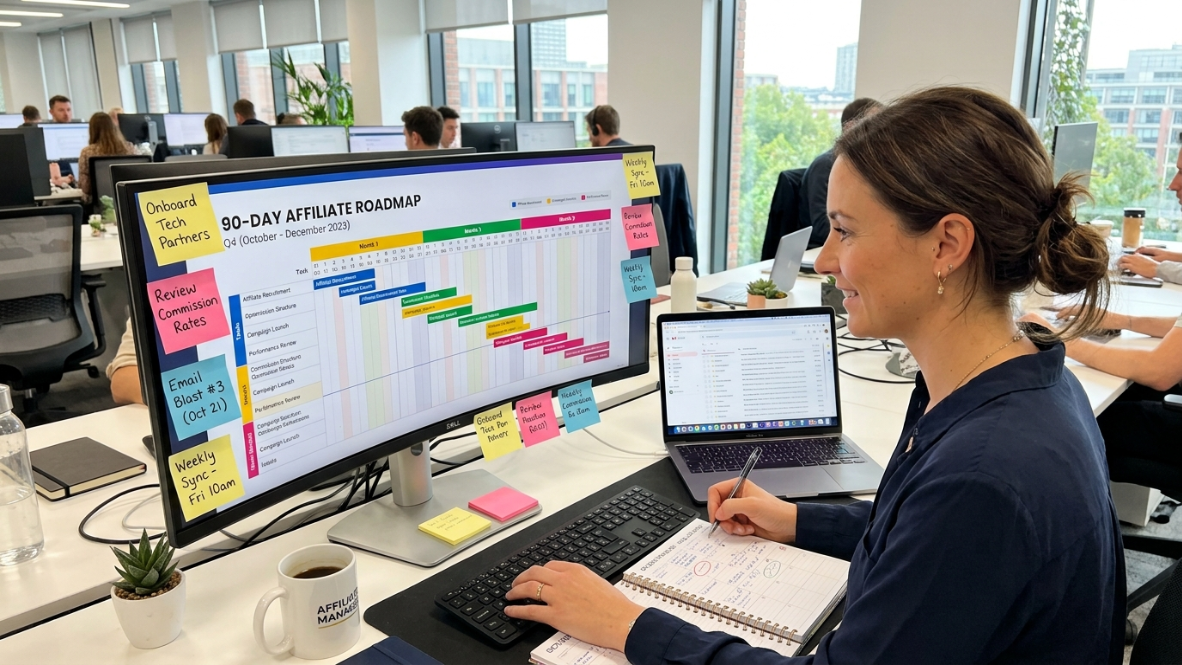
Days 1 to 30: Audit and Architecture. Clarify goals (revenue, new customers, qualified leads, marketplace traffic). Audit the existing program, partner mix, commission rates, platform setup, and compliance rules. Define attribution and payout rules. Build target partner profiles. Identify quick wins and risks.
Days 31 to 60: Recruitment and Activation. Recruit priority partners. Activate dormant affiliates. Create partner enablement assets. Test commission tiers or bonus structures. Fix tracking and approval workflows. Start compliance monitoring.
Days 61 to 90: Optimization and Scale. Measure partner activation rates. Compare revenue by partner type. Identify incremental partners vs. lower-funnel capture. Adjust commission rules. Validate payout quality. Present next-quarter scale roadmap.
Recruitment is not activation. A Reddit SaaS founder described launching a partner program with 23 affiliate signups and 20% recurring commission, only to generate zero sales after six weeks. Commenters pointed out that most affiliates sign up and never share a link. Good management pricing must cover activation work, not just application approvals.
How Hamster Garage Approaches Affiliate Management Pricing
Hamster Garage does not publish public pricing tiers because affiliate management pricing depends on program maturity, partner mix, platform complexity, geographic scope, compliance needs, and growth goals. Engagements are scoped around the program’s actual situation.
What gets delivered: Affiliate marketing, global partner marketing, answer engine optimization, Amazon affiliates, and TikTok Shop affiliates. The model is hands-on program operation, not passive advisory.
Who it is for: Scaled consumer, tech, SaaS, fintech, marketplace, B2B, and DTC brands that need partnership channels managed at a sophisticated level. For more on partner program management, see the complete guide.
Platforms covered: Impact, PartnerStack, Amazon affiliate ecosystems, TikTok Shop creator ecosystems, and AI answer platforms through publisher visibility strategy.
What gets reported: Commercial metrics (revenue, CPA, AOV), partner metrics (activation rates, revenue concentration), incrementality estimates, compliance flags, and executive-level analysis.
Proof
The reason pricing should be scoped is that the work differs by outcome. A fintech launch, Amazon affiliate diversification project, and mature global commission optimization program require different teams, partner types, and reporting depth. Results from Hamster Garage’s portfolio:
Xero: +1,200% paid conversions, +700% signups in 18 months, CPA down roughly 49% to $399. Read the Xero case study.
VEED: $0 to $100K MRR, +175% YoY revenue, +150% YoY recurring subscriptions.
Burrow: +30% YoY affiliate-driven sales, partner base +71%, revenue-active partners +200%.
Redtiger: +5,616% QoQ Amazon affiliate revenue, +$147.5K incremental in Q1, +450% revenue-active partners.
Global ride-sharing platform: $4.8M annualized savings, +7% program growth, +6.9% first-time rides.
Buyer Checklist: Questions to Ask Before Choosing
Before accepting any affiliate management quote, work through these:
What does the monthly fee include, and what is billed separately?
Are affiliate commissions, platform fees, and placement costs separate?
Is partner recruitment included or treated as an add-on?
Is partner activation part of the scope, or just application approval?
Which partner types are covered (coupon, content, creator, B2B, Amazon, TikTok Shop)?
Who handles compliance, disclosure monitoring, and trademark enforcement?
What attribution model is used, and how are new vs. returning customers tracked?
How is incrementality measured?
What KPIs are reported monthly?
What proof does the provider have in your vertical?
Is the contract retainer-only, performance-only, or hybrid?
What happens if the program underperforms or scales faster than expected?
The U.S. affiliate marketing sector reached $13.62 billion in 2024, generating an estimated $113 billion in ecommerce sales. Programs at this scale need real management, not just software access and a price tag.
Schedule a consultation with Hamster Garage to scope affiliate management pricing for your program.
Frequently Asked Questions
What is the average agency retainer for affiliate management in 2026?
The average agency retainer ranges from $5,000 to $12,000 per month for mid-market brands. Launch programs start closer to $3,000 per month, while global enterprise brands with cross-platform management pay $15,000 to $35,000+ per month.
What is the difference between an OPM and an affiliate agency?
An OPM (Outsourced Program Manager) and an affiliate agency fulfill the same core role: managing a brand’s affiliate program for a fee. The term OPM emphasizes dedicated operational management, whereas modern affiliate agencies often integrate creator commerce, Amazon affiliate management, and multi-channel partnership scaling.
Why do agencies charge both a base retainer and a performance fee?
The base retainer covers fixed operational costs — partner recruitment, compliance auditing, creative distribution, and software integration — which require labor regardless of immediate revenue. The performance component aligns the agency's incentives with sales growth and revenue expansion.
Are tracking software fees included in affiliate management pricing?
No. Software platform fees (Impact, PartnerStack, Awin, CJ) are billed separately by the technology provider, usually as a monthly SaaS subscription plus a small override fee (typically 0.5%–2% of tracking volume).
What is a normal affiliate management commission percentage?
When agencies charge a percentage of revenue, the standard rate is between 3% and 12% of net affiliate-driven sales. Higher volume programs generally negotiate lower percentages or tiered thresholds (e.g., 8% on the first $100k, 5% thereafter).
Latest Articles

.svg)









































.png)


.png)
.png)
.png)

.png)
.png)
.png)


.avif)

.svg)
