.svg)
Affiliate Localization Strategy: 2026 Guide to Global Growth


.svg)
TLDR
An affiliate localization strategy adapts your entire affiliate program, not just your website copy, to each target market’s language, partners, offers, compliance rules, payment preferences, and buyer behavior. It covers five operating surfaces: customer-facing, partner-facing, commercial, technical, and governance. Brands that treat localization as a translation project waste international affiliate traffic. The ones that localize the operating model build sustainable revenue in new markets.
Quick Answer: What Is Affiliate Localization?
An affiliate localization strategy adapts an affiliate program to each target market’s language, partners, offers, commission structure, payment methods, tracking, and compliance requirements. It goes beyond translating websites or affiliate creatives. A complete strategy localizes five areas: the customer experience, partner experience, commercial model, technical infrastructure, and governance.
What Is an Affiliate Localization Strategy?
An affiliate localization strategy is a plan for adapting an affiliate program to a specific country, language, or region so that local partners can promote the brand in a way that matches local buyer behavior, legal requirements, payment preferences, and commercial norms.
It goes beyond translation. The program itself needs different partners, different offers, different commission rates, localized landing pages, market-specific disclosures, local tracking rules, and separate reporting. W3C defines localization as adapting a product or content for a target market’s language, cultural, and other requirements, including currency, date formats, symbols, colors, legal requirements, and sometimes a rethink of design or business logic.
Applied to affiliate programs, that means the localized surface area extends well past the website. The partner mix, communications, economics, attribution, and compliance all change by market.
Here is a simple example. A US SaaS brand expanding into Germany does not just translate an affiliate banner. It needs German-language partner onboarding, German review and comparison publishers, EUR pricing, local privacy review, a commission model based on qualified trials, and German keyword research. Every piece of the program shifts.
Planning to localize an affiliate or partner program? Hamster Garage helps brands build and manage global partner programs with the operating rigor needed for multi-market execution.
Who This Article Is For
This guide is written for growth-stage and scaled brands that need to operate affiliate and partnership channels across multiple markets. Specifically:
Ecommerce and DTC brands with cross-border traffic that converts poorly.
SaaS and B2B companies recruiting regional partners on platforms like Impact or PartnerStack.
Fintech and marketplace brands with local compliance or product-availability constraints.
Affiliate managers seeing clicks from markets they do not yet serve well.
Executives evaluating whether to build localization capabilities internally or hire a specialist operator.
If you already understand the basics of affiliate program management, this article explains how to adapt that discipline for international markets.
Approach | What Changes | What Stays the Same | Typical Use |
|---|---|---|---|
Translation | Language and wording | Offers, partners, commissions, checkout, compliance | Basic content localization |
International affiliate marketing | Geographic reach and affiliate recruitment | Often uses the same operating model | Testing demand across borders |
Affiliate localization | Language, partners, offers, commissions, checkout, tracking, compliance, reporting | Global brand standards | Building a sustainable market-specific affiliate channel |
Global affiliate program management | Ongoing execution across multiple localized markets | Core program governance | Scaling and optimizing international programs |
The key difference is that translation changes the message, while affiliate localization changes the program around the market.
Affiliate Localization vs. Translation vs. International Affiliate Marketing
These terms overlap, and the confusion costs brands real money. Here is how they differ:
Translation converts words from one language to another. It does not adapt offers, culture, payments, or legal context. A translated affiliate banner is still a US offer in a different language.
International affiliate marketing means promoting products across borders through affiliates. It may or may not be localized. Many “international” programs just run the same US playbook everywhere, which is why they underperform.
Affiliate localization strategy is the plan for adapting the affiliate channel to how each market actually buys. It covers the partner ecosystem, commercial model, compliance framework, technical routing, and reporting, not just the words on the page.
Global affiliate program management is the ongoing operational discipline of running localized programs across multiple markets. Localization strategy is the plan. Program management is the execution.
The distinction matters because brands that equate localization with translation tend to stop at banners and landing pages. They miss the partner recruitment, commission calibration, disclosure requirements, and tracking configuration that determine whether the program actually works.
Why Affiliate Localization Matters
Language drives purchasing decisions
CSA Research surveyed 8,709 consumers across 29 countries and found that 76% of online shoppers prefer buying products with information in their native language, while 40% will not buy from websites in other languages. The same study found that 73% want product reviews in their language and 75% are more likely to repurchase when customer support is in their language. These are not niche preferences. They are baseline buying behavior for most of the world.
Affiliate is too large a channel to run casually
The Performance Marketing Association’s 2025 study reports that US affiliate marketing spend reached $13.62 billion in 2024, generating $113 billion in ecommerce sales. That represents 9.4% of all US ecommerce. When a channel accounts for that much revenue domestically, expanding it internationally without a localization plan is leaving money on the table.
Local payments and checkout friction destroy affiliate ROI
Worldpay’s 2026 Global Payments Report shows that digital wallets accounted for 56% of global online spend in 2025, but wallet infrastructure differs dramatically by market. Card-funded wallets dominate in the US and UK. Account-to-account rails matter in India and Brazil. Ecosystem wallets matter in China and Indonesia.
Meanwhile, Baymard Institute’s checkout research shows that unexpected extra costs (shipping, tax, fees) are the leading abandonment reason, cited by 39% of users. Sending localized affiliate traffic into a checkout that does not display local currency, local payment methods, and clear shipping costs wastes partner effort.
Compliance is jurisdiction-specific
The FTC revised its Endorsement Guides in 2023 with updated definitions and a new standard for what counts as “clear and conspicuous” disclosure. The UK’s ASA/CAP guidance adds that affiliate content in blogs, social media, and voucher sites may need additional disclosure beyond what a bottom-of-page disclaimer provides. A US disclosure template does not automatically satisfy UK, EU, or APAC rules.
For a deeper look at how compliance fits into program operations, see this guide on affiliate program governance.
Partner ecosystems are local
impact.com’s 2025 State of Affiliate Marketing report, surveying over 1,500 marketers across eight countries, found that leading brands build ecosystems with 3 to 4 partner types, including creators, publishers, affiliates, and advocates. But the right mix of partner types varies by market. A cashback partner that drives volume in the UK may not exist in Southeast Asia. A review publisher dominant in Germany may have no presence in the US.
The Five Surfaces of Affiliate Localization
Most guides describe affiliate localization as “language, culture, compliance.” That is true but incomplete. A working affiliate localization strategy covers five distinct operating surfaces.
1. Customer-Facing Localization
This is what brands think of first: the experience that end customers see after clicking an affiliate link.
It includes local-language landing pages, product descriptions in local terminology, local currency display, local payment methods, clear shipping and tax messaging, return policies, local trust badges, mobile UX, and support language.
The CSA Research data makes this case clearly: if customers cannot read, pay, or trust the landing page, they will not buy. Every point of checkout friction erodes the affiliate’s conversion rate, which erodes the affiliate’s motivation to promote the brand.
2. Partner-Facing Localization
This is the surface most brands neglect. It covers everything the affiliate or partner sees and experiences.
Partner recruitment outreach should be in the local language. The affiliate program description needs to make sense for local publishers. Commission explanations, creative libraries, promotional calendars, onboarding documents, and support hours all need to match the market.
Practitioners on LinkedIn consistently flag a recurring issue: many “global” affiliate programs are really US-led playbooks rolled out everywhere. Real localization requires regional governance, locally calibrated incentives, and local leadership, not just translated emails.
3. Commercial Localization

Commission rates that work in the US may be too low for UK publishers and too high for Southeast Asian creators. Commercial localization means adapting the economic model.
This includes CPA, CPL, and CPC model selection by market. It includes local commission benchmarks, payout currency, bonus thresholds, partner-level incrementality rules, and promotional offer structure. For context, impact.com reports that 59% of brands plan to allocate at least 25% of affiliate budgets to creator partnerships, and 94% are experimenting with alternative attribution models. Those shifts play out differently in every market.
Understanding affiliate attribution is essential here, because the way you credit partners shapes the economics of the entire localized program.
4. Technical Localization
This is where affiliate localization gets operationally complex.
Technical localization includes localized URLs, hreflang implementation, deep links, geo-routing rules, product feed localization, Amazon OneLink or equivalent routing tools, tracking parameters, coupon attribution, sub-ID conventions, and market-level dashboards.
Google recommends locale-specific URLs and hreflang or sitemaps for localized pages, and warns against relying on IP-based content adaptation because it is unreliable and Google may not crawl all variations correctly.
Practitioners on Reddit repeatedly point out that hreflang helps Google understand language or regional page relationships, but same-language markets still need real local signals: currency, shipping info, return policies, local terminology, and local content. Hreflang is a technical signal, not a strategy.
Amazon affiliate localization has its own complexity. Amazon’s documentation says OneLink can redirect international visitors to local Amazon sites, but associates may need separate accounts in each country they want to monetize. One creator on Reddit described building a custom redirector because OneLink did not work the way they needed across social media and other websites.
5. Governance Localization
Governance covers the rules, controls, and audit processes that protect the brand.
It includes disclosure templates by market, privacy and cookie consent requirements, regulated claim restrictions, trademark bidding rules, coupon leakage controls, fraud detection, reversal rules, partner approval workflows, and audit cadence.
A brand selling financial products in the UK faces different advertising restrictions than one selling skincare in Australia. The governance framework needs to flex by market while maintaining a consistent global baseline.
The Affiliate Localization Maturity Curve
Not every brand needs to localize everything immediately. Most programs move through five stages:
Stage 1: Export. Same program, same partners, same landing pages, same commission globally. This is where most brands start. It works until it does not.
Stage 2: Translation. Local-language assets exist, but partners, offers, and reporting are still centralized. The brand has translated banners but has not adapted the program.
Stage 3: Market adaptation. Landing pages, assets, offers, and disclosures are adapted for priority markets. The brand starts treating markets as distinct.
Stage 4: Partner ecosystem. Each market has a defined partner mix and activation plan. Local publishers and creators are recruited and managed with market-specific playbooks.
Stage 5: Localized performance system. Market-level economics, incrementality measurement, compliance monitoring, reporting, and partner recruitment operate continuously. The program is a real growth engine in each market.
Most brands stall between stages 2 and 3 because the jump from “translated assets” to “adapted program” requires operational capacity they do not have internally.
What a Localized Affiliate Program Looks Like in Practice
DTC ecommerce: US to UK expansion
A US DTC brand cannot simply translate US landing pages for the UK. The localized program needs GBP pricing, VAT-inclusive messaging, UK shipping and returns policies, UK spelling and product terminology, UK publisher outreach, UK disclosure language, a region-specific promotional calendar (Boxing Day matters more than Black Friday for many UK shoppers), and commission benchmarks against UK affiliate norms.
B2B SaaS: expansion into Germany
A SaaS affiliate localization strategy here might need German-language partner onboarding, local review and comparison publishers, platform configuration on Impact or PartnerStack by market, longer-evaluation-cycle content, a data privacy review for GDPR compliance, different sales handoff rules, and a commission structure tied to qualified leads or paid conversions rather than free trials.
Amazon affiliate localization
A brand or publisher driving Amazon traffic across markets needs local Amazon storefront matching, separate regional Associate accounts where required, testing for correct redirection, disclosure language on all link placements, and reporting by storefront and market. YouTube Shopping’s affiliate program adds another layer: it is available only for eligible creators in listed countries, and some features are limited to even fewer markets. Affiliate localization must account for platform availability, not just audience language.
Creator and TikTok Shop affiliate programs
Creator commerce is growing fast, but it is not globally uniform. TikTok Shop affiliate availability, commission structures, and creator tools vary by country. A brand expanding creator affiliates across markets needs localized outreach, market-specific commission modeling, and an understanding of where each platform actually operates. For more on this channel, see this guide on TikTok Shop affiliate management.
When Does a Market Need Affiliate Localization?
A market usually needs dedicated affiliate localization when it has enough demand, commercial readiness, and partner potential to justify operating differences from the existing program.
You should consider localization when:
Affiliate traffic from the market is already significant.
Conversion rates are materially below your core market.
Local publishers or creators are available but not being recruited.
Customers need different payment, currency, shipping, or product information.
Local regulations require different disclosures or promotional controls.
Competitors are already working with local affiliate partners.
The market has meaningful revenue or customer acquisition potential.
The existing global affiliate program cannot accurately measure market-level performance.
Not every country needs a separate affiliate program. The decision should be based on whether market-specific changes can materially improve partner activation, conversion, revenue, compliance, or customer quality.
How to Choose Which Markets to Localize First
An affiliate localization strategy should not try to launch everywhere at once. Score each potential market on seven dimensions:
Existing demand. Look at organic traffic, brand search volume, affiliate clicks, and publisher mentions already coming from the market. Markets with existing demand are faster to activate.
Commercial readiness. Can you sell, ship, support, and fulfill orders in that market today? If the answer is no, localization is premature.
Partner supply. Are there relevant publishers, creators, review sites, cashback players, or comparison platforms in the market? A market with no partner supply requires a longer ramp.
Unit economics. What are local AOV, LTV, refund rates, commission tolerance, and CAC targets? Some markets look attractive on traffic but fall apart on margins.
Compliance complexity. How complicated are disclosure rules, privacy requirements, regulated claims, and tax obligations? Higher complexity means higher cost.
Localization effort. How much work is needed for language, landing pages, product feeds, support, creative, and legal review? Same-language markets (US to UK) require less effort than cross-language ones.
Competitive gap. Are competitors already active with local publishers? Are local SERPs underdeveloped? Markets where competitors are absent or weak offer more opportunity.
Start with markets where demand, partner supply, and commercial readiness are high, while compliance complexity and localization cost are manageable.
What Is the Minimum Viable Affiliate Localization?
Brands do not need to localize every part of an affiliate program before testing a new market. A minimum viable localization setup should cover the elements that directly affect conversion, partner activation, tracking, and compliance.
At minimum, localize:
The customer experience: language, currency, product availability, shipping, taxes, returns, and payment options.
The partner experience: recruitment messaging, onboarding materials, affiliate terms, creative assets, and partner support.
The commercial model: commission rates, incentives, payout currency, and promotional offers.
The technical layer: market-specific URLs, deep links, redirects, tracking, and reporting.
The compliance layer: affiliate disclosures, privacy requirements, restricted claims, and partner approval rules.
Everything else can be expanded after the pilot proves demand.
The objective of a pilot is not perfect localization. It is to remove the highest-impact barriers that could prevent a qualified local partner from promoting the brand or a local customer from converting.
The Expensive Mistake: Localizing the Website but Not the Program
Many brands translate landing pages before they localize the affiliate program. This creates a broken handoff: local affiliates do not have the right offer, local customers do not see relevant trust signals, and reporting does not show whether the market is actually working.
A localized landing page without localized partner recruitment is a passive translation project. A localized affiliate strategy is an active market-entry system. The landing page is only one piece. Without the partner ecosystem, commercial model, and governance framework adapted for the market, the translation just sits there.
Same Language Does Not Mean Same Market
English-speaking markets still require localization. The US, UK, Canada, Australia, Singapore, and India can differ in currency, spelling, legal disclosures, product availability, shipping and returns, consumer payment norms, partner ecosystem, promotional calendar, tone, and local publishers.
A brand that treats “English” as one market will send UK traffic to a US checkout with USD pricing, US shipping rates, and no mention of VAT. That is not a localized experience. It is a fast way to waste high-intent affiliate clicks.
What Practitioners Actually Struggle With
The most common pain points in affiliate localization are not theoretical. They show up in forums, communities, and practitioner discussions every week.
Amazon geo-linking confusion. Reddit threads on affiliate marketing show recurring frustration with international Amazon links. Creators want one link that routes users to the correct local Amazon store with the correct affiliate tag, but OneLink setup, social media limitations, country accounts, and reporting create real operational headaches.
Hreflang treated as a complete solution. SEO practitioners on Reddit consistently point out that hreflang is a signal, not a strategy. Same-language markets still need local currency, shipping info, return policies, and local content. Adding hreflang tags without local page substance does not fix conversion.
Checkout friction killing localized traffic. Sending localized affiliate traffic into a non-localized checkout is one of the most common and most expensive mistakes. When shipping costs, taxes, or fees appear unexpectedly at checkout, 39% of users abandon, according to Baymard’s research.
US-led playbooks exported globally. Partner marketing practitioners argue that many “global” programs are really domestic playbooks pushed outward without adaptation. The commission rates, partner types, promotional calendars, and governance models that work in the US do not automatically transfer.
First 90 Days of an Affiliate Localization Strategy
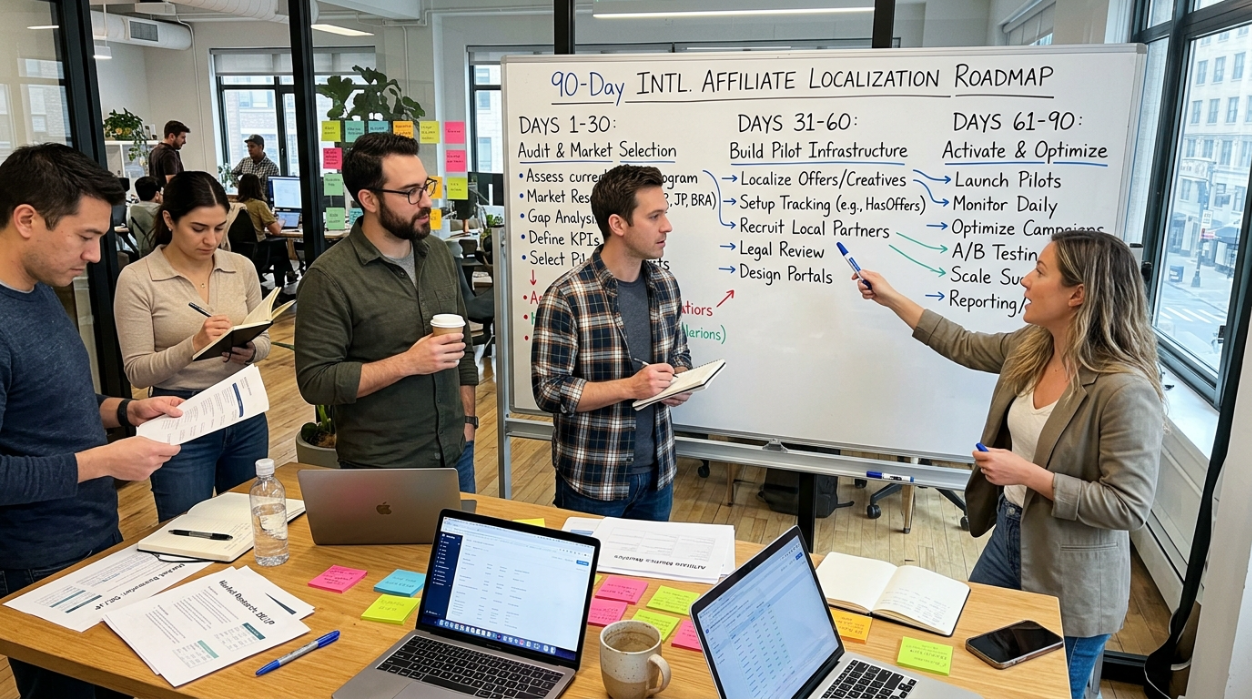
Days 1 to 30: Audit and Market Selection
Pull affiliate traffic, clicks, conversions, AOV, and revenue by country and language. Identify markets where traffic already exists but conversion is low. Review current landing pages, checkout flows, currency display, payment methods, and disclosures. Audit existing partners by market and partner type. Research local publisher and creator opportunities. Review legal and compliance requirements. Build a market prioritization scorecard and choose one to three pilot markets.
A thorough affiliate program audit is the right starting point before any international expansion.
By Day 30, you should have:
A ranked list of priority markets
Baseline traffic and conversion data by market
A local partner ecosystem map
A compliance requirements summary
A localization gap analysis
Estimated market economics
A decision on which one to three markets will enter the pilot
Days 31 to 60: Build Pilot Infrastructure
Create localized partner-facing program pages and onboarding documents. Localize affiliate creative and messaging. Build or improve localized landing pages with correct currency, payment options, and shipping info. Configure platform tracking by market. Set geo-routing and deep-link rules. Create local disclosure templates. Define market-specific commission rates and bonus rules. Recruit first-wave partners. QA links, redirects, and attribution.
By Day 60, you should have:
Localized landing pages
Localized affiliate creative
Market-specific partner terms
Commission and incentive rules
Tracking and routing configured
Local disclosure templates
Initial publisher and creator prospects
QA completed for links, redirects, checkout, and attribution
Days 61 to 90: Activate, Test, and Optimize
Launch localized campaigns with selected partners. Test offers, promotional messaging, landing pages, and commission incentives. Run compliance checks on live content. Compare partner types (content, coupon, cashback, media, creator, review, comparison). Report early performance by market. Decide whether to scale, pause, or revise the approach for each market.
Need help building a localized affiliate program? Hamster Garage operates global partner programs across affiliate, creator, Amazon, and TikTok Shop channels for scaled brands.
By Day 90, you should have:
An active group of local partners
Market-level conversion and revenue reporting
Initial EPC, CPA, AOV, and new-customer benchmarks
Compliance monitoring in place
Performance results by partner type
A scale, revise, or pause decision for each pilot market
What Metrics to Report
A localized affiliate program generates more reporting complexity than a domestic one. Here are the metric categories that matter.
Market performance. Clicks, conversion rate, revenue, AOV, CPA, and refund rate by country and language. Without market-level breakdowns, you cannot tell which localization investments are paying off.
Partner performance. Approved partners, active partners, revenue-active partners, EPC, conversion rate, partner type mix, and new-customer share by market. For guidance on evaluating affiliate traffic quality beyond volume metrics, this framework is useful.
Localization performance. Localized landing page conversion rate, local-language asset adoption by partners, local keyword visibility, and mobile conversion rate.
Compliance and quality. Disclosure violations, trademark bidding violations, coupon leakage, fraud flags, reversal rate, invalid leads or orders, and brand safety issues.
Technical health. Geo-routing accuracy, deep-link accuracy, tracking parameter integrity, product feed accuracy, and currency display accuracy.
Core Affiliate Localization Metrics
Use consistent formulas across markets so performance can be compared without changing the measurement methodology.
Conversion Rate
Conversion Rate = Conversions ÷ Affiliate Clicks × 100
EPC
EPC = Affiliate Revenue ÷ Affiliate Clicks
CPA
CPA = Affiliate Program Cost ÷ Acquired Customers
Revenue per Localized Visitor
Revenue per Visitor = Affiliate Revenue ÷ Affiliate-Referred Visitors
Localization Lift
Localization Lift = (Localized Conversion Rate − Baseline Conversion Rate) ÷ Baseline Conversion Rate × 100
The most important comparison is not simply whether a localized market generates more revenue. It is whether localization improves conversion, partner productivity, customer quality, and contribution margin relative to the market's pre-localization baseline.
What Affects Cost
There is no universal price for building an affiliate localization strategy. Cost depends less on translation volume and more on operating complexity.
Key cost drivers include the number of markets and languages, current affiliate program maturity, partner recruitment volume, partner type mix, platform complexity, compliance requirements, volume of localized assets, legal review needs, creator and influencer management, reporting depth, and whether the brand needs Amazon affiliate, TikTok Shop affiliate, or multi-platform workflows.
For scaled brands, the expensive part is usually not translating copy. It is recruiting the right local partners, configuring tracking correctly, keeping the program compliant, and proving which markets are incremental.
When to Manage Internally vs. Hire an Affiliate Localization Partner
Capability | Internal team can handle if… | An operator helps if… |
|---|---|---|
Translation and basic assets | You have localization resources | You need partner-facing assets localized quickly |
Market prioritization | Analytics and regional teams are strong | You need a practical scorecard and partner-supply view |
Partner recruitment | You know local publishers | You need local partner discovery and outreach |
Compliance | Legal has country-specific affiliate expertise | You need compliance monitoring workflows |
Platform setup | Your affiliate ops team is technical | You need tracking, routing, and attribution configured |
Commission strategy | You have local benchmarks | You need market-by-market payout modeling |
Creator, TikTok, Amazon | You manage these channels already | You need specialized channel playbooks |
Ongoing optimization | You have bandwidth | You need execution, reporting, and iteration |
For brands evaluating external help, this guide on global affiliate program management agencies covers what to look for.
Common Affiliate Localization Failure Modes
Watch for these patterns. They are the most frequent reasons localized affiliate programs underperform:
Local traffic routes to the wrong country store.
Affiliate links lose tracking after redirects.
Partners use English creative in non-English markets.
Commission rates are too low for local publisher economics.
Local payment preferences are missing at checkout.
Product is unavailable or shipping is too expensive in the target market.
Disclosure language is not clear under local rules.
Same-language markets (US, UK, Australia) are treated as identical.
Local competitors dominate search and review content.
The brand uses US shopping calendars in markets with different peak seasons.
Reporting blends all international traffic into one bucket.
Fraud and compliance workflows do not account for local tactics.
How Hamster Garage Solves This Problem
Hamster Garage is a managed growth service for affiliate and partnership programs. It operates as an execution-heavy partner, not a passive advisory shop. For affiliate localization, the relevant capabilities include market prioritization, partner recruitment by market, affiliate program setup and optimization, commission and payout strategy, localized partner activation, platform management on Impact and PartnerStack, compliance monitoring, publisher diversification, Amazon affiliate support, TikTok Shop affiliate support, and reporting on incrementality, partner quality, and revenue outcomes.
The service is built for scaled consumer brands, tech and SaaS companies, fintech, marketplaces, B2B companies, and DTC brands that need professional affiliate and partner program management across regions without losing control over compliance, partner quality, or economics.
Proof
Xero: +1,200% paid conversions and +700% signups after launching and scaling affiliate infrastructure, with CPA reduced to approximately $399.
VEED: $0 to $100K MRR through partner recruitment, dynamic commissions, and full-funnel affiliate mix.
Global ride-sharing platform: $4.8M annualized savings while growing the program and increasing first-time rides.
Redtiger: +5,616% QoQ Amazon affiliate revenue and +450% revenue-active partners after reducing partner concentration risk.
Oars + Alps: +309% sales and +144% conversions in four months after partner reactivation, recruitment, and fraud cleanup.
Explore more results on the case study page.
Buyer Checklist: Evaluating an Affiliate Localization Strategy
A sound affiliate localization strategy should answer these questions:
Which markets are worth localizing first, and why?
Which local partner types matter in each market?
What language, currency, payment, and checkout changes are required?
What local legal disclosures are required?
What regulated claims are prohibited in target markets?
What commission structure is competitive locally?
Which platform or network setup is needed?
How will links route users to the correct country page?
How will tracking survive redirects, cookies, and consent constraints?
How will reporting separate market, partner type, and customer quality?
How will the team measure incrementality?
How often will partners be audited for compliance?
What localized assets will partners receive?
Who owns local partner communication?
What does the first 90 days look like?
If your current program cannot answer most of these, the localization effort is either incomplete or has not started.
Affiliate Localization Strategy: Key Takeaways
Affiliate localization is broader than translation. It changes the customer experience, partner ecosystem, commercial model, technical setup, and governance for a target market.
Start with markets that already show demand, commercial readiness, partner supply, and attractive unit economics.
Localize the affiliate program as well as the website. Local partners, commissions, offers, tracking, disclosures, and reporting can be just as important as language.
Same-language markets still require localization because currency, payments, shipping, regulations, terminology, and partner ecosystems can differ.
Use a 90-day pilot to audit the market, build infrastructure, recruit initial partners, and measure performance before committing major resources.
Measure localization using market-level conversion rate, EPC, CPA, AOV, customer quality, partner productivity, compliance, technical health, and incremental contribution.
Scale only after the localized market demonstrates repeatable economics and a sustainable local partner ecosystem.
FAQ
What is an affiliate localization strategy?
An affiliate localization strategy is the plan for adapting an affiliate program to each target market’s language, culture, partner ecosystem, offers, compliance rules, payment preferences, tracking setup, and reporting requirements. It ensures local partners can drive relevant, compliant, high-converting traffic rather than sending generic international visitors to a one-size-fits-all experience.
Is affiliate localization the same as translation?
No. Translation changes language. Affiliate localization adapts the entire affiliate operating model to a market, including partner recruitment, commission structures, landing pages, disclosures, tracking, payment options, and reporting. W3C’s definition of localization includes cultural, legal, formatting, currency, and design considerations beyond text.
Why does affiliate localization matter for conversion rates?
Because customers overwhelmingly prefer local-language, local-currency buying experiences. CSA Research found that 76% of online shoppers prefer product information in their native language, while 40% will not buy from websites in other languages. Affiliate traffic that lands on a non-localized page converts at significantly lower rates.
What parts of an affiliate program should be localized?
Five surfaces need localization: customer-facing elements (landing pages, currency, payments), partner-facing elements (recruitment, onboarding, creative), commercial elements (commissions, bonuses, payout currency), technical elements (geo-routing, tracking, deep links, hreflang), and governance elements (disclosures, privacy, fraud controls, audits).
How do you localize affiliate links for international markets?
Use market-specific URLs, deep links, localized product feeds, geo-routing, and platform-specific tools. For Amazon, OneLink can redirect international visitors to local Amazon sites, but associates may need separate accounts in each country they want to monetize. Always test that links resolve correctly and that tracking parameters survive redirects.
How long does it take to localize an affiliate program for a new market?
A structured 90-day plan covers auditing current performance (days 1 to 30), building pilot infrastructure (days 31 to 60), and activating and optimizing partners (days 61 to 90). The timeline varies based on market complexity, compliance requirements, and whether the brand already has localized web properties.
What metrics prove that affiliate localization is working?
Track conversion rate, EPC, CPA, AOV, revenue-active partners, new-customer share, refund rate, partner-type mix, localized landing page conversion rate, compliance issues, geo-routing accuracy, and market-level incrementality. Without market-level reporting, you cannot separate localization impact from overall program trends.
When should a brand hire an agency for affiliate localization?
When internal teams lack local partner relationships, market-specific compliance expertise, multi-platform tracking experience, or the bandwidth to recruit, activate, and manage partners in new markets. The operational load of localization is heavier than most brands expect, particularly in the first year of expansion.
Want a practical plan for your next market? Talk to Hamster Garage about building, localizing, or scaling an affiliate and partner program that fits your product, markets, and compliance requirements. Get in touch here.
Latest Articles

.svg)
























































.png)


.png)
.png)
.png)

.png)
.png)
.png)


.avif)

.svg)
