.svg)
Affiliate Agency for SaaS Brands: 2026 Top 6 Compared


.svg)
TL;DR
An affiliate agency for SaaS brands manages the people, strategy, recruitment, activation, compliance, attribution, and optimization behind an affiliate or partner program. Unlike affiliate software, which provides tracking and payout infrastructure, an agency actively recruits partners, helps them promote the product, manages commissions, monitors compliance, and measures revenue quality.
When comparing SaaS affiliate agencies, focus on six factors: SaaS experience, partner recruitment, platform expertise, commission and unit-economics knowledge, activation capabilities, and reporting/incrementality measurement. The right agency depends on your sales model, ACV, customer lifetime value, program maturity, target partners, and geographic requirements.
This guide compares six affiliate agencies using those criteria, along with public pricing signals, SaaS experience, services, documented results, and potential tradeoffs.
Direct Answer: What Does a SaaS Affiliate Agency Do?
A SaaS affiliate agency builds and manages the partner channel around a software product. It can handle affiliate strategy, partner recruitment, onboarding, commission design, platform management, compliance, reporting, and ongoing optimization. Affiliate software such as PartnerStack, Impact, or Rewardful provides the technical infrastructure, while the agency provides the people and operating processes needed to recruit and activate partners.
Who This Article Is For
This guide covers the specific decision of hiring an affiliate agency for SaaS brands. It is written for:
B2B SaaS companies with product-market fit but no dedicated affiliate team
AI, productivity, marketing, finance, and vertical SaaS brands that need partner-led growth
Growth-stage SaaS companies already using PartnerStack, Impact, Rewardful, or Reditus but struggling to activate partners
SaaS teams with a live program that has signups but few revenue-generating affiliates
Enterprise SaaS teams that need compliance, international publisher management, and better incrementality measurement
Some companies should not hire an agency yet. If the product lacks product-market fit, churn is above 5-8% monthly, the ICP is unclear, or the ACV is too low to support meaningful commissions, fix those problems first. Practitioners on Reddit consistently say the best SaaS affiliates are people already trusted by the target buyer, such as consultants, agency owners, newsletter writers, and YouTubers doing tool roundups. If the product is not ready for that level of scrutiny, an agency will not solve it.
Explore Hamster Garage’s affiliate marketing services.
How We Compared SaaS Affiliate Agencies
This comparison evaluates agencies using publicly available information and documented service offerings. The goal is to identify differences in SaaS specialization and operating capabilities rather than assign a universal score.
The comparison considers:
Evaluation factor | What we looked for |
|---|---|
SaaS experience | Subscription businesses, SaaS case studies, PLG, recurring-revenue programs, or software clients |
Partner recruitment | Ability to recruit affiliates, publishers, creators, consultants, agencies, and other partner types |
Program management | Ongoing strategy, onboarding, activation, optimization, and relationship management |
Platform expertise | Experience with PartnerStack, Impact, Rewardful, Everflow, and comparable platforms |
Attribution | Ability to measure trials, paid conversions, MRR, churn, refunds, upgrades, and partner CAC |
Compliance | FTC disclosures, trademark rules, coupon leakage, fraud prevention, and partner policies |
International capability | Multi-market programs, currencies, languages, and international partner management |
Public proof | Case studies, client results, reviews, and other verifiable evidence |
Pricing transparency | Public minimums, hourly rates, project ranges, or custom-quote requirements |
Important: Public pricing and case-study availability are not equivalent to actual agency performance. A company with little public pricing information may simply use custom enterprise contracts, while a large number of public reviews does not necessarily indicate stronger SaaS specialization.
Use this table as a framework for comparing agencies based on your own program requirements.
6 Affiliate Agencies for SaaS Brands Compared
Agency | Best fit | SaaS/tech focus | Pricing signal | Main strengths | Potential limitation |
|---|---|---|---|---|---|
Hamster Garage | SaaS and technology brands seeking hands-on program management | High | Custom quote | Partner recruitment, program management, SaaS case studies | Boutique capacity; no public pricing |
Acceleration Partners | Enterprise and international programs | High | Custom/undisclosed | Global management, governance, compliance | May be more infrastructure than smaller SaaS teams need |
PartnerCentric | Mid-market programs and affiliate optimization | Medium-high | $5,000+ minimum project listed by Clutch | Program management, affiliate optimization, creator partnerships | Public SaaS-specific evidence is more limited |
Gen3 Marketing | Established programs needing analytics and publisher relationships | Medium-high | $5,000+ minimum; hourly rate listed by Clutch | Analytics, publisher relationships, affiliate optimization | Broader vertical experience than SaaS specialization |
DMi Partners | Brands combining affiliate with broader digital marketing | Medium | $5,000+ minimum listed by Clutch | Affiliate, email, SEO, influencer and performance marketing | Less SaaS-specific public positioning |
Perform[cb] | CPA acquisition and high-volume performance marketing | Medium-low for relationship-led SaaS | $10K–$25K minimum budget listed by DesignRush | CPA, lead generation, performance acquisition | May be less suited to complex B2B SaaS partner programs |
Note: “Best fit” describes the use case indicated by each agency's public positioning and documented services. It is not an overall quality ranking.
What Does an Affiliate Agency for SaaS Brands Actually Do?
The short answer: everything the software cannot do by itself.
An affiliate platform like PartnerStack, Impact, or Rewardful gives you tracking links, attribution, payouts, and dashboards. It does not recruit partners, persuade them to create content about your product, structure commission models for your margins, monitor FTC compliance, or reactivate affiliates who signed up and then went dark.
A SaaS affiliate agency handles the operational layer:
Strategy: ICP definition, ideal partner profiling, competitor program analysis, commission modeling
Recruitment: Outreach to software reviewers, comparison publishers, YouTube educators, newsletter operators, consultants, integration partners, and B2B creators
Activation: Onboarding, enablement kits, demo access, content briefs, placement negotiations
Compliance: FTC disclosure monitoring, trademark bidding rules, coupon leakage prevention, claim review
Reporting: MRR, trial-to-paid conversion, partner CAC, LTV by partner, churn by source, incrementality
Optimization: Commission testing, partner segmentation, publisher diversification, dormant partner reactivation
The scale of the activation problem is worth understanding. Rewardful’s 2026 analysis of 2,847 active SaaS affiliate programs found that 56% operate with fewer than 50 affiliates, only 7.6% generate at least one referral, and just 1.28% generate a sale. Only 15.6% of programs continue operating long-term.
That is not a tracking problem. That is a recruitment and activation problem. And solving it requires an operating model, not just a signup page.
The term “affiliate” is also becoming too narrow. PartnerStack’s 2026 report shows its network reached $2.7B in all-time GMV with 52% YoY transaction-volume growth, and its partner mix is 43.4% channel partners, 33.9% referral partners, and just 22.7% performance marketing partners. The best SaaS affiliate agencies now manage partner ecosystems that include affiliates, referral partners, creators, agencies, consultants, and integration partners.
Key SaaS Affiliate Program Benchmarks
To set realistic expectations for your agency engagement, benchmark your SaaS affiliate program against current industry data:
Metric | SaaS Industry Average | Top 10% Performing Programs | Primary Source / Signal |
Average Commission Rate | 24.16% | 20% - 30% (Recurring or Tiered) | Rewardful / PartnerStack Data |
Affiliate Activation Rate | 7.6% (generate at least 1 referral) | 25%+ active partner rate | Rewardful SaaS Analysis |
Sales Conversion Rate | 1.28% (generate at least 1 sale) | 5% - 10% active seller rate | Rewardful SaaS Analysis |
Program Survival Rate | 15.6% long-term operation | Sustained managed growth | PartnerStack / Rewardful |
Network Transaction Growth | $2.7B All-Time GMV | +52% YoY Volume Growth | PartnerStack Ecosystem Report |
Takeaway: Platform software tracks conversions, but managed agency execution is required to bridge the gap between affiliate signups and revenue activation.
Agency vs. Platform vs. Network
This distinction trips up many SaaS teams.
Category | What It Is | Examples | What It Does Not Solve |
|---|---|---|---|
Platform | Software for links, tracking, payouts, reporting | PartnerStack, Impact, Rewardful, Tapfiliate, Tolt | Does not recruit, persuade, or activate partners |
Network | Marketplace connecting brands with partners | PartnerStack Network, CPA networks | Does not guarantee relevant, active, brand-safe partners |
Agency | People operating the program | Hamster Garage, Acceleration Partners, PartnerCentric | Still needs a platform and strong SaaS unit economics |
Practitioners on Reddit say the platform matters far less than how the program is run. One thread on SaaS affiliate promotion put it plainly: buying software solves tracking, but it does not solve recruitment, enablement, commission design, or compliance. Another discussion called tools like Rewardful and FirstPromoter “empty rooms” unless the team actively recruits partners.
In a podcast episode on the Grow Your B2B SaaS show, Adam Glazer warned that many brands wrongly believe affiliate is turnkey: join a network, set up an offer, and affiliates will discover and activate themselves. The reality is that a SaaS program requires ICP definition, partner strategy, structured rewards, recruitment, onboarding, and ongoing management.
For a deeper look at the distinction, see the guide on agency vs. affiliate software. And if you need help choosing the right SaaS platform first, start there.
SaaS Affiliate Agency Services: What You Are Actually Paying For
An affiliate agency can provide much more than affiliate-link management. When comparing proposals, separate strategic work from ongoing operational work.
Service | What the agency does | SaaS-specific consideration |
|---|---|---|
Program strategy | Defines partner strategy, goals, economics, and positioning | Must account for recurring revenue and sales cycle |
Partner recruitment | Finds and contacts relevant partners | Quality matters more than raw affiliate signup volume |
Partner onboarding | Provides product education, assets, links, and terms | Partners need enough product knowledge to make credible recommendations |
Commission strategy | Designs CPA, recurring, hybrid, or tiered commissions | Must fit gross margin and LTV |
Platform management | Configures and operates affiliate software | Tracking should extend beyond clicks to meaningful SaaS events |
Content activation | Helps partners create reviews, comparisons, tutorials, and other content | Content should match buyer intent and product positioning |
Compliance | Reviews disclosures, claims, trademark rules, and promotional practices | Particularly important for regulated SaaS categories |
Reporting | Measures partner and program performance | Should include paid conversion, MRR, CAC, churn, and refunds |
Optimization | Tests offers, commissions, partner segments, and recruitment channels | Optimization should focus on incremental revenue, not just attributed revenue |
The 6 Best Affiliate Agencies for SaaS Brands
1. Hamster Garage
Best for: High-growth SaaS and tech brands that want hands-on affiliate and partner program execution, not just strategy or software recommendations.
Pricing: Custom and quote-based. No public retainer tiers. Pricing depends on program maturity, platform complexity, partner recruitment scope, number of markets, compliance needs, and reporting requirements.
Key features:
Managed affiliate program launch and ongoing management
Partner recruitment and activation across reviewers, publishers, creators, consultants, and agencies
PartnerStack and Impact platform expertise with multi-platform architecture capability
Commission strategy design (CPA, CPL, CPC, recurring, hybrid)
Publisher diversification and compliance monitoring
LTV/CAC and incrementality-focused reporting
Answer Engine Optimization through high-authority affiliate publishers
Amazon Affiliates and TikTok Shop Affiliates as specialized service lines
Creator infrastructure via Swipehouse (YC-backed)
SaaS proof:
Xero: +1,200% paid conversions, +700% signups, CPA reduced roughly 49% to $399 in 18 months. Launched on PartnerStack, then added Impact, with compliance and optimization frameworks built from scratch. Read the Xero case study.
VEED: Built the affiliate program from $0 to $100K MRR with 1,000+ partners recruited, +175% YoY revenue, and +150% YoY recurring subscriptions. See the VEED results.
Tradeoffs:
Boutique team means selective client intake. This is not a holding-company scale operation.
Not a full paid media or SEO agency. The focus is affiliate and partner-driven growth.
No public pricing, which means you need a conversation before budgeting.
User perspective: Public proof is primarily case-study based rather than high-volume review-platform based. Enterprise affiliate agencies typically sell through referrals, case studies, and private references. The SaaS case studies (Xero and VEED in particular) are among the most metrics-rich in the category.
Why it ranks first: Hamster Garage is the strongest fit for SaaS and tech brands that need someone to recruit partners, manage the platform, structure commissions, watch compliance, and improve the channel quarter over quarter. It is an operator, not an advisor.
2. Acceleration Partners
Best for: Enterprise and global SaaS brands that need international program management, governance, fraud auditing, and institutional-grade processes.
Pricing: Undisclosed on Clutch, with project sizes marked confidential. Expect enterprise-level budgets.
Key features:
Global affiliate program management across multiple countries
Fraud auditing, payment transactions, and legal coordination
Strategic partnership management and compliance governance
Service mix listed as 85% affiliate marketing, 15% social media marketing on Clutch
Midmarket and enterprise client base across IT, financial services, hospitality, retail
Tradeoffs:
Enterprise orientation may make it overbuilt and overpriced for smaller SaaS companies
Some Clutch review highlights mention clients wanted stronger strategic guidance early in the relationship
Public pricing information is limited, making it hard to compare costs upfront
User perspective: Clutch shows a 5.0 overall rating from 3 reviews. One healthcare company said Acceleration Partners felt like an extension of the internal team and quadrupled customers for its partnership programs. G2 seller reviews describe the team as proactive and communicative.
3. PartnerCentric
Best for: Mid-market and enterprise brands that need responsive affiliate optimization, program management, and expanding into influencer and creator partnerships.
Pricing: $5,000+ minimum project size on Clutch, with investments ranging from approximately $3,500/month to more than $400,000. Most common project size is under $49,999. Cost rating: 4.4/5.
Key features:
Affiliate program management and optimization
Creator affiliate programs and measurable influencer campaigns
Agentic commerce optimization
Service mix: 80% affiliate marketing, 20% social media marketing on Clutch
Tradeoffs:
Public review mix skews broader than SaaS, though shipping software and platform-based programs appear in client examples
Some Clutch reviews mention room for improvement in reporting and communication transparency
Potentially stronger at optimizing existing programs than building SaaS-native partner strategies from scratch
User perspective: Clutch shows a 4.8 rating from 30 reviews. A shipping software provider said PartnerCentric helped the affiliate program grow 100% and double results over the prior year. A cannabis company reported a 40% increase in affiliate marketing revenue.
4. Gen3 Marketing
Best for: Large, established affiliate programs that need data-driven optimization, deep publisher relationships, and analytics across finance, retail, B2B, and travel.
Pricing: $5,000+ minimum project size and $150-$199/hr on Clutch. Client spend ranges from $10,000 to more than $1M annually. Most common project size: $10,000-$49,999.
Key features:
Deep publisher relationships and affiliate traffic growth
Performance PR and influencer partnerships
Data-driven strategy across financial services, B2B, retail, and travel
Service mix: 50% affiliate marketing, 20% other digital marketing, 20% SEO, 10% social media
Tradeoffs:
Stronger public proof in ecommerce, finance, and consumer verticals than in pure SaaS
Some clients report account management challenges when the primary manager was unavailable
Scale and breadth may feel less SaaS-native than a boutique specialist
User perspective: Clutch shows a 4.9 rating from 15 reviews. One consumer products company reported affiliate traffic growth exceeding 1,000% YoY and affiliate contribution jumping from 2% to 8% of monthly ecommerce revenue. A bank review said Gen3 grew the affiliate program while improving lead quality and reducing per-unit economics.
5. DMi Partners
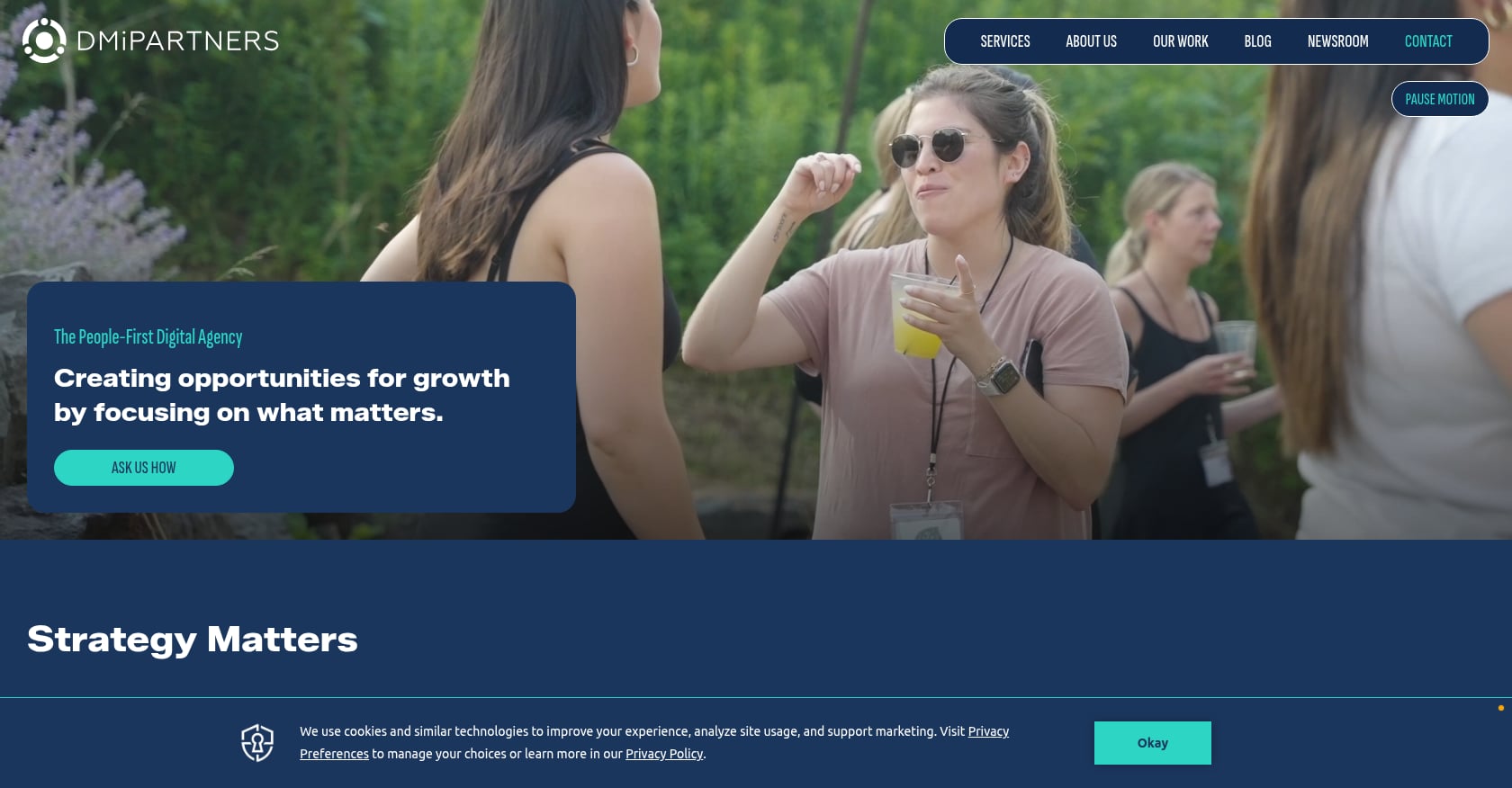
Best for: Brands that want affiliate management bundled with email, SEO, influencer, TikTok Shop, or broader performance marketing support.
Pricing: $5,000+ minimum project size and $100-$149/hr on Clutch. Cost rating: 4.8/5. Client investments range from pro bono to over $100,000 annually depending on scope.
Key features:
Affiliate marketing, influencer marketing, TikTok Shop management
Performance PR and email marketing
SEO and website development
Service mix: 40% affiliate, 30% email, 10% ecommerce development, 10% SEO, 10% web design
Tradeoffs:
Less SaaS-specialized than agencies ranked higher on this list; stronger public proof in DTC, consumer, and ecommerce
G2 reviewers note DMi may cost more than previous partners
Better fit for brands needing cross-channel performance marketing than SaaS-only partner program depth
User perspective: Clutch shows a 5.0 rating from 9 reviews. A luxury jewelry brand said DMi managed the affiliate program and optimized Impact Radius, driving conversions and boosting traffic. A G2 reviewer reported the team helped grow the affiliate program more than 20% YoY.
6. Perform[cb]
![Perform[cb] Screenshot](https://cdn.prod.website-files.com/67c7ed332a3b636fbccfb27d/6aba22f95778dbe54f1317f5_1790522685302-stt2uq.jpeg)
Best for: Outcome-based CPA, lead generation, mobile app installs, and high-volume user acquisition campaigns.
Pricing: $10,000-$25,000 minimum budget on DesignRush, with an outcome-based acquisition model. G2 shows a 4.7/5 rating from 15 reviews.
Key features:
CPA marketing and performance network across 26+ digital channels
Lead generation and mobile marketing
Digital strategy and media buying
Outcome-based pricing model
Tradeoffs:
More of a performance network than a dedicated SaaS affiliate program operator
May be misaligned for B2B SaaS products with long sales cycles, high-touch demos, or complex attribution
Less emphasis on partner relationships, enablement, and brand-level compliance than agencies higher on this list
User perspective: G2 reviewers praise support, account management, and results-driven campaigns. The AI-generated review summary notes that one common limitation is the user interface. This is the right option if you need high-volume CPA acquisition, but likely not the best fit for building a relationship-driven SaaS affiliate ecosystem.
How to Choose the Right SaaS Affiliate Agency
SaaS Agency Evaluation Matrix
Use this weighted checklist when interviewing potential affiliate agencies to ensure they understand SaaS-specific unit economics:
Evaluation Criteria | Weight | Focus Areas & Questions to Ask |
SaaS Unit Economics | 25% | Can they track LTV, MRR cohorts, trial-to-paid, expansion, and churn by partner source? |
Targeted Partner Recruitment | 20% | Do they have active networks of software reviewers, consultants, newsletter operators, and B2B creators? |
Platform Expertise | 15% | Are they certified operators on PartnerStack, Impact, Rewardful, or Everflow? |
Activation & Enablement | 15% | What specific onboarding assets, co-marketing briefs, and demo workflows will they create? |
Incrementality & Attribution | 15% | How do they isolate net-new MRR from self-referral, coupon leakage, or brand search overlap? |
Brand Safety & Compliance | 10% | How do they enforce FTC disclosures, trademark bidding rules, and coupon code restrictions? |
Score each agency on these seven dimensions before signing.
1. SaaS operating experience. Have they managed subscription programs? Can they track trials, paid conversions, upgrades, churn, and report by MRR cohort? Do they understand PLG, freemium, and sales-led motions?
2. Partner recruitment quality. Can they name the first 50 partners they would recruit for your specific market? Do they know the relevant software reviewers, publishers, and consultants? Can they avoid overconcentration in coupon and cashback partners?
3. Platform expertise. Do they operate inside PartnerStack, Impact, Rewardful, or Everflow? Can they map events like trial start, paid conversion, expansion, and refund? As one LinkedIn practitioner noted, the platform is infrastructure, not the growth strategy. The agency’s job is to operate it.
4. Commission and unit economics. PartnerStack data shows top-performing SaaS vendors often use 20%, 25%, and 30% commission levels. Rewardful found an average SaaS commission of 24.16%. The right model depends on your margins, LTV, churn, sales cycle, and how much effort partners need to invest.
5. Activation and enablement. What partner assets will they create? How often will they communicate with partners? How will they reactivate dormant affiliates? With only 1.28% of affiliates generating a sale according to Rewardful’s data, activation is the core agency function, not an afterthought.
6. Compliance and brand safety. How are FTC disclosures monitored? The FTC requires clear disclosure of material connections in endorsements and affiliate contexts. How are trademark bidding, coupon leaks, and misleading claims handled? For a full list of warning signs, see this guide on affiliate agency red flags.
7. Reporting and incrementality. Can they separate first-touch, last-touch, and assisted conversions? Can they explain whether affiliate is adding new demand or capturing demand that already existed? SaaS buyers on Reddit note that B2B sales cycles are long and complex, which creates delayed gratification for affiliates and makes attribution harder. An agency that only reports total revenue and clicks is not doing SaaS-grade work.
Talk to Hamster Garage about your SaaS affiliate program.
What the First 90 Days Should Look Like
A good SaaS affiliate agency should deliver against clear milestones, not vague promises of “ramp time.”
Days 1-15: Audit, architecture, and economics
Program audit or launch plan
ICP and ideal partner profile definition
Platform recommendation or audit (PartnerStack, Impact, or alternatives)
Tracking event map: click, signup, trial, demo, paid conversion, expansion, churn, refund
Commission model recommendation
Competitor program analysis
Compliance and partner terms review
Days 16-30: Partner map and program assets
Priority partner list built by category (reviewers, publishers, creators, consultants, agencies)
Outreach messaging drafted and tested
Partner enablement kit: positioning, screenshots, comparison briefs, UTM guidance
Attribution and payout QA completed
Approved claims and compliance rules documented
Month 2: Recruitment and activation
Outreach to priority partners across all relevant categories
Publisher, creator, and consultant conversations started
Partner onboarding completed for first cohort
First content and placement negotiations underway
Dormant affiliate reactivation (if an existing program)
Early compliance monitoring active
Month 3: First performance readout
Trials started by partner
Trial-to-paid conversion by partner
Attributed MRR
Effective partner CAC
Active partner count and partner activation rate
Content and placement pipeline
Early incrementality read
Next-quarter scale plan with clear targets
For a detailed step-by-step breakdown, see the first 90 days launch checklist.
Metrics Your Agency Should Report
SaaS affiliate programs need different reporting than ecommerce programs. Insist on these categories.
Performance metrics: Affiliate-attributed MRR, net new paid customers, trial starts, trial-to-paid rate by partner, effective partner CAC, LTV:CAC by partner type, churn by partner source, expansion and upgrade revenue.
Partner health metrics: Approved partners, active partners, revenue-active partners, partner activation rate, time to first sale, outreach response rate, dormant partner reactivation.
Quality and incrementality metrics: New vs. returning customer mix, assisted conversions, coupon/cashback share vs. content/review share, incremental revenue estimate, partner overlap with paid search or direct traffic.
Compliance metrics: FTC disclosure compliance rate, trademark bidding violations, coupon/code leakage incidents, false or outdated claims flagged, fraud flags, reversal/refund rate.
If an agency only reports total revenue and click count, that is not SaaS-grade reporting. The metrics that matter are the ones that show whether the affiliate channel is genuinely adding customers your brand would not have acquired otherwise.
How Much Does a SaaS Affiliate Agency Cost?
Most SaaS affiliate agencies use custom pricing because program complexity varies significantly. Public third-party listings can provide pricing signals, but they should not be treated as standardized agency rates.
Agency | Public pricing signal | What it indicates |
|---|---|---|
Hamster Garage | Custom/quote-based | Scope is determined individually |
Acceleration Partners | Undisclosed | Enterprise engagements are generally scoped privately |
PartnerCentric | $5,000+ minimum project listed on Clutch | Public minimum-project signal |
Gen3 Marketing | $5,000+ minimum; $150–$199/hr listed on Clutch | Project and hourly pricing signal |
DMi Partners | $5,000+ minimum; $100–$149/hr listed on Clutch | Project and hourly pricing signal |
Perform[cb] | $10K–$25K minimum budget listed by DesignRush | Larger performance-acquisition engagement |
What Changes the Cost?
Agency fees can increase when the program requires:
Multiple countries or currencies
Complex PartnerStack or Impact configurations
Custom attribution
Large-scale partner recruitment
Extensive compliance management
Multiple partner categories
Creator or influencer programs
Integration with CRM or billing systems
Enterprise reporting requirements
When comparing proposals, ask agencies to separate strategy, platform management, partner recruitment, creative/enablement, reporting, and optimization so you can understand what the fee actually covers.
Buyer Checklist
Before signing with any SaaS affiliate agency, ask these questions:
What SaaS programs have you managed, and what were the measurable results?
Which platform do you recommend for our sales motion, and why?
What events will you track beyond clicks and sales?
What is our ideal partner profile, and which partner categories should we avoid?
What commission model fits our gross margin and LTV?
What is the first 90-day plan with specific deliverables and milestones?
How many partners will you recruit, and how will you prioritize them?
How will you activate partners after they are approved?
What partner enablement assets will you create?
How do you handle FTC disclosures and trademark bidding enforcement?
How do you prevent coupon leakage and self-referral fraud?
How do you measure incrementality?
Who manages the account day to day, and what is their experience level?
What reporting will we receive weekly and monthly?
What happens if performance is weak after 90 days?
FAQ
What is an affiliate agency for SaaS brands?
An affiliate agency for SaaS brands is a managed-service partner that builds and operates affiliate and partner programs for software companies. It handles strategy, platform setup, commission design, partner recruitment, onboarding, compliance, reporting, and optimization. The software tracks the program. The agency runs it.
What is the difference between an affiliate agency and affiliate software?
Affiliate software provides tracking links, dashboards, attribution, payouts, and tax workflows. An agency recruits partners, activates them, manages relationships, designs commission structures, monitors compliance, and improves performance over time. Most SaaS companies need both once the channel reaches meaningful scale.
How much does a SaaS affiliate agency cost?
Most use custom pricing. Public signals from Clutch show minimum project sizes starting around $5,000+ for agencies like PartnerCentric, Gen3, and DMi. Enterprise providers like Acceleration Partners and Hamster Garage scope engagements individually based on platform complexity, number of markets, and partner recruitment needs.
What commission rate should SaaS companies offer affiliates?
A common range is 20-30% of the subscription price. PartnerStack reports that top-performing vendors often use 20%, 25%, and 30% commission levels, while Rewardful found an average SaaS affiliate commission rate of 24.16%. The right rate depends on gross margin, LTV, churn, and how much effort partners need to invest.
How long does a SaaS affiliate program take to produce results?
Expect months, not days. Early signs should include partner replies, approved partners, first placements, trial starts, and demo requests. Revenue matures later because SaaS buyers may need trials, internal evaluation, budget approval, and sometimes a sales conversation. Practitioners on Reddit and industry podcasts consistently emphasize that SaaS affiliate is not a passive channel.
What partner types work best for SaaS?
Software reviewers, comparison publishers, YouTube educators, newsletter operators, consultants, agencies, and integration partners. The common thread is that these partners already have trust with the target buyer. Research from impact.com shows 86% of consumers find recommendations and reviews important in purchase decisions, while only 2% consider traditional ads important. Community practitioners warn that generic affiliate marketers often attract coupon spam or low-incrementality traffic for SaaS products.
When should a SaaS brand not hire an affiliate agency?
Skip the agency if your product lacks product-market fit, churn is high, the ICP is unclear, onboarding is weak, or the ACV cannot support commissions. A SaaS affiliate agency amplifies working products and clear market positioning. It does not fix retention problems or create demand for something buyers do not want.
How do agencies prove affiliate revenue is incremental?
Strong agencies separate new vs. existing customers, brand vs. non-brand traffic, coupon/cashback share vs. content/review share, and assisted conversions. They can explain whether the channel is adding new demand or intercepting conversions that would have happened through direct or paid search. Cohort retention analysis and holdout tests (where feasible) add further proof.
For SaaS, affiliate success is not a recruitment-volume problem. It is a partner-fit, activation, attribution, and economics problem. The best agency is the one that turns a small number of credible, high-intent partners into measurable recurring revenue, without inflating CAC, overpaying for existing demand, or damaging the brand.
Latest Articles

.svg)



















































.png)


.png)
.png)
.png)

.png)
.png)
.png)


.avif)

.svg)
