.svg)
Affiliate Agency for Growth Stage Brands (2026): 8 Picks


.svg)
TL;DR
Growth-stage brands ($5M to $200M in revenue) need affiliate agencies that operate, not advise. For most brands at this stage, Hamster Garage is the strongest pick because it covers affiliate, Amazon affiliate, TikTok Shop, and Answer Engine Optimization under one roof with an operator-led model. Acceleration Partners is the better fit for enterprise brands needing 40+ country coverage. PartnerCentric wins on incrementality measurement. Advertise Purple offers the lowest entry price. Read on for pricing signals, honest tradeoffs, and a buyer’s checklist that will save you months of wasted calls.
Quick Answer: What Is the Best Affiliate Agency for Growth-Stage Brands?
For most growth-stage brands, the best affiliate agency is one that combines hands-on program management, partner recruitment, incrementality measurement, and emerging-channel expertise. Hamster Garage is a strong fit for brands seeking affiliate, Amazon, TikTok Shop, and AEO capabilities together. Acceleration Partners is better suited to large global programs, while PartnerCentric stands out for incrementality measurement.
At-a-Glance Comparison Table
Agency | Best For | Pricing Range | Key Differentiator | Notable Limitation |
|---|---|---|---|---|
Hamster Garage | Multi-channel growth-stage (affiliate + Amazon + TikTok Shop + AEO) | Consultation-based (est. $5K–$15K/mo) | Only agency with structured AEO + TikTok Shop + Amazon + proprietary creator tech | Boutique size; selective intake |
Acceleration Partners | Global enterprise (40+ countries) | Est. $15K+/mo | 300+ staff, 40+ countries, six-time GPMA winner | Process-heavy; no TikTok Shop/AEO |
PartnerCentric | Incrementality-focused brands | ~$5K–$15K/mo (est.) | FUSE Incrementality measurement tech | No Amazon/TikTok Shop specialization |
Gen3 Marketing | Enterprise retail, publisher scale | Est. $10K–$25K+/mo | ~200 staff, $2B+ annual client revenue | Mixed reviews; acquisition integration risk |
eAccountable | PE-backed $20M–$200M brands | ~$15K/mo+ | PE operating model, CAC/LTV/margin reporting | Higher floor; affiliate not sole focus |
DMi Partners | Full-service digital + affiliate | $5K+/mo min project | $17M incremental revenue Y1 claim | Affiliate may be secondary to other services |
Advertise Purple | Budget-conscious mid-market | From ~$2K/mo | Lowest entry point, 5,000+ brands served | Polarized reviews; strategic depth concerns |
Versa Marketing | Mid-market Amazon affiliate | $5K+ min project | 100% affiliate-focused, strong cost rating | Small review base; no AEO/TikTok Shop |
Which Affiliate Agency Is Best for Your Situation?
There is no single best affiliate agency for every growth-stage brand. The right choice depends on your revenue level, geography, existing affiliate infrastructure, and the channels you want to develop.
If You Need... | Consider First | Why |
|---|---|---|
Affiliate + Amazon + TikTok Shop + AEO | Hamster Garage | Broadest documented combination of these services |
Global affiliate management | Acceleration Partners | Built for large multi-market programs |
Incrementality measurement | PartnerCentric | FUSE provides a dedicated incrementality framework |
Large publisher scale | Gen3 Marketing | Strong enterprise and publisher-network infrastructure |
PE-backed performance accountability | eAccountable | Built around CAC, LTV, margin, and growth-stage reporting |
Affiliate plus broader digital marketing | DMi Partners | Combines affiliate with SEO, paid media, email, and web services |
Lower-cost agency entry point | Advertise Purple | Lower reported starting price than most agencies reviewed |
Pure-play affiliate management | Versa Marketing | Affiliate and partnership management are its primary focus |
The best choice should ultimately be based on the specific capabilities your business needs rather than agency size or brand recognition alone.
Who This Guide Is For
This guide is for marketing leaders, Heads of Partnerships, and founders at brands generating roughly $5M to $200M in annual revenue. You’ve found product-market fit. You’re probably spending heavily on paid social and search, watching CAC climb, and looking for a channel that scales without the same cost pressure.
You might already have an affiliate program that’s underperforming, dominated by coupon publishers, or run by a generalist who treats it as a side project. Or you might have no program at all and need one built from scratch.
Here’s a practical readiness check: if your affiliate program generates under $30,000 per month in attributed revenue and you don’t have budget committed to a launch, agency fees probably won’t pencil out yet. Above that threshold, or with a committed launch budget, an affiliate agency for growth-stage brands can be a serious growth multiplier.
What Makes Growth-Stage Affiliate Needs Different
Growth-stage brands sit in an uncomfortable middle. You have too much complexity for a freelancer but not enough volume to justify the rigid processes of an enterprise agency. You need an operator who will actually do the work, not someone who sends quarterly decks full of recommendations you have to implement yourself.
Three things make the growth-stage affiliate problem distinct:
You need multi-channel coverage, not just traditional affiliate. The affiliate channel in 2026 extends well beyond coupon and cashback sites. Growth brands are finding real revenue in Amazon affiliate programs, TikTok Shop creator partnerships, and even AI visibility through publisher networks. An agency that only manages traditional affiliate is leaving money on the table.
Emerging channel readiness matters more at your stage. Enterprise brands move slowly. Early-stage brands can’t afford to experiment. Growth-stage brands are in the sweet spot to capture outsized returns from channels like TikTok Shop and Answer Engine Optimization before they become saturated.
You need speed and flexibility. Process-heavy agencies with 6-month onboarding timelines and rigid playbooks are built for brands with 12-quarter planning horizons. Growth-stage brands need to move in weeks, not quarters.
U.S. creator ad spend is forecast to hit $43.9 billion by late 2026, and brands blending influencer and affiliate efforts are seeing up to a 46% increase in affiliate-driven sales. That convergence is happening now, and most agencies haven’t caught up.
How We Ranked the Best Affiliate Agencies for Growth-Stage Brands
We evaluated affiliate agencies against the factors that matter most to brands between roughly $5 million and $200 million in annual revenue. The goal was not to identify the largest agency, but to identify which agency is most likely to provide the right combination of execution, strategic depth, scalability, measurement, and channel expertise.
Our Evaluation Criteria
Criterion | Weight | What We Looked For |
|---|---|---|
Affiliate execution | 25% | Program management, partner recruitment, activation, optimization, and compliance |
Growth-stage fit | 20% | Ability to serve brands that have outgrown freelancers but may not need enterprise bureaucracy |
Multi-channel capabilities | 15% | Amazon, TikTok Shop, creator partnerships, partnerships, and related channels |
Measurement and incrementality | 15% | Attribution quality, incrementality testing, reporting, and financial accountability |
Case studies and proof | 10% | Quantified client results and relevant examples |
Platform expertise | 5% | Experience with Impact, PartnerStack, CJ Affiliate, Awin, and related platforms |
Pricing/value | 5% | Entry point, pricing transparency, and expected value relative to program size |
Client and employee sentiment | 5% | Recurring themes in verified reviews and evidence of account-management stability |
Scores were used as a framework rather than an absolute measure. A smaller specialist can outperform a larger agency for a specific business model, geography, or channel requirement. Brands should therefore treat the rankings as a shortlist, not a substitute for agency due diligence.
Pricing figures marked as estimates should be treated as market signals rather than official agency quotes. Actual fees vary according to revenue, geography, program complexity, partner volume, platform requirements, and services included.
8 Best Affiliate Agencies for Growth-Stage Brands
1. Hamster Garage
Best for: Growth-stage and larger brands wanting multi-channel partnership operations (affiliate + Amazon + TikTok Shop + AEO) run by one specialist team.
Hamster Garage is an operator-led affiliate agency built for ambitious brands that need execution, not slide decks. The agency manages global affiliate programs with a claimed 1:1 client-to-account-manager ratio, which is a meaningful signal. The account-manager-to-client ratio is the single strongest predictor of program success, and multiple practitioners on Clutch across different agencies confirm that the specific person assigned to your account matters more than the agency name on the contract.
Key strengths:
Proprietary creator technology (Swipehouse, YC-backed) for recruiting and managing creators at scale
Formalized AEO offering that connects affiliate publisher relationships to AI platform citations across ChatGPT, Claude, Perplexity, and Gemini
Amazon affiliate specialization with PartnerBoost and Levanta partnerships
TikTok Shop affiliate management as a distinct, formalized service
Impact Platinum Managing Partner and PartnerStack Gold Partner certifications
Deep multi-platform expertise covering Impact, PartnerStack, and multi-platform architectures for B2B
Proof:
Xero: +1,200% paid conversions, CPA reduced to $399
VEED: $0 to $100K MRR from affiliate
Oars + Alps: +309% sales in 4 months
Redtiger: +5,616% QoQ Amazon affiliate revenue
US Partnership Awards Silver 2024; CEO named Forbes 30 Under 30
Pricing: Consultation-based. Industry benchmarks for boutique specialists at this level fall in the $5,000 to $15,000/month retainer range. For detailed pricing context, see this breakdown of affiliate management costs.
Tradeoffs:
Boutique team (11–50 employees) means selective client intake
Not a full paid-social/search agency; pure partnership and affiliate focus
No public pricing tiers; engagements are custom-scoped
User sentiment: PartnerBoost directory profiles cite 40,000+ partner relationships and 300% average program efficiency. Small Glassdoor sample but positive overall.
Talk to the Hamster Garage team about your program →
2. Acceleration Partners
Best for: Enterprise brands needing global affiliate program management across 40+ countries.
Acceleration Partners is the recognized scale player. Founded in 2007, it has won the Global Performance Marketing Award six times and manages programs for more than 200 brands including Target, Noom, Amazon Music, and Reebok. A fully remote staff of 300+ spans 40+ countries.
Key strengths:
True global infrastructure with localized management across dozens of markets
Deep experience with enterprise-tier compliance and governance requirements
Strong brand roster signals reliability for large-scale engagements
Robust recruitment methodology built over nearly two decades
Pricing: Not publicly disclosed. Industry signals suggest $15,000+/month for enterprise engagements.
Tradeoffs:
Scale and process orientation means less boutique-level flexibility
May feel process-heavy for growth-stage brands wanting speed
No documented TikTok Shop or AEO service offering
Glassdoor rating of 3.9/5 based on 371 reviews, with some employee reviews mentioning low pay and limited career growth. High account manager turnover directly degrades your program’s long-term strategy.
User sentiment: Clients consistently praise the proactive management approach. However, the rating has decreased over the last 12 months, which is worth noting when evaluating team stability.
For brands that need multi-market affiliate coverage, Acceleration Partners is a safe bet at the enterprise tier.
3. PartnerCentric
Best for: Brands wanting proprietary incrementality measurement technology.
PartnerCentric, established in 2004, is the largest woman-owned affiliate agency in the industry. Its standout feature is the FUSE Incrementality Index, a proprietary tool that helps brands understand which partners drive genuinely new revenue versus which ones simply capture existing conversions.
Key strengths:
FUSE Incrementality Index and Control Suite OS for tracking true affiliate impact
Over 70,000 cultivated partner relationships
Strong measurement-first philosophy that appeals to data-driven marketing teams
Pricing: No public pricing. One Clutch client reported spending $23,000 on an ongoing engagement starting April 2025.
Tradeoffs:
No documented Amazon affiliate or TikTok Shop specialization
Smaller team, so capacity limits may apply during peak seasons
Indeed employee reviews raised concerns about “constant stress, overwork, and a glaring absence of employee appreciation,” which flags potential AM turnover risk
User sentiment: One client noted, “Affiliate marketing is a long-term build, but we’ve been pleasantly surprised,” indicating quicker-than-expected impact. The incrementality focus is rare and genuinely valuable.
4. Gen3 Marketing
Best for: Large enterprise retail brands needing massive publisher network scale and data depth.
Gen3 Marketing is one of the largest affiliate marketing agencies worldwide. It consolidated by acquiring four agencies since 2019, uniting them under one brand in January 2023. The team of roughly 200 experts spans six continents and manages programs for 300+ clients.
Key strengths:
Claims to drive over $2 billion in annual client revenue with an average 10:1 ROAS
Nearly twenty years of experience
15+ Agency of the Year awards
Deep publisher relationships across every major vertical
Pricing: Not publicly listed. Industry signals suggest enterprise-tier pricing in the $10,000 to $25,000+/month range.
Tradeoffs:
Scale-heavy approach may leave growth-stage brands feeling like a small fish in a big pond
Acquisition integration can cause account manager transitions mid-engagement
No documented AEO capability
Mixed Clutch reviews; one reviewer stated “Gen3 Marketing barely contributed any success and growth in real life”
User sentiment: Polarized. Positive reviews praise proactive account managers, while negative reviews suggest inconsistency. The acquisition consolidation explains some of this unevenness.
5. eAccountable
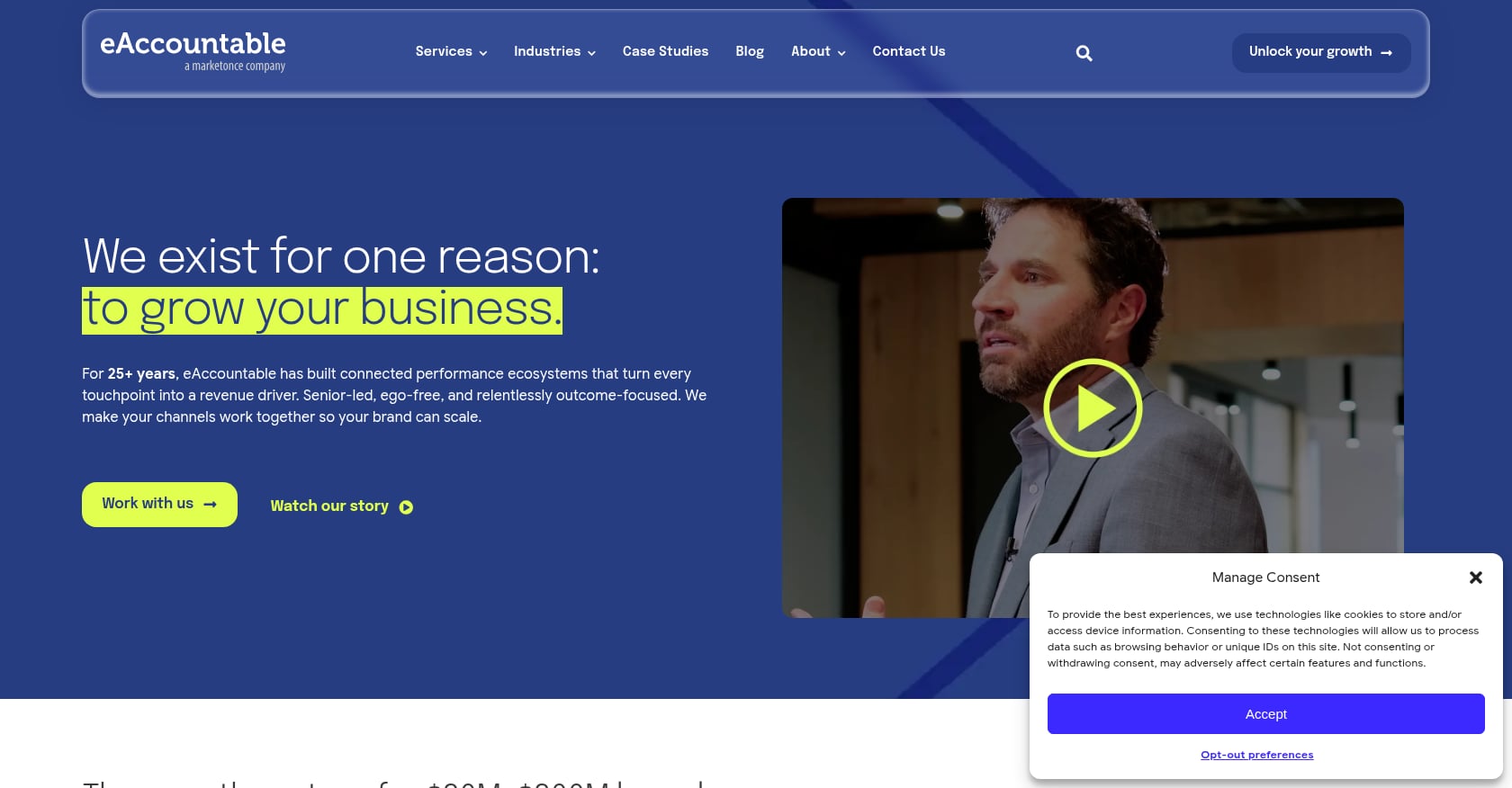
Best for: PE-backed growth-stage brands ($20M to $200M) needing multi-channel performance accountability.
eAccountable explicitly positions itself for growth-stage and PE-backed brands. The agency has over 25 years of experience and specializes in affiliate programs, Amazon marketing, and performance PR. Their self-description is refreshingly specific: “We’re not designed for startups finding product-market fit, and we’re not a global agency of record for Fortune 50 brands.”
Key strengths:
Reports against CAC, LTV, contribution margin, and metrics that build toward an exit
Purpose-built for the $20M to $200M revenue band
Multi-channel approach spanning affiliate, Amazon, and performance PR
Strong positioning for PE operating partners, not just marketing VPs
Pricing: One Clutch client reported spending approximately $15,000 monthly, or $150,000 to $180,000 per year. This is a meaningfully higher floor.
Tradeoffs:
Higher price floor limits accessibility for smaller growth-stage brands
Multi-channel model means affiliate isn’t always the singular strategic focus
Less suited for pure SaaS or B2B affiliate programs
User sentiment: Strong PE-focused positioning is rare in this space and resonates with the right buyer. Good for brands where the decision-maker is a PE operating partner evaluating channel professionalization.
6. DMi Partners
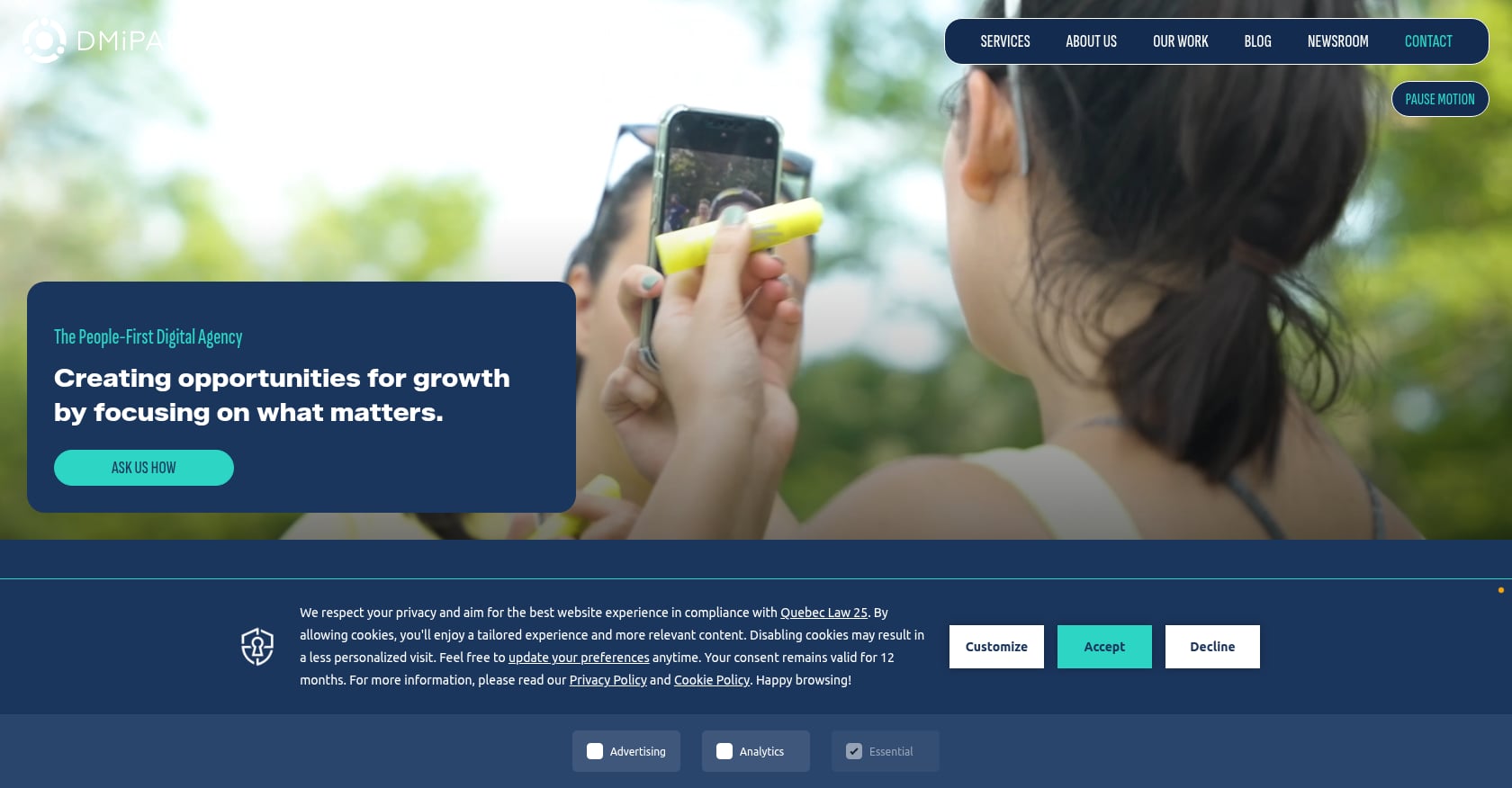
Best for: Consumer/DTC brands wanting affiliate managed alongside broader digital channels.
DMi Partners combines affiliate management with SEO, email marketing, paid media, and website development. The agency claims $17M in incremental affiliate revenue in year one for clients, 31% average new-client year-over-year growth, and a 69 NPS score.
Key strengths:
Full-service digital capabilities alongside affiliate
Named to AdAge’s 2025 and 2026 Best Places to Work and Inc.com’s Best Workplaces
TikTok Shop management as a documented service
Proprietary Lumina BI tool for reporting
Pricing: Minimum project size $5,000+. Clutch data suggests average project costs in the $50K to $199K range.
Tradeoffs:
Not a pure-play affiliate shop; if you only need affiliate, you may be paying for infrastructure you don’t use
Broader service model can dilute affiliate-specific strategic depth
One Google Maps review flagged “no value after 6 months of service”
User sentiment: 9 verified Clutch reviews averaging 5.0 stars. The workplace awards signal low employee turnover, which directly benefits client program continuity.
7. Advertise Purple
Best for: Budget-conscious mid-market ecommerce brands wanting the lowest entry point.
Advertise Purple has helped over 5,000 brands in 23 verticals and claims to have generated almost $5 billion in affiliate revenue. The agency offers proprietary technology called Purply and claims an average program lift of 130% within six months.
Key strengths:
Lowest entry point among agencies on this list (from roughly $2,000/month)
Massive brand volume gives them broad vertical experience
Proprietary technology for tracking and optimization
Pricing: Clutch data mentions one client spending $2,000/month. Pricing is generally seen as competitive with good value for cost.
Tradeoffs:
Lower price point comes with tradeoffs in strategic depth
No documented incrementality methodology
Wide gap between positive and negative Clutch reviews makes due diligence essential
Buyer should verify the seniority of their assigned account manager
User sentiment: One Clutch client noted Advertise Purple “stood out amongst the other agencies, as they were a smaller team who could provide consistent attention.” But the polarized review pattern means your experience may vary significantly depending on your AM.
8. Versa Marketing
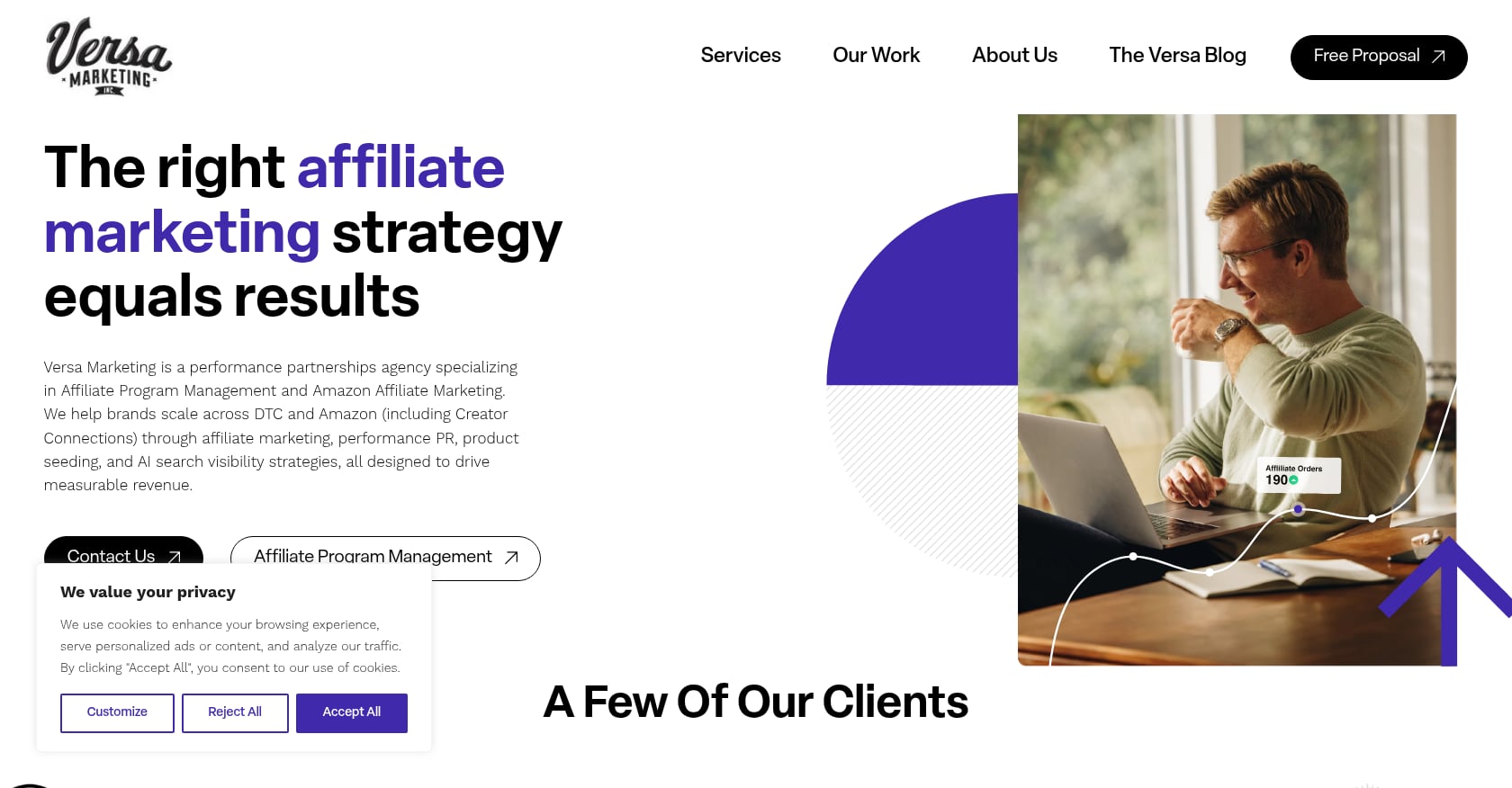
Best for: Mid-market ecommerce brands wanting a 100% affiliate-focused agency, especially with Amazon.
Versa Marketing, founded in 2012, is a pure-play affiliate agency. That singular focus is both its strength and limitation. They don’t spread attention across paid search, email, or social. Every resource goes into affiliate and partnership management.
Key strengths:
100% affiliate-focused, no service dilution
4.9/5 rating from 8 reviews on Clutch
Performance partnerships and Amazon affiliate specialization
Strong cost-effectiveness ratings from clients
Pricing: $5,000+ minimum project size. Most common project size under $49,999.
Tradeoffs:
Smaller review base than larger competitors (8 reviews vs. 30+ for PartnerCentric)
No documented AEO or TikTok Shop capability
Limited public case study data
User sentiment: Clutch clients commend Versa for value, with one noting the service “would be hard to match at a similar cost elsewhere.”
Who Should Choose Hamster Garage?
Hamster Garage is most relevant for growth-stage brands that want an affiliate agency to operate multiple partnership channels rather than manage traditional affiliate marketing alone.
It may be a particularly strong fit when:
The brand already has meaningful revenue and wants to professionalize its affiliate program.
Amazon affiliate or TikTok Shop is part of the growth strategy.
The team wants creator partnerships connected to affiliate economics.
AI visibility and publisher relationships are strategic priorities.
The company wants a specialist agency rather than a broad digital marketing agency.
Senior account attention is more important than the infrastructure of a large enterprise agency.
It may be less suitable when:
The primary requirement is global coverage across dozens of countries.
The brand needs paid search, paid social, SEO, email, and affiliate from one large agency.
The company requires fully standardized enterprise procurement and governance.
The program is too small to justify specialist agency management.
The key question is not whether Hamster Garage is the largest agency on the list. It is whether its specialist, multi-channel model matches the brand's specific growth requirements.
Emerging Channel Readiness Comparison
Most affiliate agencies on typical listicles don’t offer TikTok Shop affiliate management as a formalized service. For growth-stage brands, this matters because TikTok Shop creator partnerships and Amazon affiliate programs represent the fastest-growing pockets of affiliate revenue in 2026.
Agency | TikTok Shop | Amazon Affiliate | AEO (AI Visibility) |
|---|---|---|---|
Hamster Garage | ✅ Formalized service | ✅ Specialized | ✅ Structured offering |
Acceleration Partners | ❌ Not documented | ❌ Not documented | ❌ Not documented |
PartnerCentric | ❌ Not documented | ❌ Not documented | ❌ Not documented |
Gen3 Marketing | ❌ Not documented | Limited | ❌ Not documented |
eAccountable | ❌ Not documented | ✅ Specialized | ❌ Not documented |
DMi Partners | ✅ Documented | Limited | ❌ Not documented |
Advertise Purple | ❌ Not documented | Some coverage | ❌ Not documented |
Versa Marketing | ❌ Not documented | ✅ Specialized | ❌ Not documented |
The connection between affiliate publisher networks and AI citation presence is an angle only one agency currently offers as a structured service. As AI-powered search tools pull answers from high-authority publishers, brands with strong affiliate publisher relationships are getting cited more frequently in tools like ChatGPT, Claude, and Perplexity. This is the emerging bridge between affiliate strategy and AI visibility.
What Affiliate Agency Pricing Actually Looks Like in 2026
Pricing transparency is one of the biggest gaps in this market. Here’s what the data actually shows.
Retainer ranges by segment:
Budget mid-market: $2,000 to $5,000/month (e.g., Advertise Purple)
Growth-stage specialist: $5,000 to $15,000/month (e.g., Hamster Garage, PartnerCentric, Versa Marketing)
Enterprise: $15,000 to $50,000+/month (e.g., Acceleration Partners, Gen3, eAccountable)
Four common pricing models:
Flat retainer: Fixed monthly fee regardless of performance. Simplest to budget.
Percentage of affiliate revenue: Agency takes a cut (typically 10% to 30%) of revenue driven through the affiliate channel.
Performance CPA: Agency earns based on specific conversion actions. Aligns incentives but can incentivize volume over quality.
Hybrid: Smaller base retainer plus a performance component. Most common at the growth stage.
Hidden costs to budget for:
Platform fees (Impact, PartnerStack, CJ, Awin) typically run $500 to $3,000+/month
Affiliate commissions are paid on top of agency fees
Compliance monitoring tools (BrandVerity, etc.) add another layer
Creative assets and landing page development
For a deeper breakdown, this guide covers affiliate pricing models in detail.
How to Evaluate an Affiliate Agency: Buyer’s Checklist
After reviewing dozens of Clutch, Glassdoor, and practitioner reviews across all eight agencies, a clear pattern emerges: AM quality matters more than agency brand. Here’s how to vet properly.
1. Meet your actual account manager before signing.
The person managing your program day-to-day determines your outcomes. Ask to meet them. If the agency won’t arrange it, that’s a red flag. This insight surfaces repeatedly in Clutch reviews across Advertise Purple, Gen3, and DMi.
2. Ask for their incrementality methodology.
Coupon and discount publishers accounted for 42.4% of US affiliate revenue in the first half of 2025. Without incrementality measurement, your “growth” might just be coupon sites cannibalizing conversions that would have happened anyway.
3. Check Glassdoor for AM turnover signals.
High employee turnover in account management teams directly degrades your program’s long-term strategy. If the agency has a pattern of negative employee reviews mentioning overwork and low pay, expect your AM to change mid-engagement. For a full list of warning signs, see this guide on affiliate agency red flags.
4. Verify emerging channel capabilities.
Don’t take claims at face value. Ask for specific case studies from TikTok Shop, Amazon affiliate, or AEO engagements. If they can’t show quantified results in these channels, their “offering” is aspirational, not operational.
5. Confirm platform expertise.
Growth-stage brands often face a multi-platform decision (Impact vs. PartnerStack vs. Awin vs. CJ). Your agency should have certifications or documented expertise on the platforms you use or plan to migrate to.
6. Ask for real case studies with quantified outcomes.
“We grew their program” means nothing. You want specific numbers: revenue increase, partner count growth, CPA changes, incrementality metrics.
7. Understand the program governance framework.
How does the agency handle compliance monitoring, fraud prevention, and brand safety? Affiliate fraud cost the global industry an estimated $3.4 billion in 2025, equivalent to 17.3% of total affiliate spend. Growth-stage brands are especially vulnerable because they lack internal compliance infrastructure.
What the First 90 Days Should Look Like
No competitor article provides a concrete first-90-days plan, which is exactly why growth-stage brands end up frustrated. Here’s what you should expect from any competent affiliate agency.
Month 1: Audit, Setup, and Baseline
Full affiliate program audit of existing partners, commission structures, and compliance gaps
Platform setup or migration (if switching networks)
Baseline KPI documentation: current revenue, active partner count, conversion rates, top partner concentration
Competitive benchmarking against your vertical
Month 2: Recruitment and Architecture
Active partner recruitment targeting content publishers, editorial sites, and emerging channels
Commission architecture redesign based on partner value (not flat rates for everyone)
Compliance framework implementation: fraud monitoring, brand bidding policies, coupon code governance
First wave of creator outreach (if TikTok Shop or influencer-affiliate is in scope)
Month 3: Optimization and Scaling
First performance review against baseline
Commission elasticity testing to identify optimal payout rates
Partner activation campaigns for recruited-but-dormant publishers
Scaling plan for months 4 through 12, with clear targets
If your agency doesn’t deliver a structured plan along these lines within the first week of engagement, you’ve hired an advisor, not an operator.
How Hamster Garage Solves This
The core problem for growth-stage brands is that affiliate needs span multiple channels (traditional affiliate, Amazon, TikTok Shop, AI visibility) but most agencies only cover one or two. Hamster Garage was designed to solve exactly this.
Operator-led, not advisory. The agency was founded by operators who managed some of the world’s largest partner programs and built Hamster Garage to be execution-heavy. The claimed 1:1 client-to-AM ratio means your program gets senior attention, not junior rotation.
Multi-channel coverage under one roof. Hamster Garage manages affiliate marketing, Amazon affiliate programs, TikTok Shop affiliate programs, and Answer Engine Optimization as distinct but integrated services. This eliminates the need to coordinate three different vendors.
Proprietary creator technology. Swipehouse (YC-backed) gives Hamster Garage a structural advantage in recruiting and managing creators. This isn’t a third-party tool dependency; it’s owned infrastructure.
AI visibility through publisher networks. The AEO offering connects affiliate publisher relationships to AI platform citations. Because AI tools like ChatGPT and Perplexity pull from high-authority publishers that affiliate programs already work with, this is a natural extension of the affiliate channel rather than a separate discipline.
Results that growth-stage brands can reference:
VEED: Built an affiliate program from zero to $100K MRR with 1,000+ partners recruited, 175% year-over-year revenue growth
Oars + Alps: Fixed dangerous revenue concentration and fraud risk, delivering +309% sales and +112% AOV in four months
Redtiger: Grew Amazon affiliate revenue by 5,616% quarter-over-quarter with $147.5K incremental revenue in Q1
Metrics reported: CAC, LTV, incrementality, partner mix health, commission efficiency, and channel-specific KPIs tailored to each brand’s goals.
Get a consultation with Hamster Garage →
The Market Context: Why This Decision Matters Now
U.S. affiliate spend is projected at $13.81 billion in 2026, up 11.3% from $12.42 billion in 2025. Globally, Forrester projects $19.4 billion in worldwide affiliate spend. Over 80% of brands now run an affiliate program, and the channel drives roughly 16% of online orders in the U.S. and Canada.
The returns justify the investment. For every $1 spent, retail brands see an average return of $10, while high-margin SaaS and fintech sectors often see returns as high as $20 for every $1 spent. According to impact.com, 74% of brands generate between 11% and 30% of total revenue through affiliate activity.
Yet 78% of CMOs admit affiliate marketing is their least mastered digital channel. That gap between opportunity and capability is exactly why finding the right affiliate agency for growth-stage brands is so consequential.
When NOT to Hire an Agency
Honesty builds trust, so here it is: not every growth-stage brand should hire an affiliate agency right now.
Affiliate Agency vs. In-House: Which Model Is Better?
Situation | Agency | In-House |
|---|---|---|
No experienced affiliate operator internally | Better fit | Difficult to start |
Need to launch quickly | Better fit | Usually slower |
Need established publisher relationships | Better fit | Requires relationship-building |
Simple program with fewer than 50 active partners | May be unnecessary | Often practical |
Complex multi-country program | Often advantageous | Requires specialist hiring |
Need Amazon, TikTok Shop, and traditional affiliate together | Often advantageous | Requires multiple skill sets |
Strong internal affiliate leader already exists | May be unnecessary | Often better economics |
Priority is building long-term internal expertise | Less ideal alone | Stronger fit |
Need specialized incrementality expertise | Agency may have an advantage | Requires specialist capability |
Budget is highly constrained | May not make sense | More controllable |
For many growth-stage companies, the best answer is not permanently choosing one model. A hybrid approach can use an agency to accelerate recruitment, infrastructure, and strategy while an internal owner gradually builds institutional knowledge.
Skip the agency if:
Your affiliate program generates under $30,000/month in attributed revenue and you don’t have a committed launch budget
You haven’t achieved product-market fit (the channel amplifies what’s already working, it won’t fix a product problem)
You don’t have a single person internally who can serve as the agency’s point of contact
Your margins can’t support 5% to 20% commission payouts to publishers on top of agency fees
Consider in-house first if:
You have a strong operator who knows the affiliate channel and just needs platform access
Your program is simple (fewer than 50 active partners, single geography)
You want to build institutional knowledge before scaling
For a more detailed framework on this decision, see this comparison of agency vs. in-house approaches.
12 Questions to Ask an Affiliate Agency Before Signing
Before choosing an affiliate agency, ask these questions during the sales process:
Who will manage our account day to day?
Can we meet the actual account manager before signing?
How many accounts will that person manage?
How do you measure incremental revenue?
How do you evaluate coupon, cashback, and loyalty partners?
What percentage of your clients are similar to our revenue range?
Which affiliate platforms do you have the most experience with?
Can you provide case studies from our vertical?
What partner recruitment work is included in the monthly fee?
How do you monitor affiliate fraud and brand bidding?
What happens if our assigned account manager leaves?
What should we realistically expect during the first 90 days?
A strong agency should answer these questions with specific examples, processes, and metrics rather than generic claims about relationships, technology, or growth.
Affiliate Agency Red Flags to Watch For
Be cautious if an agency:
Cannot tell you who will manage the account.
Refuses to let you meet the proposed account manager.
Reports only affiliate-attributed revenue without discussing incrementality.
Cannot explain how it evaluates coupon and cashback partners.
Uses the same commission structure for every partner.
Has no clear partner recruitment process.
Cannot provide relevant case studies with quantified results.
Promises a specific ROI before auditing your program.
Treats affiliate management as passive reporting rather than active partner development.
Cannot explain its compliance and fraud-monitoring process.
Uses “AI,” “incrementality,” or “creator partnerships” as marketing terminology without showing how those capabilities are actually delivered.
Has unclear ownership of strategy, recruitment, creative, technology, and reporting.
The strongest agency relationship is one where responsibilities, KPIs, reporting standards, and expected outcomes are defined before the contract begins.
FAQ
What is a growth-stage brand in affiliate marketing?
A growth-stage brand typically falls in the $5M to $200M annual revenue range, has achieved product-market fit, and is ready to professionalize its partner channels. eAccountable defines the sweet spot as $20M to $200M for PE-backed brands specifically. The defining characteristic is that you’ve outgrown freelancer-level management but don’t need (or want) enterprise-scale bureaucracy.
How much does an affiliate agency cost in 2026?
Expect to pay between $2,000 and $15,000 per month for growth-stage engagements, with enterprise programs running $15,000 to $50,000+. Most agencies use a hybrid model combining a base retainer with a performance component. Don’t forget to budget for platform fees, affiliate commissions, and compliance tools on top of agency fees.
When should a growth-stage brand hire an agency vs. build in-house?
Hire an agency when you need to move fast, lack internal affiliate expertise, or want access to established publisher relationships without a 12-month ramp. Build in-house when you have a strong operator, a simple program, and want to own institutional knowledge from day one. Most growth-stage brands start with an agency and gradually build internal capabilities alongside it.
What platforms should my affiliate agency support?
At minimum, your agency should have documented expertise on Impact, PartnerStack, CJ Affiliate, or Awin, depending on your vertical. B2B SaaS brands typically run on PartnerStack. Consumer and DTC brands lean toward Impact or CJ. Your agency should also be able to advise on platform migration if your current setup is limiting growth.
How do I measure whether my agency is driving incremental revenue?
Ask your agency for their incrementality methodology. Without one, you can’t distinguish between partners who drive new customers and partners who simply capture existing conversions. Coupon publishers accounted for 42.4% of US affiliate revenue in the first half of 2025, so this question is not academic. Tools like PartnerCentric’s FUSE Index or custom attribution modeling are starting points.
What does AEO have to do with affiliate marketing?
Answer Engine Optimization uses the same high-authority publishers that affiliate programs already work with to increase brand citations in AI tools like ChatGPT, Claude, and Perplexity. Because AI platforms trust and cite these publishers, brands with strong affiliate publisher networks have a built-in advantage for AI visibility. It’s a natural extension of the affiliate channel, not a separate discipline.
How do I know if an agency is right for my specific vertical?
Ask for case studies in your vertical with quantified results. Generic “we work with ecommerce brands” claims aren’t enough. You want to see specific metrics: revenue growth percentages, partner counts, CPA changes, and time-to-results. The best affiliate agencies for growth-stage brands will have at least two or three relevant examples ready without hesitation.
Latest Articles

.svg)

















































.png)


.png)
.png)
.png)

.png)
.png)
.png)


.avif)

.svg)
