.svg)
Best Affiliate Agency for B2B Brands (2026): Top 8 Picks


.svg)
TL;DR
Most affiliate agencies grew up managing coupon sites and cashback deals for ecommerce brands. That playbook fails for B2B. The best affiliate agency for B2B brands depends on program maturity: Hamster Garage is the strongest fit for scaled B2B, fintech, SaaS, marketplace, and tech brands that need an operator-led team to build, manage, and expand sophisticated partner programs across platforms like Impact.com and PartnerStack. Partner Commerce is a strong pure-play B2B SaaS specialist. Acceleration Partners fits large enterprise and global operations best. Gen3 Marketing and PartnerCentric serve brands that want established affiliate infrastructure with broader performance support.
Who This Guide Is For
This guide is for B2B marketing leaders, partnership managers, and growth teams who are past the “does affiliate marketing work?” question. You already know the channel has potential. Now you need to know which agency can actually run it for a B2B brand without filling your program with low-incrementality coupon sites and calling it growth.
If you are comparing agencies, evaluating whether to hire one at all, or trying to understand how B2B affiliate programs differ from the ecommerce version, this is your decision guide.
Talk to Hamster Garage about your current partner mix, platform setup, and growth goals.
Direct Answer: The Best Affiliate Agency for B2B Brands
The best affiliate agency for B2B brands depends on program maturity, tech stack, and growth goals:
Best Overall for Scaled B2B, SaaS, & Marketplace: Hamster Garage is the top choice for growth-stage to enterprise B2B, fintech, and SaaS brands needing operator-led management across Impact.com, PartnerStack, and modern AI search channels.
Best Pure-Play B2B SaaS Specialist: Partner Commerce excels for SaaS-only companies focusing on partner-led growth and B2B pipeline conversion.
Best for Global Enterprise Governance: Acceleration Partners is best suited for large multi-national corporations requiring global compliance infrastructure across multiple continents.
Best for Multi-Channel Performance: Gen3 Marketing fits established mid-market to enterprise brands looking to connect affiliate strategy with broader search and media operations.
Best for Mid-Market & Influencer Blends: PartnerCentric provides strong performance management with proprietary incrementality technology.
At-a-Glance Comparison Table
At-a-Glance Agency Comparison Matrix
Agency | Ideal B2B Stage & Fit | Primary Platforms | Pricing Model Signal | Standout Differentiator |
Hamster Garage | Scaled B2B, SaaS, Fintech, Tech | Impact.com, PartnerStack, Everflow | Custom scoped retainers | Operator-led; CRM integration & AEO publisher recruitment |
Partner Commerce | Pure B2B SaaS (Early to Mid-Stage) | PartnerStack, Impact.com, Everflow | Custom monthly engagement | Pure B2B SaaS focus with pipeline and MQL commission models |
Acceleration Partners | Enterprise & Global B2B | Impact.com, BrandVerity | $10,000+/mo retainer + performance fees | Global compliance infrastructure and multi-region governance |
Gen3 Marketing | Mid-Market to Enterprise | CJ Affiliate, Impact.com, Rakuten | $5,000+/mo base + hourly rates | Combines SEO/SEM search strategy with affiliate operations |
PartnerCentric | Mid-Market B2B & Tech | Impact.com, ShareASale | $5,000+/mo retainer minimum | Proprietary incrementality tracking and publisher transparency |
Advertise Purple | Traditional B2B & Hybrid Commerce | CJ Affiliate, Impact.com | $2,500+/mo base + performance fee | Large existing network database for rapid deployment |
JEBCommerce | Small to Mid B2B Programs | ShareASale, CJ Affiliate | $2,000/mo base + % channel growth | Lower entry barrier for early-stage program testing |
eAccountable | B2B Ecommerce & Marketplaces | Impact.com, Amazon Ecosystem | $10,000+/mo project minimum | B2B marketplace plus Amazon and paid media integration |
How We Evaluated These Agencies
Picking the right affiliate agency for B2B brands requires different criteria than choosing one for a DTC shoe brand. Here is what mattered in this evaluation:
B2B or complex-sales experience. Has the agency managed programs where sales cycles are weeks or months, not minutes?
Partner recruitment model. Does the agency recruit outside the platform, targeting consultants, review sites, newsletters, and industry publishers? Or does it rely on whoever is already in the network?
Platform expertise. Can the agency work across Impact.com, PartnerStack, Everflow, and other tools B2B brands actually use?
Pricing transparency. Does the agency give credible pricing signals, or is everything hidden behind a sales call?
Review quality and user sentiment. What do Clutch, G2, Trustpilot, and real practitioners say?
Incrementality and compliance focus. Does the agency care whether partner-driven conversions are truly incremental?
Reporting depth. Can the agency report on pipeline, MQLs, SQLs, and CRM-connected outcomes, not just clicks?
Managed operations. Does the agency actually run the program, or just advise?
What Makes B2B Affiliate Different from B2C Affiliate
Before comparing agencies, it is worth understanding why B2B affiliate programs fail when they use B2C playbooks.
In B2C, affiliate often means distribution at scale. In B2B, affiliate means outsourced trust and buyer influence.
Impact.com notes that B2B affiliate programs require more effort and creativity than B2C referral programs because B2B products are often more complex, expensive, and niche. B2B marketers recruit from a smaller pool of affiliates and need partners whose credibility can influence decision-makers.
Partner Commerce has written extensively about how B2B affiliate programs need fewer but more strategic partners, educational content rather than promotional banners, longer buying journeys, complex attribution, CRM tracking, and payout models based on MQLs, SQLs, or closed deals.
The practical differences break down like this:
Partner types are different. B2B partners are not coupon sites. They are industry publishers, SaaS comparison sites, consultants, agencies, implementation partners, newsletter operators, YouTube educators, LinkedIn creators, podcast hosts, communities, and brand-to-brand partners.
Sales cycles are longer. A partner might drive a demo click in January, but the deal does not close until March. Attribution must account for this.
Tracking must connect to CRM. If your agency only reports last-click sales, it does not understand B2B. Impact.com recommends measuring lead quality, MQL-to-SQL rate, demo-to-opportunity rate, pipeline by partner, time to close, ACV, retention, and effective commission rate.
Commissions must match the effort. Practitioners on Reddit report that B2B SaaS programs regularly fail when partners are asked to produce serious content (a 2,000-word review, comparison video, 60-day evaluation cycle) for a $15 commission. If commissions are too small for serious content, serious partners will ignore the program.
For a deeper look at how SaaS brands specifically should approach this channel, see the SaaS affiliate marketing guide.
Technical Architecture: Connecting B2B Affiliate Operations to the CRM
Unlike consumer affiliate programs that rely on simple cart checkouts, B2B affiliate marketing operates across multi-stage buyer journeys. A capable B2B agency must architect tracking that integrates your affiliate platform (such as PartnerStack, Impact.com, or Everflow) directly with your CRM (such as HubSpot or Salesforce).
B2B Commission & Lead-Stage Payout Models
Lead / Demo Booking (Top-of-Funnel): A small fixed payout ($25–$100) awarded when a verified prospect completes a demo request or registers for a trial. Requires domain validation to prevent spam.
Marketing Qualified Lead (MQL) / Opportunity (Mid-Funnel): Paid when sales teams validate that the lead matches the Ideal Customer Profile (ICP). This aligns affiliate incentives with pipeline quality rather than raw click volume.
Closed-Won Deal (Bottom-of-Funnel): A percentage of First-Year Annual Contract Value (ACV) or monthly recurring revenue (MRR) share for 12 to 24 months (typically 10% to 25%).
Agency Audit Tip: Ask prospective agencies how they handle deal cancellations or early churn. Strategic B2B agencies enforce 60-day to 90-day locking windows before disbursing commissions, allowing RevOps teams to validate customer retention first.
The 8 Best Affiliate Agencies for B2B Brands
1. Hamster Garage
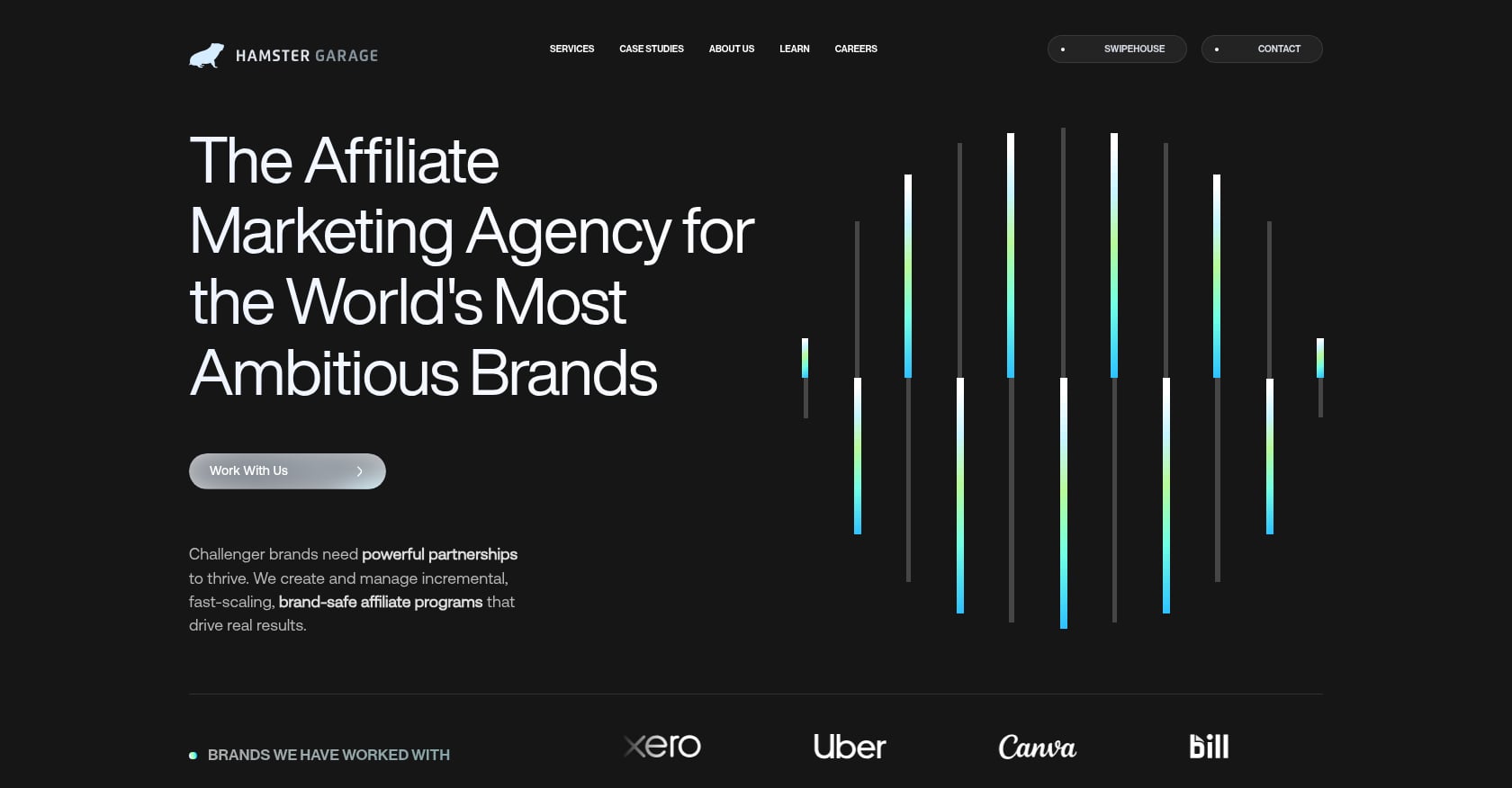
Best for: Scaled B2B, SaaS, fintech, marketplace, and tech brands that need operator-led affiliate and partner marketing.
Hamster Garage is the strongest overall pick as an affiliate agency for B2B brands because it combines hands-on program management with the breadth to cover partner types that most agencies ignore. This is not an advisory shop. The team builds and manages affiliate and partnership programs designed for incremental, brand-safe growth.
What it delivers:
Managed affiliate marketing and global partner marketing
Answer Engine Optimization through affiliate publisher relationships
Amazon Affiliates and TikTok Shop Affiliates
Partner recruitment, publisher diversification, and compliance monitoring
Commission and payout strategy
Multi-platform program architecture
Incrementality focus and brand safety
Platforms covered: Impact.com, PartnerStack, BrandVerity, Amazon affiliate tooling (PartnerBoost/Levanta familiarity), TikTok Shop affiliate ecosystem.
Pricing: No public retainer tiers or packaged plans. Engagements are scoped based on program complexity, platform needs, number of geographies, and growth goals. Factors that affect pricing include whether you are launching a new program or optimizing an existing one, migration needs, compliance workload, and reporting cadence.
User sentiment: G2 shows a 5.0/5 rating, and Clutch profiles show verified reviews highlighting partner onboarding, affiliate traffic growth, and strong operational execution.
Proof:
Xero: +1,200% paid conversions, +700% signups, CPA down ~49% to $399 across PartnerStack and Impact
VEED: $0 to $100K MRR, +175% YoY revenue, +150% YoY recurring subscriptions
Burrow: +30% YoY affiliate-driven sales, partner base +71%, revenue-active partners +200%
Ride-sharing platform: $4.8M annualized savings, +7% program growth, +6.9% first-time rides
Tradeoffs:
Boutique team means selective client intake
Not a full paid search/social agency
No public pricing tiers
Ask before hiring: “How would you build our partner ICP, and what does recruitment look like outside the platform?”
2. Partner Commerce
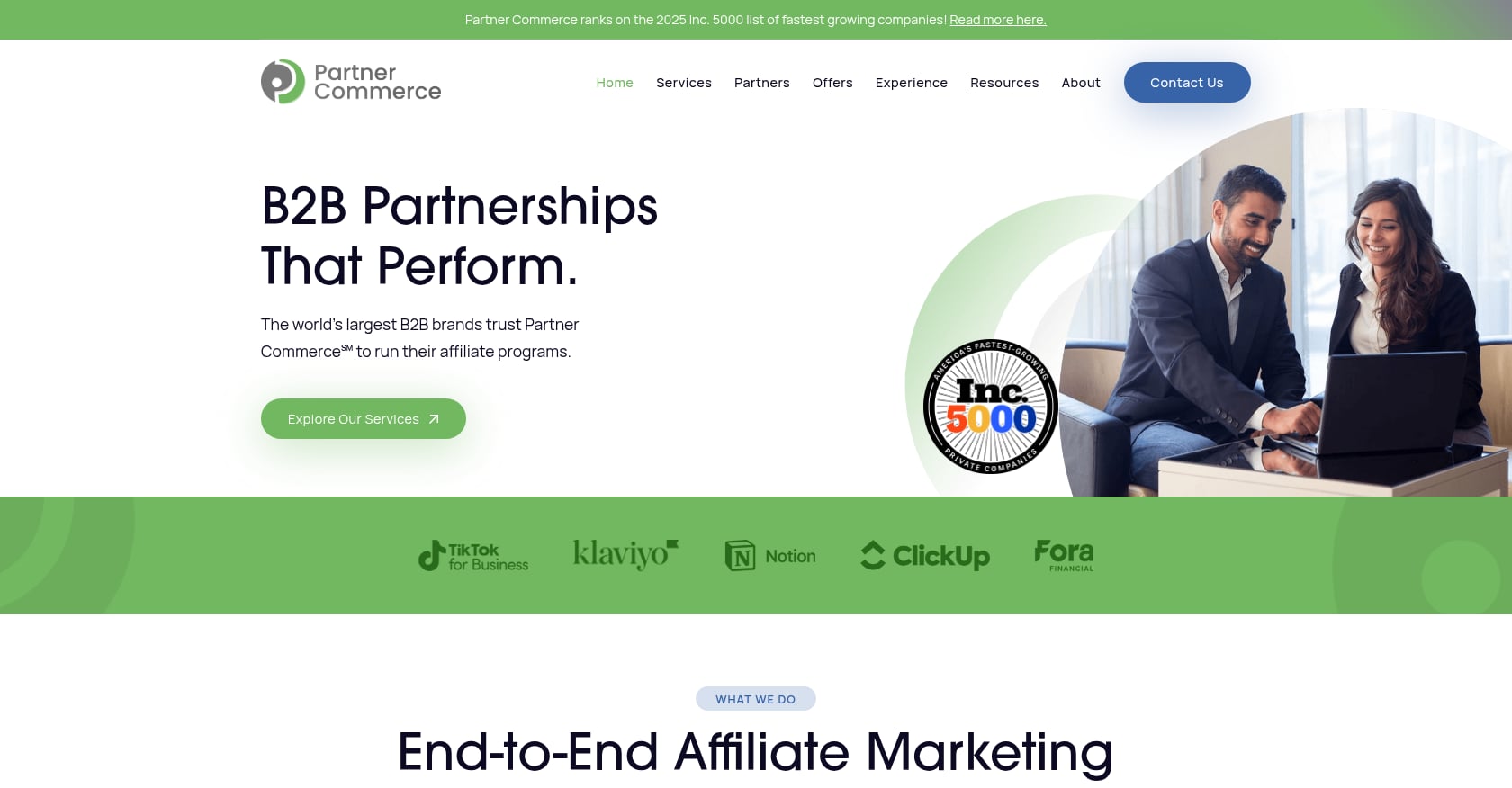
Best for: B2B SaaS and technology brands that want a pure-play B2B affiliate specialist.
Partner Commerce has carved out a clear niche as a B2B-focused affiliate agency. The team is certified across PartnerStack, Impact.com, and Everflow, and their published content shows genuine understanding of B2B complexities: longer buying journeys, CRM tracking, MQL/SQL/closed-deal payouts, and the importance of recruiting consultants and review sites rather than cashback publishers.
Key features:
B2B SaaS and technology program focus
Affiliate program setup and management
Partner recruitment across B2B partner types
Reported access to 75,000 business partners
Certified on PartnerStack, Impact.com, and Everflow
Pricing: Custom pricing; not publicly listed in reliable third-party sources.
User sentiment: G2 shows a 5.0/5 rating, and Clutch profiles show verified reviews highlighting partner onboarding, affiliate traffic growth, and strong operational execution.
Tradeoffs:
Narrower B2B SaaS focus means less utility for consumer, DTC, Amazon, or marketplace programs
Public review and pricing data is harder to find than for Clutch-heavy agencies
If you need broader partnership ecosystems (AEO, Amazon, TikTok Shop, marketplace), the scope may be too narrow
Ask before hiring: “What B2B SaaS programs have you managed in our vertical, and what partner types drove the most pipeline?”
3. Acceleration Partners
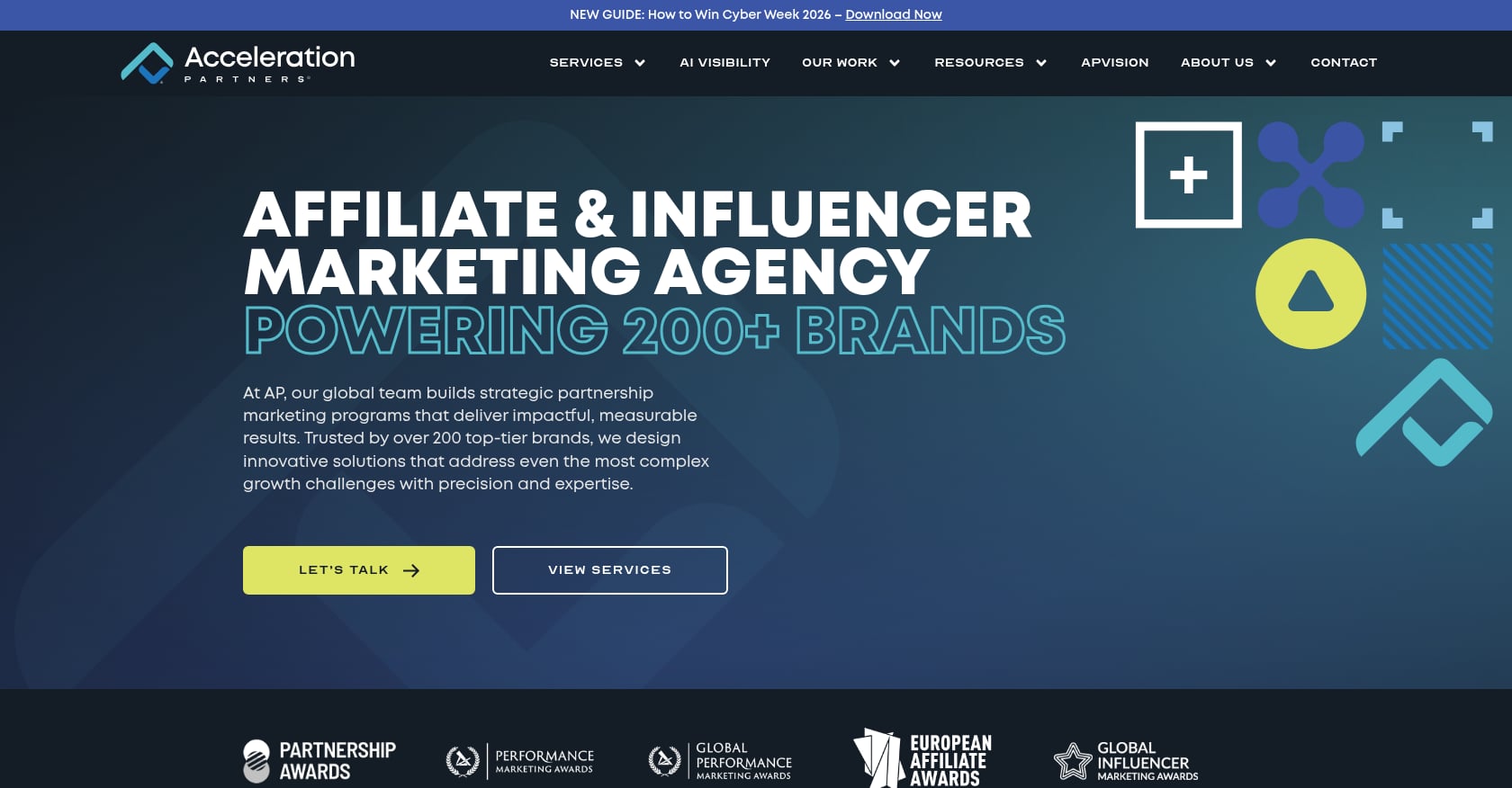
Best for: Enterprise and global B2B brands with complex governance requirements.
Acceleration Partners is the agency to consider when your affiliate program spans multiple countries, requires fraud auditing, and involves complex internal processes. With 300+ employees globally, they offer partnership marketing across affiliate, influencer, content, mass media, and B2B partner channels according to their Clutch profile.
Key features:
Global multi-country program management
Fraud auditing and compliance
Partnership marketing across affiliate, influencer, content, and B2B partner types
Enterprise-scale processes and governance
Pricing: Clutch lists pricing as undisclosed. Third-party estimates (via Track360) suggest $12K–$20K/mo retainer plus 8–12% performance fee, though these are not official numbers.
User sentiment: Recognized on the Inc. 5000 list, Partner Commerce specializes exclusively in B2B SaaS affiliate and partner-led growth.
Tradeoffs:
Some Clutch reviews mention a lack of strategic guidance early in the engagement, though this improved over time
May be more expensive or process-heavy than growth-stage brands need
Less differentiated for boutique, AEO, or emerging channel work
Ask before hiring: “How many B2B programs do you currently manage, and who would be our day-to-day team?”
4. Gen3 Marketing
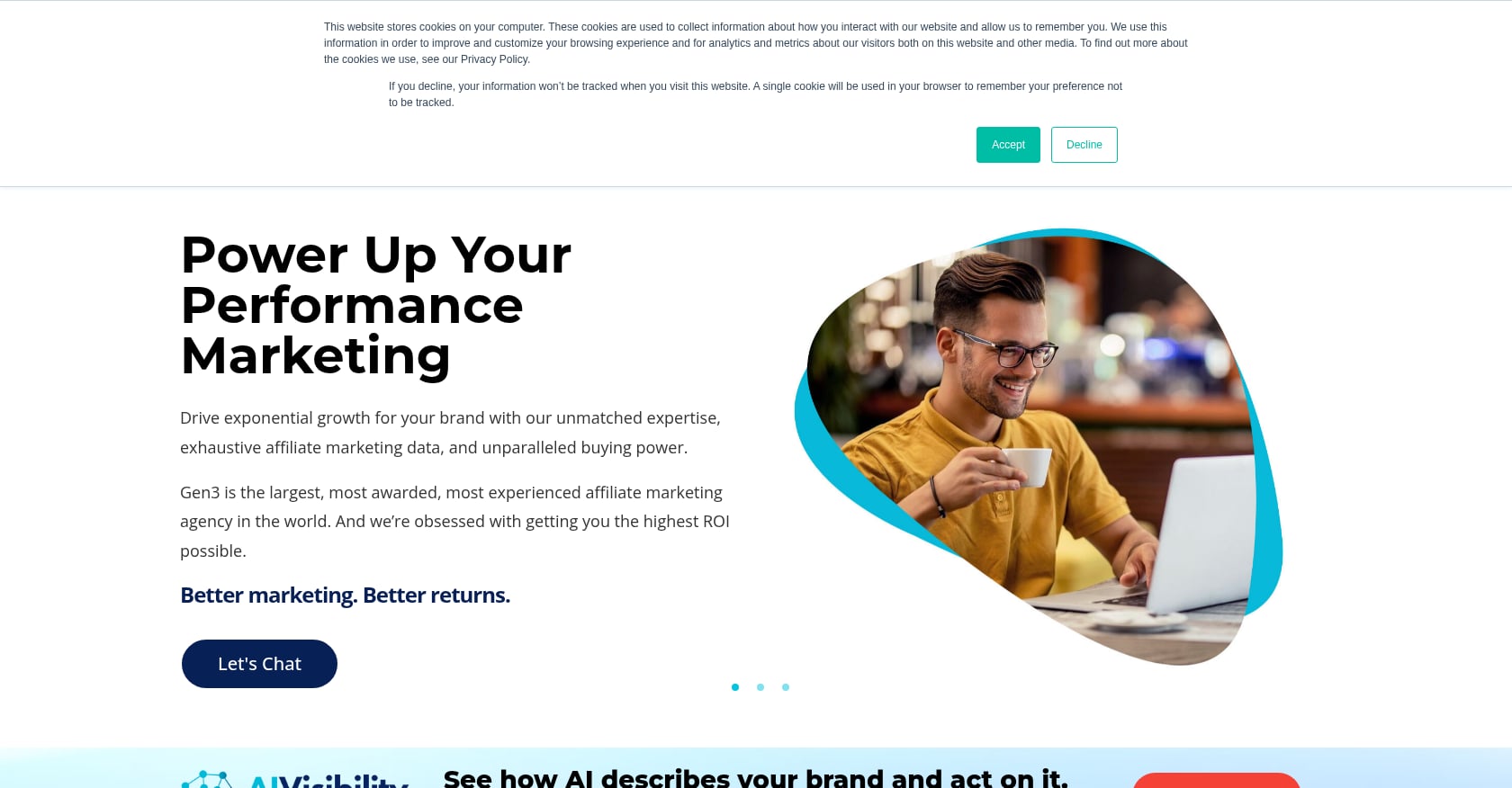
Best for: Established brands that want affiliate marketing combined with broader SEO/SEM performance support.
Gen3 Marketing brings nearly two decades of publisher relationships and 200+ employees across the USA, Canada, and Europe. If your B2B brand wants affiliate management connected to SEO and paid search strategy, Gen3’s broader service set can be an advantage. Their Clutch profile shows a strong track record across multiple performance channels.
Key features:
Global affiliate marketing with established publisher networks
Integration with SEO, SEM, and performance marketing
Two decades of publisher relationships
Multi-network management
Pricing: Clutch lists $5,000+ minimum project size and $150–$199/hr average hourly rate. Client spending ranges from $10,000 to over $1M annually, with the most common project size being $10,000–$49,999.
User sentiment: Clutch: 4.9/5 from 15 reviews. Clients praise affiliate expertise, results orientation, and strategic insights. G2 shows 5.0/5 from 1 review noting Gen3 helped drive online sales through affiliates using CJ.
Tradeoffs:
May be more agency than a B2B brand needs if you only want specialist partner-channel operations
Clutch reviews mention challenges with account management resources when a primary account manager was unavailable
Higher hourly range than many boutique agencies
Ask before hiring: “What percentage of your managed programs are B2B, and how do you handle CRM-connected attribution?”
Need an affiliate program that goes beyond coupon sites? Hamster Garage builds and manages affiliate and partner programs for ambitious B2B, tech, fintech, and marketplace brands. Start a conversation about your partner mix and growth goals.
5. PartnerCentric
Best for: Mid-market brands that want affiliate, influencer, and partner management with strong third-party reviews.
PartnerCentric positions itself as a full-service performance marketing agency helping brands grow measurable, incremental revenue through affiliate, influencer, and partner channels. With 30 Clutch reviews (the most of any agency on this list), there is more independent feedback to evaluate than for most competitors.
Key features:
Affiliate, influencer, and partner channel management
Performance-based program optimization
Structured project management and communication cadence
Mid-market focus
Pricing: Clutch data shows a $5,000/month retainer minimum, with comprehensive multi-channel engagements scaling based on scope.
User sentiment: Clutch: 4.8/5 from 30 reviews. One review describes PartnerCentric helping a shipping software provider grow its affiliate program 100%. Top mentions include timely communication, knowledgeable team, and proactive management.
Tradeoffs:
Clutch reviews mention some clients wanted better analytics and reporting transparency
Industry mix leans retail, financial services, legal, and hospitality rather than pure B2B SaaS
For highly technical B2B buyer journeys, ask for specific B2B case studies
Ask before hiring: “Can you share B2B SaaS case studies, and how do you report lead quality and pipeline?”
6. Advertise Purple
Best for: Mid-market brands wanting traditional affiliate volume and network access.
Advertise Purple is a well-known affiliate agency with strong Trustpilot ratings and a focus on affiliate program management, partner onboarding, and placement optimization. For B2B brands, the question is how much of the program will involve strategic B2B partner recruitment versus traditional network activation.
Key features:
Affiliate program management and partner onboarding
Publisher relationship optimization
Placement securing and network access
Broad industry coverage
Pricing: Clutch lists pricing as undisclosed. Some clients report costs around $2,000 monthly. Third-party estimates suggest $8K–$15K/mo plus 8–12% performance fee. Most common project size is $10,000–$49,999.
User sentiment: Clutch: 4.3/5 from 18 reviews. Trustpilot: 4.8/5 from 167 reviews. Positive reviews describe strong partner support and ROAS improvements. However, one Clutch reviewer reported poor delivery and only $42 revenue in the second month.
Tradeoffs:
Mixed Clutch reviews suggest inconsistent delivery for some clients
Some pricing-flexibility concerns noted in reviews
B2B brands should ask how much of the program involves consultant/community/publisher recruitment versus coupon and cashback activation
Ask before hiring: “What is your B2B partner recruitment process, and what percentage of your managed programs are B2B?”
7. JEBCommerce
Best for: Brands wanting an affiliate-only agency with lower published entry pricing.
JEBCommerce has been operating as a dedicated affiliate agency since 2004. For B2B brands with simpler affiliate needs or smaller budgets, the lower entry pricing could be attractive, though B2B-specific capabilities are less documented.
Key features:
Affiliate program management
Publisher recruitment
Program modernization
Nearly two decades of affiliate experience
Pricing: Third-party sources report entry pricing of $2,000/mo plus 2% on channel growth, making it one of the more accessible options on this list.
User sentiment: Limited third-party review volume in the sources found. A case study corroborated by impact.com shows Sweet Zzz achieving 290% affiliate revenue growth and 335% AOV increase over 8 months.
Tradeoffs:
Less B2B-specific than Partner Commerce or Hamster Garage
Limited Clutch/G2 review signals
Ask about B2B SaaS, CRM tracking, lead-stage attribution, and non-coupon partner recruitment before shortlisting
Ask before hiring: “What B2B programs have you managed, and how do you handle lead-based payouts?”
8. eAccountable
Best for: B2B ecommerce, marketplace, and performance-commerce brands needing affiliate plus Amazon and paid media support.
eAccountable brings 25 years of experience and was an early pioneer in affiliate marketing. For B2B brands that sell through ecommerce or marketplaces and want affiliate connected to Amazon management, paid media, and SEO, this is a relevant option.
Key features:
Affiliate and partnership marketing
Amazon and marketplace management
Paid media and programmatic
GEO/SEO and organic growth
Serves SMBs to Fortune 1000
Pricing: Clutch lists $10,000+ minimum project size. Project costs range from $5,000 to over $200,000 annually, with the most common project size being $10,000–$49,999.
User sentiment: Clutch: 4.9/5 from 23 reviews. Top mentions include knowledgeable, proactive, and customer-first. One review says eAccountable “exceeded our expectations and understood our business well.”
Tradeoffs:
More ecommerce and performance-commerce oriented than pure B2B SaaS
Broader service mix can dilute affiliate focus depending on internal priorities
Ask who specifically manages the affiliate channel and their B2B partner recruitment experience
Ask before hiring: “How much of your team’s work is B2B-specific, and how do you separate affiliate from your other service lines?”
Agency vs. Platform: Do You Need PartnerStack, Impact, Everflow, or an Agency?
This is one of the most common questions B2B teams ask before hiring an affiliate agency. The short answer: the platform is not the strategy.
Practitioners on Reddit consistently reinforce this point. One commenter described PartnerStack as “less a growth engine and more a management layer” when partner demand does not already exist. Another thread emphasized that B2B programs need partner development, competitive incentives, conversion flows, and enablement resources, not just software. And one practitioner managing B2B clients noted that most recruiting was done “outside of the platform” through direct negotiations.
Here is a framework for the decision:
Option | Best When | Weakness |
|---|---|---|
Platform only | You already have partner demand and someone internally can recruit and manage | Software does not recruit serious B2B partners for you |
In-house manager | Partnerships is a core function and you have enough volume to justify headcount | One person may lack publisher relationships and platform depth |
Agency | You need speed, expertise, recruitment, compliance, and optimization | Retainer cost; must manage agency quality |
Hybrid | Mature brands with internal strategy and external execution | Requires clear roles and reporting ownership |
For platform selection specifically: PartnerStack often fits B2B SaaS partner ecosystems. Impact.com often fits broader enterprise partnership automation with advanced integrations. Everflow can fit performance tracking and complex programs. B2B SaaS Reviews notes that more robust tools like Impact and PartnerStack may take a month or two to set up properly.
A good affiliate agency for B2B brands should be platform-agnostic enough to recommend the tool that matches your operating model. For a deeper comparison of agency versus software models, see the guide on affiliate agency vs. affiliate software.
What the First 90 Days Should Look Like
A B2B affiliate program is not a “hire an agency and wait” situation. The first 90 days should prove operating quality before it proves full revenue scale.
Days 1 to 15: Audit and Architecture
Review program goals, ICP, audience, existing partner data, tracking, platform setup, commission terms, and compliance risks
Identify leakage: coupon over-crediting, low-quality partners, tracking gaps, wrong commission tiers, inactive partners, missing CRM fields
Use an affiliate program audit checklist if you already have a program running
Days 16 to 30: Partner Strategy and Platform Cleanup
Define partner ICPs (not just publisher lists)
Build priority partner target lists
Finalize commission and attribution model
Clean up partner terms, creative, application rules, and reporting logic
Align with sales and RevOps on CRM stages and payout triggers
One LinkedIn practitioner described a B2B SaaS case where a failed “recruit everyone” approach was replaced by an ICP-based, out-of-network, content-driven strategy. His takeaway: “Volume is vanity. Partner quality is velocity.”
Days 31 to 60: Recruitment and Activation
Start outbound recruitment targeting industry publishers, comparison sites, newsletters, consultants, agencies, and creators
Reactivate dormant high-fit partners
Build enablement assets and partner onboarding flows
Test early placements and content opportunities
Active outbound matters. A LinkedIn post from a B2B affiliate discussion described one agency sending 6,000 recruitment emails that generated roughly 200 affiliate opportunities in 30 days. That is practitioner-reported, not a guaranteed benchmark, but it illustrates what active recruitment looks like versus hoping partners find your program on their own.
Days 61 to 90: Optimization and Scale Plan
Review early partner response, lead quality, conversion, pipeline, and cost
Adjust commissions and placements based on partner value
Expand winning partner segments
Create a quarterly roadmap for partner recruitment, compliance, content, paid placements, and incrementality measurement
How Much Does a B2B Affiliate Agency Cost?
Most serious affiliate agency engagements for B2B brands are custom priced. But total cost includes more than just the agency retainer. Here is the full picture:
Agency costs:
Monthly retainer (ranges widely from $2,000 to $20,000+ depending on agency and scope)
Performance fee (commonly 8–12% of partner-driven revenue or commissions)
Setup or migration fee (some agencies charge separately)
Platform costs:
PartnerStack, Impact.com, Everflow, or other platform subscription
Network transaction fees where applicable
Partner costs:
Commissions to affiliates and partners
Tenancy or placement fees for premium publishers
Bonuses for performance milestones
Hidden costs people forget:
Creative and content production for partner enablement
CRM integration and reporting setup
Legal and compliance monitoring
Internal team time for approvals, sales alignment, and partner communication
Public review sources show many affiliate agency projects clustering around $10,000 to $49,999, though enterprise programs run much higher. For more detail on pricing models and what to expect, see the affiliate agency pricing guide.
Metrics Your B2B Affiliate Agency Should Report
If an agency only reports clicks and last-click sales, it is not ready for B2B. Here are the metrics that matter:
Recruitment metrics: Partner applications, approved partners, activated partners, revenue-active partners, partner diversification by type.
Performance metrics: Clicks and traffic quality, leads/trials/demos/signups, MQLs and SQLs, opportunities created, pipeline sourced and influenced, closed-won revenue.
Economics metrics: CPA/CPL, effective commission rate, CAC and payback period, LTV/CAC ratio, AOV or ACV.
Quality metrics: New customer rate, trial-to-paid conversion, churn and retention by partner, incrementality by partner type, compliance violations found and resolved.
Market data supports this comprehensive approach. The IAB Australia affiliate marketing review found that publishers rated tracking and compliance practices at 8.0/10 importance, and commission validation/payment times at 7.5/10. A B2B affiliate agency should not just recruit partners. It must make the program attractive enough for serious partners to invest time in content, demos, webinars, reviews, and sales enablement.
The B2B Partner Pyramid: Why Volume Is Not the Goal
The strongest B2B affiliate programs are built like portfolios, not subscriber lists. Here is how to think about partner tiers:
Tier 1: Strategic influence partners. Industry analysts, consultants, agencies, review and comparison sites, category publishers, integration partners, communities, and high-trust creators. These drive pipeline and high-quality customer acquisition.
Tier 2: Scalable content partners. Blogs, YouTube channels, newsletters, SaaS roundups, and educational creators. These generate discovery, consideration, and long-tail demand.
Tier 3: Conversion partners. Deal pages, limited B2B coupon/reward sites, employee benefits portals, and marketplace placements. These assist conversion, but incrementality must be monitored.
Tier 4: Risk partners. Opaque subnetworks, unauthorized search bidders, low-quality coupon scraping, and incentive-only traffic with weak lead quality. These should be limited, monitored, or removed.
Impact.com’s 2025 benchmark report, which analyzed nearly 1 billion transactions and over $116 billion in GMV across 2,368 brands, found that the strongest affiliate programs did not optimize for one partner type. They built diversified portfolios covering research, decision, and execution stages. While that data is retail-focused, the principle applies even more to B2B, where trust and buyer education matter at every stage.
Are You Ready for a B2B Affiliate Agency?
Not every B2B brand is ready. Use this quick-fit assessment:
Signal | Good Fit for an Agency | Wait or Fix First |
|---|---|---|
Deal value / ACV | Enough margin to pay meaningful partner incentives | Tiny payouts that cannot fund partner content |
Sales motion | Self-serve, assisted sales, demo, trial, or partner-trackable pipeline | Fully offline enterprise deals with no trackable journey |
Product category | Existing search, review, comparison, or consultant ecosystem | No third-party influence points exist |
Internal owner | Someone can approve offers, content, and partner terms | No internal owner or extremely slow approvals |
Tracking readiness | CRM and analytics can support partner attribution | No clean conversion event or CRM hygiene |
Budget | Can fund agency + platform + commissions + placements | Only willing to pay commission after revenue with zero enablement budget |
B2B Affiliate Agency Evaluation Scorecard
Use this scoring checklist when auditing prospective agency proposals:
CRM & RevOps Integration: Can the agency team natively configure webhooks and API triggers between PartnerStack or Impact.com and HubSpot or Salesforce?
Out-of-Network Recruitment: Does the agency execute active outbound outreach to industry analysts, niche newsletters, and B2B podcasters rather than relying only on platform directories?
Incrementality Protection: How does the agency prevent coupon and deal-scraping sites from intercepting existing organic brand search traffic?
Content Enablement: Does the agency build co-branded landing pages, slide decks, and copy templates for top-tier strategic partners?
AEO & LLM Citation Strategy: Does the agency target high-authority comparison sites and trade publications that feed AI search tools like Google AI Overviews and Perplexity?
Questions to Ask Before Hiring a B2B Affiliate Agency
These twelve questions separate agencies that understand B2B from those running a B2C playbook with a different label:
What B2B programs have you managed, and in which verticals?
Which partner types perform best for our ICP?
How do you recruit outside the platform?
What platform would you recommend for our program and why?
How do you connect affiliate data to CRM?
How do you define and measure incrementality?
How do you prevent coupon and code leakage?
What is your partner activation and enablement process?
What does the first 90 days include?
What do we own if we end the engagement (platform account, partner relationships, data)?
Who is our day-to-day manager, and how many clients do they handle?
What is included in the retainer versus billed separately?
For a more detailed RFP framework, see the full list of questions to ask an affiliate agency.
Final Recommendation
Choosing an affiliate agency for B2B brands comes down to matching your program maturity, budget, and growth ambitions to the right operator.
Hamster Garage for scaled brands needing operating depth, multi-platform expertise, and broader partner-channel execution across affiliate, AEO, Amazon, and TikTok Shop.
Partner Commerce for pure B2B SaaS affiliate programs where the focus is entirely on business buyer partnerships.
Acceleration Partners for enterprise and global programs with complex governance needs.
Gen3 Marketing for brands that want affiliate connected to broader SEO/SEM performance marketing.
PartnerCentric for reviewed mid-market affiliate and influencer programs.
Advertise Purple for traditional affiliate volume with network access.
JEBCommerce for affiliate-only programs with lower budget entry points.
eAccountable for B2B ecommerce and marketplace brands needing affiliate plus Amazon/paid media.
If your B2B brand needs an affiliate and partner channel that is measurable, partner-diverse, and managed by operators who understand CRM attribution and B2B buying cycles, contact Hamster Garage for a consultation.
FAQ
What is an affiliate agency for B2B brands?
An affiliate agency for B2B brands builds and manages partner programs that drive qualified leads, pipeline, signups, demos, trials, or revenue through third-party partners. Unlike a B2C affiliate agency focused on coupon, cashback, and retail publishers, a B2B affiliate agency recruits industry publishers, review sites, consultants, agencies, newsletters, communities, creators, and strategic partners that already influence business buyers.
Does affiliate marketing work for B2B SaaS?
Yes, but it works differently from ecommerce affiliate marketing. B2B programs have longer sales cycles, more complex attribution, more educational content requirements, and fewer but more strategic partners. Tracking often needs to connect with CRM systems, analytics software, and affiliate platforms to measure outcomes beyond last-click sales.
How much does a B2B affiliate agency cost?
Most serious engagements are custom priced. Public review sources show many affiliate agency projects in the $10,000 to $49,999 range, but enterprise programs can run much higher. Total cost includes agency retainer, platform subscription, partner commissions, placement budgets, creative/content support, compliance monitoring, and CRM integration work.
Should a B2B brand use PartnerStack or Impact.com?
It depends on the program model. PartnerStack is often associated with B2B SaaS partner ecosystems. Impact.com is typically used for broader enterprise partnership automation with more advanced integration and analytics capabilities. A good agency should recommend the platform that matches your operating model rather than defaulting to one tool.
What partners work best for B2B affiliate programs?
The strongest B2B partners are high-trust sources that influence business buyers: industry publications, SaaS review sites, comparison pages, consultants, implementation partners, agencies, newsletters, YouTube educators, LinkedIn creators, communities, podcasts, and strategic brand partners. These deliver more qualified pipeline than coupon or cashback sites.
How long does a B2B affiliate program take to produce results?
Expect the first 30 days to focus on strategy, platform setup, and partner ICP definition. Days 31 to 60 should focus on recruitment and activation. By day 90, you should see leading indicators: approved partners, activated partners, early placements, initial leads, and first pipeline signals. Closed revenue may take longer if the product has a multi-month sales cycle.
How do B2B affiliate commissions work?
B2B programs can pay per lead, demo, trial, SQL, opportunity, closed deal, subscription revenue, or hybrid milestone. Some programs add fixed placement fees or bonuses. The key is matching commission levels to the effort required from partners, because serious B2B content partners will deprioritize programs with tiny payouts.
What should B2B brands avoid when hiring an affiliate agency?
Avoid agencies that cannot explain CRM attribution, lead only with coupon and cashback partner strategies, report only clicks and last-click sales, have no B2B case studies, or cannot articulate how they measure incrementality. Also clarify upfront who owns the platform account and partner relationships if the engagement ends.
Latest Articles

.svg)
























































.png)


.png)
.png)
.png)

.png)
.png)
.png)


.avif)

.svg)
