.svg)
Challenger Brand Growth Strategy: 2026 Playbook + Examples


.svg)
TL;DR
A challenger brand growth strategy is the playbook brands use to compete against bigger, better-funded category leaders by combining a bold brand posture with capital-efficient growth tactics. It starts with mindset (challenging category conventions, not just competitors), moves through niche-first market sequencing, and increasingly relies on performance-based partnerships like affiliate programs, creator commerce, and editorial placements to scale without outspending incumbents. This guide covers the definition, the 10 challenger types from the Overthrow II framework, and the specific execution tactics that turn challenger positioning into measurable revenue growth.
Quick Answer: What Is a Challenger Brand Growth Strategy?
A challenger brand growth strategy is a systematic way for a non-dominant brand to grow against larger competitors by combining distinctive positioning with focused market entry, efficient customer acquisition, community building, partnerships, and measurable experimentation. The strategy is not simply about having a smaller budget. It is about choosing where to compete, what category convention to challenge, and how to turn limited resources into disproportionate growth.
In practice, a challenger strategy follows five steps: define what you are challenging, identify a narrow market beachhead, build a differentiated brand narrative, select capital-efficient growth channels, and scale the channels that produce profitable incremental growth.
What Has Changed for Challenger Brands in 2026?
The fundamentals of challenger strategy have not changed: a distinctive point of view, focused market entry, strong customer relevance, and disciplined resource allocation still matter. What has changed is how challengers build distribution and credibility.
Three shifts are particularly important in 2026.
AI-mediated discovery: Customers increasingly encounter brands through AI-generated answers, summaries, recommendations, and comparisons. Challenger brands therefore need to build not only search visibility but also credible third-party evidence that can support their claims across the web.
Creator-led commerce: Creators increasingly operate as both media channels and commerce partners. For challengers, this can combine trusted recommendation with measurable acquisition.
Distribution diversification: Brands that depend heavily on a single advertising platform, marketplace, or social network face concentration risk. Challenger strategies increasingly emphasize a portfolio of owned, earned, paid, community, creator, affiliate, and partnership channels.
The strategic implication is simple: in 2026, challenger brands need to compete not only for attention but also for distribution, credibility, and inclusion in the information sources customers use to make decisions.
What Is a Challenger Brand Growth Strategy?
A challenger brand growth strategy is a framework for brands with ambitions bigger than their budgets to achieve sustained growth by challenging category conventions and using capital-efficient channels to compete with market leaders.
The term “challenger brand” was established by Adam Morgan in his 1999 book, Eating the Big Fish. The core idea: a challenger brand is not a market leader but has ambitions to become one, or at least a strong contender. The Challenger Project, founded by Morgan, defines it more precisely: “A Challenger Brand has business ambitions bigger than its conventional resources and is prepared to do something bold to overcome that gap.”
The growth strategy part is where most content on this topic falls short. Knowing you’re a challenger is the beginning. The real question is what you actually do to grow.
Building a challenger growth engine? Explore affiliate marketing as your performance-based foundation.
Who This Guide Is For
This article serves three audiences:
Marketers at growth-stage brands who aren’t the category leader and need a framework for competing without matching incumbent ad budgets. Think Series B SaaS companies, emerging DTC brands, or regional players entering national markets.
Brand teams adopting a challenger posture for the first time, whether that’s a startup building its identity or an established company that wants to shake off complacency and compete more aggressively.
Performance marketers who need to translate brand strategy into channel execution. You’ve read the positioning frameworks. Now you need to know which growth channels actually work for brands that can’t outspend the market leader on paid media.
What Makes a Brand a Challenger
Being a challenger isn’t about being small. It’s about how you think and act.
King Ursa puts it directly: “Challenger is not a stage of growth. Established and even market-leading brands can adopt challenger strategy when they decide to define a clear enemy, refuse category orthodoxy, and behave with the urgency of a contender.” Kleber & Associates reinforces this: “Even the world’s largest and most profitable companies can benefit from challenger-brand thinking.”
Three conditions define a challenger brand:
State of market. You’re competing against at least one player with significantly more resources, distribution, or brand recognition than you have.
State of mind. You refuse to accept the category’s existing rules as permanent. You believe the way things are done can be improved, rethought, or replaced entirely.
Rate of success. You’re growing, or positioned to grow, faster than your conventional resources would predict. The gap between ambition and resources is closed through boldness, not budget.
The Shift from “Who” to “What”
The most important evolution in challenger brand thinking happened in the last decade. Early challenger strategy was about picking a fight with the market leader. Think Pepsi vs. Coke, Avis vs. Hertz. That David vs. Goliath narrative still resonates, but it’s no longer the most effective approach.
According to eatbigfish, “the most compelling Challengers understand and clearly communicate what they are challenging (about the category or the customer experience), rather than who they are challenging.” Tony’s Chocolonely doesn’t attack Hershey’s. It challenges the existence of slave labor in chocolate supply chains. Oatly doesn’t attack dairy brands by name. It challenges the assumption that cow’s milk is the default. Liquid Death doesn’t target Evian. It challenges the idea that water has to be boring.
This distinction matters strategically because challenging a “what” gives you a narrative that scales. Challenging a “who” pins you to a single competitor and often limits your positioning as you grow.
The Challenger Brand Growth Strategy Framework
A challenger brand strategy works best when brand positioning and growth execution are treated as one system. The brand decides what it is challenging, while the growth strategy determines where to find the people most likely to care, how to convert them, and how to scale the resulting demand.
A practical challenger growth framework has six stages:
Stage | Strategic Question | Primary Output |
|---|---|---|
1. Define the challenge | What category convention, customer frustration, or industry assumption are we challenging? | Challenger thesis |
2. Choose the beachhead | Which specific audience is most likely to care first? | Initial target segment |
3. Build the narrative | Why should this audience believe our alternative is better or different? | Positioning and messaging |
4. Select growth channels | Where can we reach this audience efficiently and credibly? | Channel portfolio |
5. Build distribution | Which partners, communities, creators, publishers, or platforms can amplify the story? | Distribution engine |
6. Scale what works | Which channels produce incremental, profitable growth? | Repeatable growth model |
The important point is that these stages should happen in sequence.
A challenger should not begin by asking, “Which marketing channel should we use?” The better question is, “Which audience needs our alternative most urgently, and which channels already have its attention?”
Step 1: Define What You Are Challenging
Start with a category assumption rather than a competitor.
Examples include:
A pricing model customers consider unfair
An outdated product experience
An industry norm customers tolerate but dislike
Excessive complexity
Poor customer service
Lack of transparency
A legacy solution that no longer fits customer behavior
The output should be a simple challenger thesis:
“We believe [category assumption] is wrong because [customer insight], and we are building [alternative] for [specific audience].”
Step 2: Choose a Beachhead Market
Do not attempt to become the alternative for everyone immediately.
Identify the customer segment with the strongest combination of:
Problem intensity
Willingness to switch
Ability to pay
Concentrated media consumption
Community participation
Low satisfaction with incumbent solutions
The objective is not maximum reach. It is maximum relevance.
Step 3: Turn the Challenge Into a Narrative
Your positioning should explain three things quickly:
What is wrong with the existing category?
Why does your brand believe it should be different?
What does the customer get instead?
A strong challenger narrative gives customers a reason to switch beyond price.
Step 4: Match Channels to the Strategy
Different challenger positions require different distribution strategies.
A community-driven challenger may prioritize creators, Reddit, Discord, and organic social. A product-led challenger may prioritize reviews, comparison publishers, demonstrations, and search. A mission-driven challenger may prioritize aligned creators, editorial partnerships, communities, and earned media.
The channel should reinforce the challenger story rather than operate independently from it.
Step 5: Build Distribution Through Partners
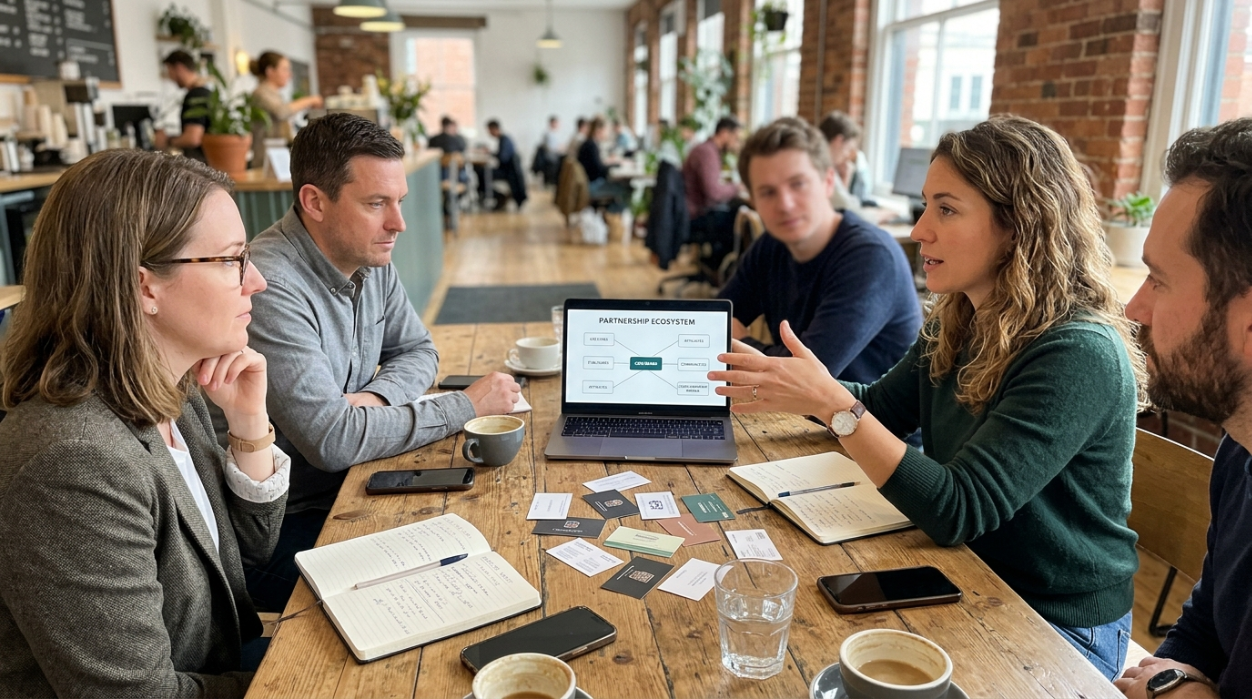
Once the core audience and narrative are clear, identify third parties that already have credibility with that audience.
Potential partners include:
Content publishers
Affiliate partners
Product reviewers
Creators
Industry communities
Newsletter operators
Comparison websites
Loyalty platforms
Complementary brands
Marketplaces
The goal is to turn the challenger narrative into distributed credibility.
Step 6: Scale Through Evidence
A challenger strategy should be experimental early and increasingly systematic as it gains traction.
Track which audiences, messages, partners, and channels generate incremental customers and profitable revenue. Then shift resources toward the combinations that consistently outperform.
The result is a growth loop:
Challenge → Position → Beachhead → Distribution → Conversion → Measurement → Reinforcement → Expansion.
Challenger Brand vs. Related Terms
These terms get conflated constantly. Here’s how they differ:
Term | Definition | Key Distinction |
|---|---|---|
Challenger Brand | A brand with ambitions exceeding its resources that challenges category conventions to grow | A brand and creative posture, not a business model claim |
Disruptor Brand | A brand that fundamentally changes how a market operates (e.g., Airbnb, Uber) | Starts with a technical or structural breakthrough, not necessarily an ideology |
Underdog Brand | A brand that emphasizes its smaller size as part of its appeal | One of 10 challenger types, not the whole category |
Niche Brand | A brand serving a narrow segment without aspirations to compete broadly | Accepts its position; challengers want to expand beyond it |
Market Leader | The dominant brand in a category by share or mindshare | Can still adopt a challenger mindset (Apple still behaves like a challenger in many categories) |
The challenger vs. disruptor distinction is the one that trips people up most. As The Challenger Project explains, “Belief and conviction is what distinguishes challenger brands from disruptors. The disruptor more often than not starts with an insight about a technical capability. But challengers use ideology.” A brand can be a challenger without disrupting the underlying business model of its category, and a disruptive business can fail to behave like a challenger.
The 10 Types of Challenger Brand Strategy
Adam Morgan and Malcolm Devoy’s 2019 book Overthrow II (published with PHD Media) identified 10 distinct challenger brand types. Each type represents a different strategic narrative, a different answer to the question “What are we challenging?”
Type | What It Challenges | Example |
|---|---|---|
The Missionary | Indifference to a cause | Tony’s Chocolonely, Patagonia |
The Democratizer | Exclusivity and inaccessibility | IKEA, Xiaomi |
The Irreverent Maverick | Category seriousness and decorum | BrewDog, Oatly |
The Real & Human | Corporate impersonality | Zappos, Mailchimp |
The Feisty Underdog | The dominant player directly | Bumble, Under Armour |
The Dramatic Disruptor | Product mediocrity | Casper, Dyson |
The Enlightened Zagger | The direction the category is moving | Lush (no packaging when everyone adds it) |
The Next Generation | Whether legacy solutions fit today’s world | Tesla, Warby Parker |
The Local Hero | Global homogenization | Regional craft breweries, local banks |
The Visionary | The limits of current imagination | SpaceX, Rivian |
Understanding which type you are gives you strategic clarity on positioning, culture, and communications. But it also has direct implications for how you grow, which channels you prioritize, and which partners can authentically amplify your story.
A Missionary challenger, for example, needs partners who genuinely care about its cause. Content publishers and creators who share the brand’s values become natural affiliates. A Democratizer needs reach into price-sensitive audiences, making comparison sites and deal-focused publishers effective growth channels. A Dramatic Disruptor benefits from review sites and product demonstration content that showcases its superiority claims.
How to Build a Challenger Brand Growth Strategy
Building a challenger strategy requires more than choosing an unconventional brand voice. The strategy needs a defined market opportunity, a defensible point of view, a focused audience, and a growth system that can scale without depending entirely on incumbent-level spending.
1. Identify the Category Convention
List the assumptions your category treats as normal.
Ask:
What do customers complain about repeatedly?
What does every major competitor do the same way?
Where are customers forced to compromise?
Which industry practices exist because “that is how it has always been done”?
Choose one important convention that your brand can credibly challenge.
2. Find the Customers Most Ready to Switch
Not every customer is equally valuable to a challenger.
Prioritize people who already experience the problem your brand is designed to solve. These customers require less education and are more likely to become early adopters, advocates, reviewers, and community members.
3. Write a One-Sentence Challenger Thesis
Use this structure:
“We challenge [category convention] for [target audience] by providing [alternative], because [core belief or customer insight].”
If the statement could describe five competitors, it is not specific enough.
4. Define the Proof Behind the Position
A bold claim without evidence becomes advertising noise.
Support the challenger position with:
Product differences
Customer outcomes
Pricing or packaging advantages
Technology
Customer experience
Supply-chain decisions
Expert validation
Reviews
Demonstrations
Original research
The more consequential the claim, the stronger the proof needs to be.
5. Choose One Initial Beachhead
Select one customer segment, use case, geography, community, or category niche where the challenger proposition has unusually high relevance.
Win there before expanding.
6. Build a Distribution Portfolio
Choose channels based on where your target customers already discover, evaluate, and discuss products.
A challenger growth portfolio can include:
Organic search
Paid search
Paid social
Creator partnerships
Affiliate marketing
Editorial placements
Community marketing
Email
Referral programs
Marketplaces
Strategic partnerships
Answer engine optimization
Do not treat every channel equally. Concentrate resources on the channels that provide the strongest combination of reach, credibility, economics, and scalability.
7. Create a Measurement System
Track both brand and commercial indicators.
Brand metrics can include:
Branded search growth
Direct traffic
Share of conversation
Earned media mentions
Creator mentions
Community engagement
Growth metrics can include:
CAC
CPA
Conversion rate
Revenue
Contribution margin
LTV/CAC
Partner-generated revenue
Revenue-active partners
Repeat purchase rate
The goal is not simply to generate attention. It is to determine whether challenger positioning is creating profitable customer demand.
8. Scale the Winning Combination
Once a specific audience-message-channel combination consistently produces results, expand it.
Expansion can happen through:
Adjacent customer segments
New geographic markets
New partners
New creators
New publishers
New product categories
New use cases
The sequence should be prove → repeat → expand, rather than launch everywhere → spend heavily → hope.
Core Growth Strategies for Challenger Brands
Challenger brand growth strategy isn’t just positioning. It’s a set of tactical choices about where and how to invest limited resources for maximum impact. Here are the five pillars that the most successful challengers use.
1. Niche-First Sequencing
The beachhead strategy is fundamental. As Hangar12 puts it: “Dominate a beachhead before expanding. Be the obvious choice for someone before you try to be a choice for everyone.”
This means resisting the temptation to compete everywhere at once. Gymshark didn’t try to take on Nike across all of fitness. It owned a specific corner of bodybuilding culture on YouTube and Instagram before expanding. Mejuri didn’t launch as a mass jewelry brand. It became the brand for women buying fine jewelry for themselves, then scaled from there.
For challenger brands considering DTC affiliate marketing strategies, niche-first sequencing has a direct channel implication: recruit partners who own your specific niche audience before chasing broad publisher networks.
2. Performance-Based Partnerships
This is where challenger brand theory meets growth execution. Incumbents can afford to spend millions on brand awareness campaigns with uncertain ROI. Challengers usually can’t.
Silverlight Digital states it plainly: “Partnerships are the currency of challenger brands.” While legacy brands may view co-op partnerships as threats to their market position, challengers treat them as force multipliers. Boil Agency adds that “collaborating with other businesses that share similar values or target demographics can extend a challenger brand’s reach without significant cost increases.”
The pay-for-results model is structurally built for the challenger premise. You only pay when a partner generates a sale, a lead, or a specific action. That aligns perfectly with the core challenger reality of ambitions exceeding resources.
3. Community-Driven Marketing
Challengers build audiences that feel more like movements than customer bases. This is where channels like Reddit, Discord, and organic social become strategic.
Commit Agency, which recently acquired Gumas Advertising (the originator of “Challenger Brand Marketing®”), notes that subreddits are where a brand’s market “tells the truth” and that for challengers, that truth is “strategy fuel: sharper audience research, better keyword mining, stronger content ideas.” Practitioners on Reddit echo this. The best challenger brands treat community platforms as listening posts and co-creation spaces, not just distribution channels.
4. Content Commerce and Editorial Authority
Challenger brands that earn editorial coverage in credible publications gain something money can’t easily buy: third-party validation. When a trusted outlet writes about your product, it carries more weight than any ad.
This is where affiliate marketing and content strategy converge. Mass media publishers like Wirecutter, Forbes Vetted, and GQ run affiliate programs. Getting featured in their editorial content drives sales while building the brand credibility that challengers desperately need. The Business of Fashion reports that digitally native challengers like Gymshark and Hodinkee captured market segments without leaning on paid advertising, in part by earning organic editorial attention.
5. AI-Era Visibility
A newer dimension of challenger brand growth strategy involves showing up in AI-generated answers. When someone asks ChatGPT or Perplexity for a product recommendation, appearing in that response is increasingly valuable.
This is not traditional SEO. It requires having your brand mentioned and cited by the high-authority publishers that AI platforms already trust. For brands exploring this channel, answer engine optimization represents a practical extension of a partnership-driven growth approach.
Which Growth Channels Should a Challenger Brand Prioritize?
There is no universal challenger marketing channel. The right mix depends on the brand's positioning, audience, sales cycle, margins, and ability to produce compelling content or partnerships.
Business Situation | Priority Channels | Why |
|---|---|---|
Strong niche audience | Creators, communities, affiliates | Builds credibility within a concentrated market |
Highly differentiated product | Reviews, comparison content, affiliates, search | Lets third parties explain the difference |
Mission-driven brand | Communities, aligned creators, editorial | Amplifies values and advocacy |
Low average order value | Affiliates, creators, marketplaces, paid search | Requires efficient customer acquisition |
High-consideration SaaS | Content, partners, referrals, comparison sites | Supports education and trust |
New category creation | Thought leadership, PR, creators, search | Creates category awareness and demand |
Strong existing community | Referral, creator, UGC, community programs | Converts existing advocacy into distribution |
Heavy paid-media dependence | Affiliates, partnerships, organic search, creators | Diversifies acquisition risk |
Amazon-dependent brand | Amazon affiliates, creators, editorial, off-Amazon demand | Expands discovery beyond marketplace algorithms |
Strong brand story but low awareness | Editorial, creators, PR, partnerships | Converts narrative into third-party reach |
A Simple Channel Selection Rule
Prioritize channels where at least three conditions are true:
Your target customers already spend time there.
Your challenger story is naturally interesting in that environment.
The economics can work at your current scale.
A channel should not be selected simply because competitors are using it. Challengers gain an advantage by finding distribution opportunities where their particular story is unusually relevant.
The 90-Day Challenger Brand Growth Plan
A challenger strategy does not need to begin with a large marketing budget. The first 90 days should be used to validate the positioning, identify the strongest audience, build initial distribution, and establish a measurement baseline.
Period | Primary Objective | Key Actions | Deliverable |
|---|---|---|---|
Days 1–30 | Define the challenge | Research competitors, customer frustrations, category conventions, and audience segments | Challenger thesis and beachhead |
Days 31–60 | Build distribution | Recruit initial partners, creators, publishers, communities, and referral sources | Initial partner/channel portfolio |
Days 61–90 | Validate and scale | Test offers, messaging, commissions, content, and acquisition channels | Winning channel and optimization plan |
Days 1–30: Define the Challenger Position
Focus on strategy before scale.
Complete:
Competitor positioning analysis
Customer review analysis
Category convention mapping
Audience segmentation
Challenger type selection
Messaging development
Baseline CAC and conversion analysis
Initial channel economics
By the end of the first month, the team should be able to explain exactly what the brand is challenging, who cares most about that challenge, and why the brand has the right to make the claim.
Days 31–60: Build Initial Distribution
Begin testing distribution through a focused group of partners and channels.
Potential actions include:
Recruit niche creators
Approach relevant publishers
Launch or improve an affiliate program
Identify complementary brand partnerships
Develop comparison and review content
Participate in relevant communities
Build referral mechanisms
Create content designed around customer questions
The goal is not maximum partner count. It is finding the small number of partners and channels capable of generating qualified demand.
Days 61–90: Measure and Scale
Review performance by audience, channel, partner, content type, and offer.
Ask:
Which channel produces the lowest sustainable acquisition cost?
Which partners generate incremental customers?
Which audience has the highest conversion rate?
Which message produces the strongest response?
Which customers have the strongest retention or LTV?
Where is revenue overly concentrated?
Which activities create attention but little commercial value?
At the end of 90 days, eliminate weak experiments, increase investment in proven combinations, and create the next 90-day growth plan.
The objective of the first 90 days is not to “finish” the challenger strategy. It is to create enough evidence to know where the strategy deserves more investment.
Why Performance Partnerships Are a Challenger’s Growth Engine
Every challenger brand growth strategy eventually hits the same wall: you need to scale, but you can’t outspend the leader on paid media.
Paid advertising on Google, Facebook, and other platforms no longer provides as clear a path to growth for direct-to-consumer brands as it once did. Customer acquisition costs have risen across every major platform. For challengers, this makes the economics of paid media increasingly hostile.
Performance partnerships solve this problem structurally, for several reasons.
Capital efficiency. You pay commissions after revenue is generated, not before. This directly addresses the core challenger constraint of ambitions exceeding resources.
Narrative amplification through trusted voices. Affiliates, particularly content creators and editorial publishers, tell your story in their own voice to their own audience. Adtraction, a European affiliate network, reports seeing “more and more advertisers join our network who are challengers” and notes that content affiliates in particular can “market like you mean it” only if the brand’s story resonates with them. That’s a feature, not a bug. It forces challenger brands to have stories worth telling.
Measurable incrementality. Unlike brand awareness campaigns where attribution is murky, performance partnerships generate trackable results. Adtraction reports having “increased revenue to a brand by 20%” in some cases through affiliate channels alone.
Channel diversification. Over-reliance on any single platform is dangerous. A diversified partner ecosystem spanning editorial publishers, coupon and loyalty sites, content creators, and emerging channels like TikTok Shop and Amazon affiliates reduces platform dependency.
Collaborative ecosystems. The Agile Brand Guide predicts that “collaborative challenger ecosystems, partnerships between multiple smaller brands to counter large incumbents, including shared platforms, co-marketing, and bundled offers, will become more common.” This is already happening in practice.
WPP Media has observed “the rise of scaled challenger brands” firsthand, noting that these businesses have achieved significant size but continue to prioritize agility, community, and digital-first growth. The implication: challenger brand growth strategy isn’t something you graduate from. It’s something you scale with.
Ready to build a partnership program for your challenger brand? Talk to the Hamster Garage team about what that looks like.
Real-World Proof: Challenger Brands Scaling Through Partnerships

The challenger brand growth strategy framework isn’t theoretical. Here are four brands that used performance partnerships as a primary growth engine.
VEED: The AI Video Challenger
VEED entered the AI video editing space as a complete unknown competing against established tools with massive user bases. The challenge was building an affiliate program from zero in a crowded market. Through recruiting over 1,000 partners, implementing dynamic commissions, and building a full-funnel partner mix, VEED went from $0 to $100K in monthly recurring revenue through its partnership channel, with 175% year-over-year revenue growth.
Oars + Alps: The Men’s Grooming Challenger
Oars + Alps faced a problem common to challenger brands: dangerous revenue concentration, with too few partners driving too much volume. The brand also had dormant partners and fraud risk. After restructuring payouts, recruiting and reactivating partners, and cleaning up compliance issues, the results over four months were striking: +309% in sales, +144% in conversions, and +112% increase in average order value.
Redtiger: The Amazon Electronics Challenger
Redtiger, a dashcam brand, was competing on Amazon against established electronics companies with just five partners driving 85% of affiliate revenue. That concentration was an existential risk. Through aggressive recruitment via PartnerBoost, mass media outreach, and strategic activations, the brand achieved +5,616% quarter-over-quarter affiliate revenue and added $147.5K in incremental revenue in a single quarter. Revenue-active partners grew by 450%.
Burrow: The DTC Furniture Challenger
Burrow competed in online furniture against well-funded players. Its existing partner base was underperforming. By diversifying into content publishers, scaling editorial placements through Skimlinks, and securing Capital One placements, Burrow grew affiliate-driven sales by 30% year-over-year while increasing its partner base by 71% and revenue-active partners by 200%.
Each of these brands followed the challenger playbook: start with a bold brand story, identify the right growth channels, and use performance partnerships to scale without the budget of an incumbent.
See all case studies for the full picture of how challenger brands grow through partnerships.
How Hamster Garage Helps Challenger Brands Grow
Hamster Garage is a specialist operator for performance partnerships, built specifically for brands that need someone to recruit partners, structure economics, manage platforms, protect the brand, and keep scaling efficiently.
What Hamster Garage Delivers
The agency builds and manages affiliate and partnership programs across five core offerings: affiliate marketing, global partner marketing, answer engine optimization, Amazon affiliates, and TikTok Shop affiliates. It also operates Swipehouse, a YC-backed creator marketplace that helps brands and creators connect.
Who the Service Is For
Growth-stage and larger brands in tech, finance, B2B, marketplace, DTC, and consumer goods. Specifically, companies where no affiliate program exists and one needs to be built from scratch, where an existing program is large but inefficient, where the partner mix is too narrow, or where growth needs to come from channels beyond paid search and social.
Platforms Covered
Impact (Platinum Managing Partner), PartnerStack (Gold Partner), Amazon (via Levanta/PartnerBoost), and TikTok Shop.
The First 90 Days
Program audit or build, partner recruitment and activation, compliance setup, and commission architecture design. For brands with an existing program, an affiliate program audit comes first to identify what’s working, what’s leaking value, and where the growth opportunities are.
Metrics Reported
Incrementality, CPA, partner diversification, revenue-active partners, and LTV/CAC impact. The focus is on measurable, incremental growth rather than inflated volume numbers.
What Affects Pricing
Program scope, platform count, and partner scale. No public retainer tiers exist because engagements are scoped to each brand’s situation.
Proof
Impact Platinum Managing Partner. PartnerStack Gold Partner. US Partnership Awards Boutique Agency Bronze (2023) and Silver (2024). Forbes 30 Under 30 (CEO). Documented results across SaaS, fintech, retail, marketplace, and DTC verticals.
For brands exploring whether to manage partnerships in-house or work with a specialist, this outsourced affiliate management guide breaks down the decision framework.
Buyer Checklist: Is a Challenger Brand Growth Strategy Right for You?
Use this to assess whether a challenger approach fits your situation:
[ ] You compete against at least one player with significantly more budget, distribution, or brand recognition
[ ] Your paid media CAC is rising and becoming unsustainable as a primary growth channel
[ ] You have a clear point of view on what’s wrong with your category (not just who you want to beat)
[ ] You’re willing to invest in building a partner ecosystem rather than relying solely on direct-response ads
[ ] You have (or can build) a brand story compelling enough that third-party publishers and creators want to tell it
[ ] You’re already running at least one paid marketing channel and want to diversify into performance partnerships
[ ] You can commit to a 90-day runway for a partnership program to ramp before judging results
If most of these apply, a challenger brand growth strategy built around performance partnerships is worth pursuing. If you’re still relying primarily on paid social and search, the channel diversification alone could meaningfully reduce your customer acquisition risk.
FAQ
What is a challenger brand growth strategy?
A challenger brand growth strategy is a framework for brands that aren’t category leaders to achieve outsized growth by challenging industry conventions and using capital-efficient channels like performance partnerships, community marketing, and content commerce. It combines brand positioning (what you stand for and against) with tactical execution (how you actually acquire customers without outspending incumbents).
Can large companies use a challenger brand strategy?
Yes. Challenger is a mindset, not a market position. Established brands, including market leaders, can adopt a challenger posture when they define a clear enemy, refuse to accept category norms, and behave with the urgency of a contender. Apple, despite being the world’s most valuable company, consistently positions itself as challenging the status quo.
What is the difference between a challenger brand and a disruptor?
A challenger brand challenges category conventions through ideology and creative positioning. A disruptor fundamentally changes how a market operates through structural or technological innovation. Airbnb disrupted hospitality by creating an entirely new supply model. Oatly challenged dairy through brand storytelling and cultural positioning without changing how beverages are distributed. A brand can be one without being the other, and sometimes both.
How do challenger brands grow without big budgets?
Through niche-first market sequencing (dominating a beachhead before expanding), performance-based partnerships (paying only for results), earned media and editorial placements, community building on platforms like Reddit and social media, and increasingly through AI visibility strategies. The common thread is using boldness and strategic precision rather than spending power.
Why is affiliate marketing effective for challenger brands?
Affiliate marketing’s pay-for-performance model directly addresses the core challenger constraint: ambitions bigger than resources. Brands only pay commissions when partners generate actual sales or leads. This makes it capital-efficient, measurable, and scalable. Affiliates also amplify the brand’s narrative through trusted third-party voices, which is often more credible than paid advertising.
What is the Overthrow II framework?
Overthrow II is a 2019 book by Adam Morgan and Malcolm Devoy (published with PHD Media) that identifies 10 distinct types of challenger brand strategies. These include The Missionary, The Democratizer, The Irreverent Maverick, The Feisty Underdog, and six others. Each type represents a different narrative approach to challenging category conventions.
Who coined the term “challenger brand”?
Adam Morgan established the concept in his 1999 book Eating the Big Fish. He defined it as a brand that is not a market leader but has ambitions to become one, or at least a strong contender. Morgan went on to found eatbigfish, a consultancy dedicated to challenger brand strategy, and co-authored the Overthrow II framework.
What is a “scaled challenger” brand?
A scaled challenger is a brand that has achieved significant size but continues to prioritize agility, community, and digital-first growth rather than shifting to incumbent-style marketing. WPP Media has noted this as a rising trend, observing that “challenger brands no longer simply aspire to be absorbed by global giants; they are the ones in the driving seat.”
If your brand has challenger ambitions and needs a performance partnership engine to match, get in touch with Hamster Garage to start the conversation.
Latest Articles

.svg)





























































.png)


.png)
.png)
.png)

.png)
.png)
.png)


.avif)

.svg)
