.svg)
Best Affiliate Program Management Company: 8 Picks for 2026


.svg)
TL;DR
The best affiliate program management company for your brand depends on program size, vertical, and channel priorities. For multi-channel execution across traditional affiliates, Amazon, TikTok Shop, and AI visibility, Hamster Garage is the top operator-led pick. For global enterprise scale across 40+ countries, Acceleration Partners. For proprietary incrementality measurement, PartnerCentric. Most agencies charge $2,000 to $25,000+ per month in retainers, often combined with a 5% to 15% performance fee on affiliate-generated revenue.
78% of CMOs admit affiliate marketing is their least mastered digital channel. With U.S. businesses spending $13.81 billion on affiliate marketing in 2026 (up 11.3% from 2025), the gap between “having an affiliate program” and “running one well” keeps widening. That gap is exactly what an affiliate program management company fills.
But here’s the problem with searching for one: most search results mix up software platforms with actual management companies. Buying affiliate software without hiring someone to run it is like buying a CRM without hiring a salesperson. This guide covers only companies that will actually operate your program, not platforms that give you a dashboard and wish you luck.
Explore Hamster Garage’s affiliate management services to see what operator-led program management looks like.
Quick Answer: What Is the Best Affiliate Program Management Company in 2026?
The best affiliate program management company in 2026 depends on your business model.
- Choose Hamster Garage if you need affiliate management across Amazon, TikTok Shop, traditional affiliate networks, and AI search.
- Choose Acceleration Partners if you operate internationally.
- Choose PartnerCentric if measuring incrementality is your highest priority.
- Choose Gen3 Marketing if publisher scale is more important than emerging channels.
Most companies should expect to pay between $2,000 and $25,000 per month for outsourced affiliate program management, with an additional 5% to 15% performance fee.
There is no universally "best" agency. The right choice depends on your company size, revenue, vertical, channel mix, and growth goals.
Quick Takeaway: Choosing the Best Affiliate Program Management Company
The ideal affiliate program management company depends entirely on your brand's growth maturity, technical infrastructure, and channel strategy:
Hamster Garage: Best overall for modern, multi-channel brands looking to integrate traditional affiliate networks with Amazon, TikTok Shop, and AI-driven Answer Engine Optimization (AEO).
Acceleration Partners: Best for global enterprise brands requiring multi-country execution, regional teams, and localized compliance systems across 40+ countries.
PartnerCentric: Best for data-driven brands requiring advanced, proprietary incrementality tracking and conversion attribution software.
Gen3 Marketing: Best for traditional retail and ecommerce brands looking for maximum publisher scale and large consolidated agency footprint.
What Is an Affiliate Program Management Company?
An affiliate program management company, often called an OPM (outsourced program manager), is an agency that launches, manages, and grows your affiliate program on your behalf. They handle partner recruitment, commission structuring, compliance monitoring, performance optimization, and day-to-day operations.
This is fundamentally different from an affiliate network or a tracking platform. Networks like CJ Affiliate or ShareASale provide infrastructure: tracking links, payment processing, a publisher marketplace. Platforms like Impact or PartnerStack provide software. Neither one provides strategy or execution. An OPM provides both.
The distinction matters enormously for buyers. If you want a deeper breakdown, read our guide on affiliate agencies vs. affiliate software and the companion piece on agencies vs. affiliate networks.
Quick Comparison Table
Company | Best For | Estimated Monthly Retainer | Key Feature / Tech | Platform Ecosystems |
Hamster Garage | Multi-channel & Creator Growth | Custom Scoped | Swipehouse Creator Tech & AEO Playbook | Impact, PartnerStack, TikTok Shop, Amazon |
Acceleration Partners | Enterprise Global Scale | $5,000 to $25,000+ | Localized Global Compliance Systems | Impact, CJ Affiliate, Awin, ShareASale |
PartnerCentric | Incrementality Attribution | $3,500 to $5,000+ | Patented FUSE Precision Platform | Impact, ShareASale, CJ Affiliate, PartnerStack |
Gen3 Marketing | High-Volume Retail Scale | $5,000+ | 200+ Global Publisher Network | Major Legacy Networks, Amazon Affiliate |
Advertise Purple | Mid-Market Turnkey Entry | $2,000+ | Purply Data Analytics Engine | Major Traditional Networks |
DMi Partners | Cross-Channel Performance | $5,000+ | Lumina BI Engine Integration | Impact, TikTok Shop, Traditional Networks |
Versa Marketing | SMB & Amazon Focus | Custom Scoped | Amazon & Dedicated Content Partnerships | Major Networks, Amazon Associates |
Perform[cb] | CPA & Lead Generation | Tiered Marketplace | Patented Performance Marketplace Platform | Proprietary CPA Network / Marketplace |
Which Affiliate Management Company Is Right for Your Business Size?
Different agencies specialize in different stages of growth.
Business Stage | Recommended Agency | Why |
|---|---|---|
Startup | Hamster Garage | Flexible growth strategy |
SMB | Versa Marketing | Cost-effective management |
Mid-market | Advertise Purple | Lower entry costs |
Enterprise | Acceleration Partners | International operations |
Global enterprise | Acceleration Partners | Compliance across 40+ countries |
Creator-first brands | Hamster Garage | TikTok Shop and creator infrastructure |
Amazon-focused brands | Versa Marketing | Amazon affiliate specialization |
Lead-generation companies | Perform[cb] | CPA marketplace model |
Choosing an agency based solely on reputation often leads to overspending. Growth stage should be one of the first filters in your evaluation process.
How We Evaluated These Companies

Five criteria guided every evaluation. These aren’t arbitrary. They reflect what actually predicts whether an affiliate program management company delivers results or just collects retainers.
1. Account manager quality. Across G2, Clutch, and practitioner forums, this shows up as the single strongest predictor of program success. A great agency with a weak account manager will underperform. Always ask to meet your actual AM before signing, and check Glassdoor reviews for turnover signals.
2. Incrementality methodology. Does the agency measure whether affiliate-driven sales are truly incremental? Or are they just reporting gross revenue inflated by coupon partners who intercepted customers already on their way to checkout? This is the most important technical question you can ask any OPM.
3. Emerging channel readiness. TikTok Shop U.S. e-commerce sales are projected to hit $23.4 billion in 2026, a 48% year-over-year increase. Creator-driven affiliate revenue has doubled from $570 million in 2021 to $1.1 billion in 2024. Amazon affiliate management is becoming a standalone need. Agencies stuck in the coupon-and-cashback era are already behind.
4. Pricing transparency. Directional pricing data is almost impossible to find for affiliate management companies. We’ve assembled what’s publicly available or inferable from review platforms.
5. Verified user review sentiment. We pulled data from G2, Clutch, Trustpilot, and practitioner communities to surface real patterns, not just star ratings.
For a more detailed evaluation framework, our guide on how to choose an affiliate marketing agency walks through each criterion with specific questions to ask during the RFP process.
The 8 Best Affiliate Program Management Companies in 2026
1. Hamster Garage
Best for: Growth-stage and enterprise brands needing multi-channel execution across affiliate, Amazon, TikTok Shop, and answer engine optimization under one operator.
Hamster Garage is the affiliate marketing agency for brands that don’t need a “paper-pushing agency” but an operator that will do the work. The company builds and manages affiliate and partnership programs with an explicitly anti-bureaucratic, execution-heavy model. The founders built it after facing their own challenges while working on some of the world’s largest partner programs.
Key features:
Five core services: Affiliate Marketing, Global Partner Marketing, Answer Engine Optimization (AEO), Amazon Affiliates, and TikTok Shop Affiliates
Owns Swipehouse, a YC-backed creator marketplace, giving it a proprietary infrastructure advantage for creator recruitment
AEO service uses a network of high-authority affiliate publishers to increase brand visibility in AI platforms like ChatGPT, Claude, Perplexity, and Gemini
Impact Platinum Managing Partner and PartnerStack Gold Partner
1:1 client-to-account-manager ratio with 40,000+ partner relationships
Hubs in Chicago and Lahore, with NYC coming soon
Pricing: Engagements are custom-scoped. No public pricing tiers or packaged plans.
Proven results:
Xero: +1,200% paid conversions, +700% signups, CPA down approximately 49%
VEED: $0 to $100K MRR from affiliate
Burrow: +30% YoY affiliate-driven sales, partner base grew 71%
Oars + Alps: +309% sales in four months
Redtiger on Amazon: +5,616% quarter-over-quarter affiliate revenue
Global ride-sharing platform: $4.8M in annualized savings while growing the program 7%
Awards: US Partnership Awards Boutique Agency Bronze (2023), Silver (2024), 2025 shortlist. CEO recognized on Forbes 30 Under 30.
Tradeoffs:
Boutique team (11 to 50 employees), which means selective client intake
Channel specialist in affiliates and partnerships, not a full paid-media agency
No public pricing, so you’ll need a discovery call to get scoping details
Who it’s best for: Brands that want senior-level operators running their program daily, not junior associates following playbooks. Particularly strong for companies expanding into Amazon affiliate, TikTok Shop, or AI visibility channels alongside traditional affiliate. The Swipehouse ownership gives it a structural edge in creator commerce that no other OPM on this list can match.
Talk to Hamster Garage about building or optimizing your affiliate program.
2. Acceleration Partners
Best for: Enterprise brands needing large, multi-country affiliate programs with global compliance infrastructure.
Acceleration Partners is the largest global partnership marketing agency, founded in 2007. They manage programs in 40+ countries for over 200 brands including Target, Noom, and Reebok, with a fully remote staff of 300+.
Key features:
$8.6 billion in client revenue driven in 2025, with 110 million+ conversions
Programs managed across 40+ countries with localized compliance
Six-time Global Performance Marketing Award winner
Fully remote team of 300+ employees
Pricing: G2 lists multiple tiers, all marked “Contact Us.” No public retainer ranges are available.
User sentiment: G2 reviewers give it 4.6 out of 5 from 8 reviews, praising account team support, reporting, and strategic recommendations. One reviewer said AP helped scale a program globally but noted growing pains at scale. Another wanted more competitive insights and benchmarking data.
Tradeoffs:
Scale comes with layers. Some review feedback mentions slower communication through less experienced associates
May feel less nimble for brands wanting a smaller, operator-led team
If you value direct senior access, clarify that in your contract upfront
Emerging channel readiness (TikTok Shop, AEO) is not well-documented publicly
Who it’s best for: Fortune 500 and large enterprise brands that need a single agency to manage affiliate programs across dozens of countries with consistent compliance and reporting standards.
3. PartnerCentric
Best for: Brands that prioritize incrementality measurement and want proprietary attribution technology backing every optimization decision.
Founded in 2017 by industry veteran Stephanie Harris, PartnerCentric is the largest independent partnership marketing agency in the U.S. Its core differentiator is technological: the patented FUSE Precision platform and FUSE Incrementality tool.
Key features:
Proprietary FUSE technology reveals an average 35% reduction in wasted marketing spend
WBE-certified, fully remote team
Clients include Lemonade, VSP Vision Plans, Visible, and hims/hers
Strong focus on data-driven partner optimization rather than volume-first growth
Pricing: Clutch data shows a $5,000+ minimum project size. Client-reported investments range from $3,500 per month to over $400,000 total engagement value.
User sentiment: PartnerCentric holds a 4.8 out of 5 rating from 30 reviews on Clutch, with approximately 95% of reviewers noting strong communication. However, one Clutch reviewer shared that their first account team was not optimizing the program, and results only improved after a stronger manager took over. This reinforces the industry-wide pattern: account manager quality is everything.
Tradeoffs:
Smaller agency footprint compared to AP or Gen3
Emerging channel readiness (TikTok Shop, Amazon affiliates, AEO) is not documented
FUSE technology is a genuine differentiator, but you need to verify how actively it’s being used on your specific account
Who it’s best for: Brands with mature affiliate programs that suspect they’re overpaying for non-incremental conversions. The FUSE technology is worth exploring if your CFO is asking hard questions about affiliate attribution.
4. Gen3 Marketing
Best for: Large retail brands needing massive publisher scale, deep data, and multi-service integration.
Gen3 Marketing claims the title of largest affiliate marketing agency worldwide. It consolidated its position by acquiring four leading agencies since 2019, uniting them into a single entity in January 2023.
Key features:
Nearly twenty years of experience with approximately 200 industry experts across six continents
Managing programs for 300+ clients
Over $2 billion in annual client revenue driven, with an average 10:1 ROAS
Services span Affiliate Marketing, Influencer Marketing, Performance PR, Amazon Affiliate Marketing, SEO, and Paid Media
15+ Agency of the Year awards
Pricing: Clutch lists a $5,000+ minimum project size and $150 to $199 per hour rate.
User sentiment: Clutch rates it 4.9 out of 5 from 15 reviews. Clients express high satisfaction, often continuing or expanding engagements. The agency is described as an extension of clients’ teams. However, some clients noted a need for more frequent updates on day-to-day affiliate marketing activities.
Tradeoffs:
Emerging channel offerings (TikTok Shop, AEO) are less documented compared to newer, specialized agencies
Acquisition-driven growth means team culture and service quality may vary across legacy entities
With 200+ employees, you need to verify which team and account manager you’ll actually work with
Scale is a strength for large retail, but mid-market brands may get less attention
Who it’s best for: Large retail and ecommerce brands that want the widest publisher network, deep data analytics, and don’t mind a bigger-agency experience.
5. Advertise Purple
Best for: Budget-conscious mid-market DTC and ecommerce brands seeking the most accessible entry point to outsourced affiliate management.
Advertise Purple has been around for over a decade, assisting more than 3,000 clients and generating over $3 billion in affiliate revenue. Based in Santa Monica, California, the agency uses its proprietary Purply analytics technology.
Key features:
Proprietary Purply analytics platform for program optimization
Over 3,000 clients served, $3B+ in affiliate revenue generated
Accessible pricing for mid-market brands
Performance-based marketing specialization
Pricing: Specific project costs reported on Clutch include $2,000 per month for one client. Pricing is generally seen as competitive and good value for cost, making it the most accessible entry point on this list.
User sentiment (mixed, pay attention): Trustpilot shows a 4-star rating from 164 reviews. A tourism brand said Advertise Purple made affiliate marketing a top online revenue source. But one Clutch reviewer said the agency was “excellent at sales talk but wasn’t good at delivering promises.” An ecommerce client reported no sales in the first month and only $42 in revenue in the second month after paying $4,000. The polarized review profile is real. Quality varies significantly by account team.
Tradeoffs:
Review sentiment is notably split, more so than any other agency on this list
Emerging channel capabilities (TikTok Shop, Amazon, AEO) are limited
Lower price point may correlate with less experienced account managers
Ask for references from clients in your specific vertical before signing
Who it’s best for: Brands spending under $5K per month on affiliate management who need an entry point. Go in with clear expectations and request a strong AM.
6. DMi Partners
Best for: Brands wanting affiliate marketing tightly integrated with SEO, email, paid media, and CRM under one full-service performance roof.
DMi Partners is a full-service performance marketing agency that spans Affiliate Marketing, Influencer Marketing, TikTok Shop, Performance PR, Email Marketing, SEO, and Website Development. They earned back-to-back AdAge Best Places to Work honors in 2025 and 2026.
Key features:
Approximately 140 employees generating $47.6 million in revenue
$17M in incremental affiliate revenue in year one for clients, with 31% average new-client YoY growth
Proprietary Lumina BI platform for cross-channel campaign measurement
Active TikTok Shop capabilities, making it one of the few established agencies with documented emerging channel readiness
Pricing: Clutch data shows a $5,000+ minimum project size with average hourly rates between $100 and $149.
User sentiment: Clients praise consistent work quality and timely responses with thought-out detail. One reviewer noted a smooth transition and genuine client advocacy. However, a Google Maps review flagged “no value after 6 months of service.”
Tradeoffs:
Full-service breadth means affiliate may not always be the core focus
Philadelphia-based team, not fully remote
Less documented case study depth for pure affiliate compared to specialist agencies
Ask how the affiliate team is structured relative to other service lines
Who it’s best for: Brands that want a single agency managing affiliate alongside email, SEO, and paid media with unified reporting through Lumina BI.
7. Versa Marketing
Best for: Small-to-mid market ecommerce brands that want cost-effective, reliable affiliate management with Amazon expertise.
Versa Marketing is a performance partnerships agency specializing in Affiliate Program Management and Amazon Affiliate Marketing. Created over a decade ago by a team of internet marketing veterans, they maintain preferred agency partner status with major affiliate networks.
Key features:
Affiliate program management and Amazon affiliate management as dual specialties
Performance PR, product seeding, and AI search visibility strategies
Preferred partner status with major affiliate networks
Long-standing team continuity on client accounts
User sentiment: Clients cite reliability and consistent communication. One reviewer highlighted “always on time, trustworthy and reliable.” The long-term commitment of the same team to accounts further reinforces trust.
Tradeoffs:
Smaller team with fewer documented case studies for enterprise-scale brands
Less public visibility and fewer industry awards compared to larger agencies
Emerging channel capabilities beyond Amazon are less documented
May not suit brands needing rapid, large-scale global expansion
Who it’s best for: SMB ecommerce brands, particularly those selling on Amazon, that value consistency and a personal relationship with their account team over flashy case studies.
8. Perform[cb]
Best for: Brands wanting a CPA marketplace model with built-in compliance monitoring rather than traditional agency management.
Perform[cb] takes a different approach from the other agencies on this list. Rather than a pure OPM model, it operates a patented partner marketplace with flexible service tiers and 24/7 compliance monitoring.
Key features:
Patented partner marketplace connecting brands with performance publishers
Flexible service tiers from self-serve to fully managed
24/7 compliance monitoring built into the platform
Services include affiliate program management, CPA marketplace, mobile and app marketing, pay-per-call, and lead generation
Tradeoffs:
The marketplace model means less hands-on strategic guidance than a traditional OPM
Less documented case study depth for specific verticals
May be better suited for lead generation and app install verticals than for traditional ecommerce affiliate
Pricing and service tier details require direct inquiry
Who it’s best for: Brands in lead generation, fintech, or app-based verticals that want a performance marketplace with compliance baked in, rather than a traditional agency relationship.
Best Affiliate Program Management Companies by Industry
Not every agency performs equally across every vertical.
Industry | Best Choice |
|---|---|
SaaS | Hamster Garage |
Ecommerce | Gen3 Marketing |
Amazon brands | Versa Marketing |
DTC | Advertise Purple |
Healthcare | PartnerCentric |
Finance and fintech | Perform[cb] |
Enterprise retail | Acceleration Partners |
Creator commerce | Hamster Garage |
Industry expertise matters because publisher relationships vary dramatically between verticals.
A SaaS affiliate strategy built around software review sites differs significantly from an ecommerce strategy centered on coupon publishers, editorial partners, and creator commerce.
Always request case studies from brands operating within your industry.
How Much Does an Affiliate Program Management Company Cost?
Pricing transparency is terrible across this industry. Most agencies force you through a sales call before sharing numbers. Here’s what’s actually known, assembled from Clutch data, client reports, and affiliate agency pricing research.
Three common pricing models:
Flat monthly retainer ($2,000 to $7,500 per month): Common among mid-market agencies, covering baseline operations like publisher recruitment, compliance monitoring, and standard reporting.
Hybrid model (retainer + performance fee): The industry standard for growth and enterprise programs. A reduced base retainer (for example $5,000 per month) plus a performance kicker, typically 5% to 15% of the incremental affiliate revenue generated.
Tier-1 enterprise pricing: Top-tier U.S. and EU agencies charge $8,000 to $25,000+ per month in retainers plus a 5% to 15% performance fee. One-time setup fees of $2,000 to $10,000 are common on top of that.
The in-house comparison:
Hiring a single affiliate manager in-house costs $80,000 to $130,000 per year in loaded salary. Add $1,500 to $3,000 per month for SaaS platform fees, plus tool subscriptions. Mid-senior affiliate program managers command $70,000 to $95,000 base salary in North America.
Outsourcing generally makes financial sense for brands generating under $80,000 per month in affiliate-attributed gross merchandise value. Above that threshold, a hybrid model (in-house lead + OPM support) or full in-house team starts to pencil out. Our in-house vs. agency cost framework breaks down the math in detail.
Affiliate Agency vs Freelancer vs In-House Team
Factor | Agency | Freelancer | In-House |
|---|---|---|---|
Cost | Moderate | Lowest | Highest |
Publisher relationships | Extensive | Limited | Moderate |
Scalability | High | Low | High |
Specialized expertise | High | Moderate | Varies |
Management overhead | Low | Moderate | High |
Freelancers can work well for smaller programs, but most enterprise affiliate programs eventually require either an agency or a dedicated internal team.
What ROI Should You Expect From an Affiliate Program Management Company?
Affiliate marketing ROI varies based on partner mix, commission structures, and industry.
Program Maturity | Expected Timeframe | Typical Results |
|---|---|---|
New program | 3 to 6 months | Initial publisher recruitment |
Growth-stage program | 6 to 12 months | Revenue acceleration |
Mature program | 12+ months | Optimization and incremental gains |
Realistic performance benchmarks include:
Increased active publisher counts
Improved conversion rates
Higher average order values
Greater partner diversification
Reduced dependence on coupon partners
Be skeptical of agencies promising overnight growth. Most affiliate programs require at least one full quarter before meaningful optimization data becomes available.
When Should You Hire an Affiliate Program Management Company?
Not every brand needs an OPM. But several trigger events make outsourcing the clear right move:
No program exists yet. Building an affiliate program from scratch requires network setup, commission modeling, partner recruitment strategy, compliance infrastructure, and platform configuration. An experienced affiliate program management company can compress months of learning into weeks.
Program revenue has stalled. Flat or declining affiliate revenue despite growing site traffic usually means the partner mix is stale, commissions are mispriced, or no one is actively recruiting.
Coupon and cashback dependency. If 60% or more of your affiliate revenue comes from coupon sites, your program is likely cannibalizing organic conversions. A good OPM will diversify toward content, editorial, and creator partners.
Expanding into new channels. Amazon affiliate, TikTok Shop affiliate, and answer engine optimization require specialized playbooks that most in-house teams haven’t built yet.
Going global. Multi-country affiliate programs involve local compliance, regional networks, currency management, and localized partner relationships.
If you’re a startup exploring this channel for the first time, our affiliate agency guide for startups covers what to expect at earlier stages.
What to Expect in the First 90 Days
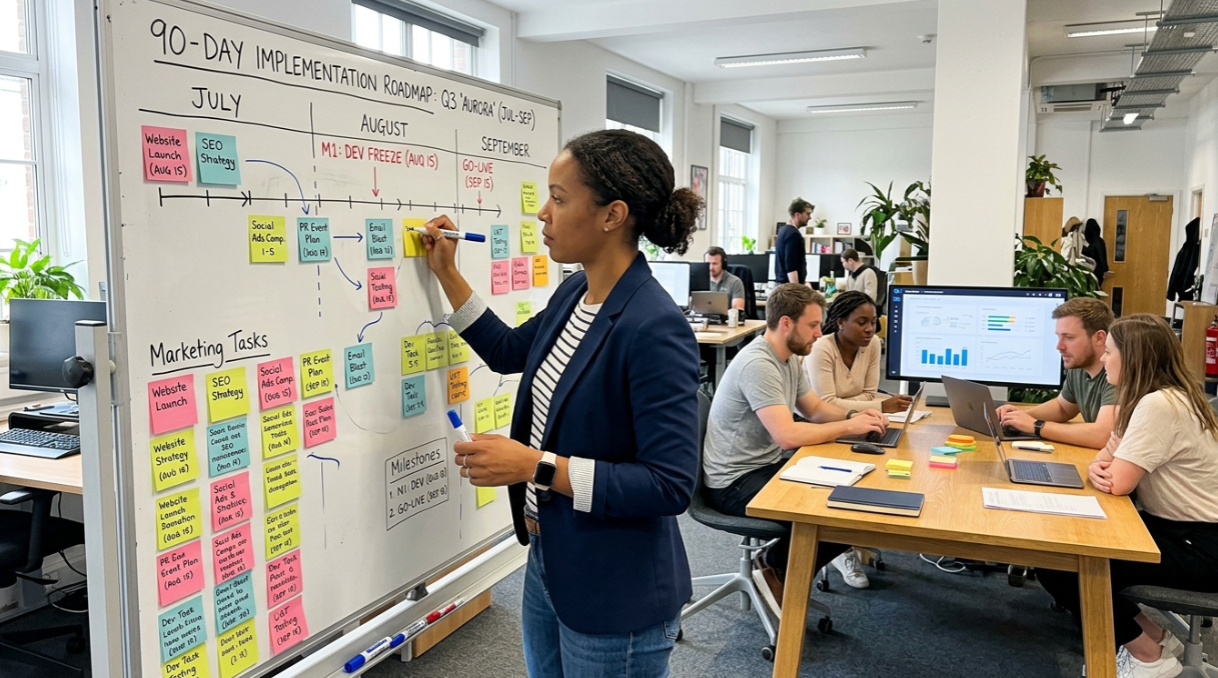
A good affiliate program management company follows a predictable onboarding arc. Knowing this timeline helps you hold them accountable.
Weeks 1 to 2: Audit and discovery. The agency audits your existing program (or competitive landscape if you’re starting fresh). They review your partner mix, commission structures, compliance gaps, and attribution setup. Expect a lot of data requests during this phase.
Weeks 3 to 4: Strategy and roadmap. You should receive a documented strategy covering target partner types, commission tiers, competitive positioning, and a 90-day activation plan.
Weeks 5 to 8: Recruitment and activation. This is where the real work begins. The agency recruits publishers, negotiates placements, activates dormant partners, and begins content and creator outreach. Expect to see early partner applications and initial placements.
Weeks 9 to 12: Optimization cadence. By the end of the first quarter, you should have baseline performance data, an active recruitment pipeline, initial revenue attribution, and a clear optimization rhythm (weekly calls, monthly reporting, quarterly strategy reviews).
Geno Prussakov captures the dynamic well: in the most developed affiliate programs, “the success was always a result of teamwork, a collaborative effort between the OPM and the advertiser’s in-house team.” One of his clients put it plainly: “Be an active participant in your affiliate program. They can be a great extension of your marketing team, but unless you equip them with internal data, your journey to success may take longer.”
Timeline | Deliverables |
|---|---|
Days 1-14 | Program audit, attribution review, partner analysis |
Days 15-30 | Strategy development and commission planning |
Days 31-60 | Partner recruitment and publisher outreach |
Days 61-90 | Performance analysis and optimization |
If an agency cannot provide a documented 90-day roadmap, consider it a warning sign.
How to Choose an Affiliate Program Management Company
Use this framework to narrow your options.
Do you operate internationally?
Yes → Consider Acceleration Partners.
No → Continue.
Is Amazon a major sales channel?
Yes → Consider Hamster Garage or Versa Marketing.
No → Continue.
Do you need creator commerce and TikTok Shop support?
Yes → Consider Hamster Garage or DMi Partners.
No → Continue.
Is incrementality your primary concern?
Yes → Consider PartnerCentric.
No → Continue.
Are you spending less than $5,000 per month?
Yes → Consider Advertise Purple.
No → Continue.
Do you need traditional affiliate scale?
Yes → Consider Gen3 Marketing.
Buyer Checklist: Questions to Ask Before Signing
Before you commit to any affiliate program management company, ask these questions:
Can I meet my actual account manager before signing? Account manager quality is the #1 predictor of success across every review platform. If the agency won’t arrange this, that’s a red flag.
What is your methodology for measuring incrementality? If the answer is “we report on revenue,” push harder. You need to know whether they distinguish between sales they actually drove and sales that would have happened anyway.
Which emerging channels do you actively manage? TikTok Shop, Amazon affiliate, and AI search visibility are where the growth is. If the agency doesn’t have documented capabilities here, they’re running a 2020 playbook.
What does your partner recruitment process look like? Vague answers (“we reach out to relevant publishers”) are not enough. You want specifics: how many partners recruited per month, what activation rate they target, how they source content creators.
Can you share references from brands in my vertical and at my scale? Case studies on a website are marketing. A reference call with a current client is evidence.
What happens if my AM leaves? High turnover is endemic in agency life. Understand the transition protocol.
For a more comprehensive checklist, our RFP guide with scoring criteria gives you a ready-made evaluation template.
4 Red Flags to Watch for When Hiring an Affiliate OPM
When evaluating agency pitches, look out for these common industry warning signs to protect your margins:
Guaranteed Overnight Revenue Spikes: Affiliate marketing relies heavily on external publisher timelines and editorial calendars. Agencies promising immediate overnight revenue gains are often over-indexing on low-quality coupon extension sites that hijack your existing organic checkout traffic instead of driving net-new customers.
Refusal to Disclose Your Actual Account Manager: Many agencies use senior executives to close the deal, only to pass your daily execution to junior, entry-level associates post-signature. Insist on meeting the day-to-day operators before signing.
Vague Responses to Traffic Incrementality: If an agency cannot explain exactly how they track, isolate, and filter out non-incremental revenue (such as last-second coupon injections at checkout), they are likely inflating their reporting metrics at the expense of your profit margins.
Zero Capability in Modern Video Marketplaces: Affiliate marketing has migrated significantly toward creator-led channels like TikTok Shop and Amazon Live. An agency running exclusively on legacy coupon networks is running an outdated playbook.
FAQ
What’s the difference between an affiliate management company and an affiliate network?
An affiliate network (like CJ Affiliate, ShareASale, or Awin) provides the technology infrastructure: tracking links, payment processing, and a marketplace of publishers. An affiliate management company (OPM) provides the strategy and execution layer on top of that infrastructure. They recruit partners, negotiate placements, optimize commissions, monitor compliance, and actively grow your program. Most brands need both, but they serve very different functions.
How much does outsourced affiliate program management cost?
Monthly retainers typically range from $2,000 to $25,000+ depending on program size. Most agencies also charge a 5% to 15% performance override on affiliate-generated revenue. One-time setup fees of $2,000 to $10,000 are common. For brands generating under $80,000 per month in affiliate-attributed GMV, outsourcing is usually more cost-effective than hiring in-house.
When does it make sense to bring affiliate management in-house?
The approximate breakeven point is around $80,000 per month in affiliate-attributed gross merchandise value. Below that, the cost of a full-time hire ($80K to $130K loaded salary) plus platform fees ($1,500 to $3,000 per month) exceeds what most agencies charge. Above that threshold, consider a hybrid model: an in-house lead plus OPM support for recruitment and strategy.
What metrics should an affiliate management company report?
At minimum: revenue by partner type, new partner activations, click-to-conversion rate, average order value from affiliate traffic, commission costs as a percentage of revenue, and (critically) incrementality data showing how much revenue is truly net-new. The best agencies also report on partner mix diversification, content placement quality, and competitive benchmarking.
Can an OPM manage Amazon and TikTok Shop affiliates?
Some can, but most cannot. Traditional affiliate agencies built their expertise around networks like CJ and ShareASale. Amazon affiliate management and TikTok Shop affiliate management require different platform knowledge, creator relationships, and operational playbooks. Only a few agencies on this list (notably Hamster Garage, DMi Partners, and Versa Marketing for Amazon) have documented capabilities in these emerging channels.
What’s the difference between an affiliate management company and affiliate software?
Affiliate software (like Impact, PartnerStack, or Everflow) gives you a platform to track, attribute, and pay partners. An affiliate program management company gives you the people who use that software to build and grow your program. You typically need both. The confusion between the two is one of the biggest problems in this market, and it’s why many “best affiliate management” lists actually recommend software, not services.
How do I know if my current affiliate program is underperforming?
Common signs include: more than 50% of revenue coming from coupon or cashback partners, flat or declining revenue despite growing site traffic, a high ratio of dormant-to-active partners, no active recruitment pipeline, and an inability to answer whether affiliate sales are incremental. An affiliate program audit can diagnose these issues quickly.
How long does it take an affiliate management company to produce results?
Most programs require 90 to 180 days before meaningful performance trends emerge.
Can an affiliate program management company migrate my program to another network?
Yes. Most agencies can migrate affiliate programs between platforms such as Impact, CJ Affiliate, PartnerStack, ShareASale, and Awin.
What percentage of affiliate revenue should commissions represent?
Most affiliate programs allocate between 5% and 20% of revenue to publisher commissions, depending on margins and industry.
How many affiliates should an active program have?
Program size varies by industry, but most healthy programs continuously recruit new partners rather than relying on a fixed publisher count.
The affiliate channel influences roughly 16% of ecommerce sales in North America, and the Performance Marketing Association found that $9.1 billion in affiliate investment drove $71 billion in ecommerce sales in its most recent measurement period. The opportunity is massive. The question is whether your program is capturing its share.
Get in touch with Hamster Garage to find out what a properly managed affiliate program looks like for your brand.
Latest Articles

.svg)



















































.png)


.png)
.png)
.png)

.png)
.png)
.png)


.avif)

.svg)
