.svg)
Top 9 TikTok Shop Affiliate Agency Choices for 2026


.svg)
TL;DR
A TikTok Shop affiliate agency helps brands recruit creators, manage commissions, control samples, and turn affiliate content into profitable sales on TikTok Shop. Most “TikTok agencies” are really influencer or paid media shops that bolt on affiliate as an afterthought. The best fit depends on whether you need a managed partnership operator, a software platform, a paid media engine, or a marketplace-style commerce agency. This guide ranks nine options by service model, pricing signals, proof, and honest tradeoffs so you can choose based on what your business actually needs.
At a Glance: Top TikTok Shop Affiliate Agencies for 2026
To maximize ROI on TikTok Shop, brands are moving away from traditional influencer agencies and toward performance-driven affiliate partners. Based on service model, creator network size, and operational depth, here are the top choices:
Best Overall for Scaled Brands: Hamster Garage (Focus on incrementality and partner operations)
Best Software/Hybrid Choice: Trendio (AI-powered creator matching and CRM)
Best for Paid Media Integration: MuteSix (Scaling affiliate content via Shop Ads)
Best for Marketplace Sellers: BellaVix (Expertise in Amazon/Walmart expansion)
Best Enterprise Solution: Tinuiti (Full-funnel retail media integration)
Why TikTok Shop Affiliate Agencies Exist (and Why You Need One Now)
TikTok Shop is no longer a side experiment. When it launched in the U.S. on September 12, 2023, TikTok said more than 200,000 sellers had registered and over 100,000 creators were already participating in the affiliate program source. By mid-2025, TikTok reported U.S. Shop sales were up 120% year over year, with sellers listing more than 70 million products across 750+ categories source. Momentum Works pegged U.S. TikTok Shop GMV at $15.1 billion in 2025, a 68% jump from $9 billion the year before source.
The growth is real. But so is the operational mess.
Opening a TikTok Shop takes a few days. Building a repeatable, profitable creator affiliate engine takes months of recruiting, vetting, sample management, commission strategy, compliance monitoring, and performance analysis. That gap between “shop is live” and “shop is profitable” is exactly where a TikTok Shop affiliate agency earns its fee.
The problem? Most agencies ranking for this term are not actually TikTok Shop affiliate specialists. They are influencer agencies, paid social shops, or generic marketing firms that added “TikTok Shop” to their services page. The distinction matters because managing affiliates who sell on commission is fundamentally different from running a one-off influencer campaign.
What Is a TikTok Shop Affiliate Agency?
A TikTok Shop affiliate agency manages the seller side of TikTok’s built-in affiliate program. TikTok’s official affiliate page explains the model: sellers connect with creators, track sales and metrics, and commissions are automatically paid when a sale happens source. Creators recommend products in videos and LIVE streams, earning a cut of each sale they drive.
TikTok offers two collaboration modes. Open Collaboration lets any affiliate creator discover and promote your products. Target Collaboration lets sellers handpick specific creators that fit the brand. Most serious TikTok Shop affiliate agencies manage both, using Open Collaboration for volume and Target Collaboration for quality.
This is different from hiring an influencer agency. Influencer agencies negotiate flat fees for content. A TikTok Shop affiliate agency builds a performance channel where creators earn based on sales, which means commission strategy, creator economics, sample ROI, and profit reporting all become critical.
It is also different from hiring a paid social agency. TikTok allows sellers to use affiliate posts as ad creative through what it calls “affiliate creatives,” which can feed Video Shopping Ads and GMV Max campaigns source. But if the affiliate collaboration ends, ads using that creator’s content can pause. So an agency managing Shop Ads needs to also manage creator relationships and permissions, not just media budgets.
If your brand is new to affiliate program management fundamentals, understanding the basics of partner recruitment, payout structures, and program governance will help you evaluate agencies more critically.
Quick Comparison: Best TikTok Shop Affiliate Agencies
Agency | Best for | Model | Pricing signal | Main strength | Key tradeoff |
|---|---|---|---|---|---|
Hamster Garage | Scaled brands wanting performance partnership execution | Managed agency | Custom / contact-based | Affiliate program operations, incrementality, brand safety | No public pricing; selective intake |
Trendio | Software-assisted creator affiliate matching | Software / hybrid | From $149/mo (Starter) | AI-powered affiliate matching and CRM | Internal team still owns strategy |
MuteSix | DTC brands tying TikTok Shop to paid social | Paid media agency | Custom / mid-market+ | Creative production + paid amplification | Less affiliate-program-specific |
The Influencer Marketing Factory | Influencer-led campaigns with TikTok Shop layer | Influencer agency | From $20,000 project min | Creator storytelling and campaign execution | Mixed public reviews; premium pricing |
Ubiquitous | High-volume TikTok creator campaigns | Influencer agency | From $20,000/mo managed | Large creator network | Confirm TikTok Shop affiliate specifics |
Upfluence | In-house teams wanting creator discovery software | SaaS platform | From ~$478/mo | Influencer CRM and ecommerce integrations | Annual contracts; requires internal operator |
Blue Wheel | Marketplace brands needing ecommerce + TikTok Shop ops | Commerce agency | Custom / few thousand/mo | Multi-channel ecommerce management | Small, negative Trustpilot sample |
BellaVix | Amazon/marketplace sellers expanding to TikTok Shop | Marketplace agency | From $1,000+ project min | Marketplace operations expertise | TikTok Shop may be newer extension |
Tinuiti | Enterprise brands wanting TikTok Shop in full-funnel strategy | Enterprise agency | From ~$8,000/mo | Advanced attribution and retail media | Overkill for smaller sellers |
Best TikTok Shop Affiliate Agencies
1. Hamster Garage
Best for: Scaled brands that want TikTok Shop affiliates managed like a performance partnership channel, not an influencer experiment.
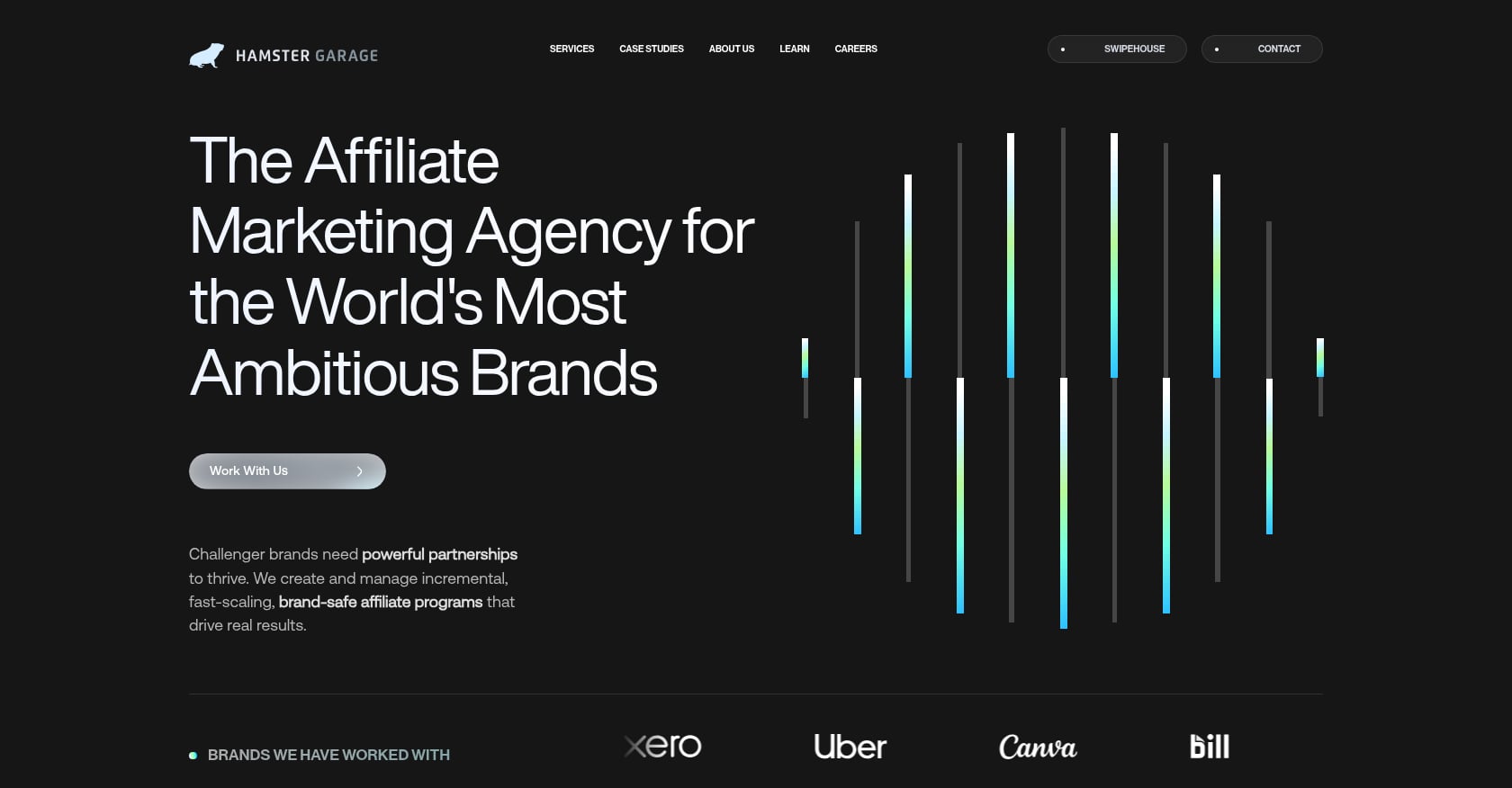
Hamster Garage is a managed growth agency that builds and operates affiliate and partnership programs. Its positioning as “The Affiliate Marketing Agency for the World’s Most Ambitious Brands” reflects a specific bet: that TikTok Shop affiliate is a partnership channel requiring the same rigor as traditional affiliate, including partner recruitment, commission economics, compliance, incrementality measurement, and brand safety.
The agency’s TikTok Shop Affiliates service is built around creator-centric commerce for brands launching or scaling on TikTok Shop. What sets it apart from most competitors on this list is that TikTok Shop is not treated as a standalone social media offering. It sits alongside affiliate marketing, Amazon affiliates, global partner marketing, and answer engine optimization, all managed by the same operator-led team. That means learnings from one channel feed the others.
Hamster Garage also has Swipehouse, a YC-backed platform for connecting brands and creators, which adds proprietary creator infrastructure that most agencies lack.
Pricing: Custom, contact-based. No public retainer tiers or packaged plans. Engagements are scoped to the brand’s needs.
Key features:
Managed TikTok Shop affiliate strategy and execution
Creator recruitment with partner quality and brand safety emphasis
Commission and payout strategy design
Compliance monitoring across affiliate content
Integration with broader affiliate, Amazon, and partner programs
Swipehouse creator/brand connection infrastructure
Operator-led model with senior attention (not a self-serve tool)
Proof: Hamster Garage’s affiliate case studies demonstrate the operating discipline that translates directly to TikTok Shop. The Oars + Alps case study shows how the agency drove a 309% sales increase in four months through recruitment, reactivation, payout restructuring, and fraud cleanup in the beauty category. The Redtiger Amazon case study shows 5,616% quarter-over-quarter affiliate revenue growth and $147.5K in incremental revenue through publisher diversification, a playbook that maps closely to TikTok Shop creator recruitment.
Tradeoffs:
No public pricing means you need a discovery call to understand cost
Boutique, selective model may not suit very small brands seeking cheap creator outreach
Not a full paid-social agency; best fit is when affiliate/partnership is strategically important
Brands that only need TikTok content production may prefer a UGC marketplace
Who should pick Hamster Garage: Brands that treat TikTok Shop affiliate as a serious revenue channel requiring the same partner management, commission optimization, and compliance infrastructure they would expect from any scaled affiliate program.
Talk to Hamster Garage about TikTok Shop affiliate management →
2. Trendio
Best for: Brands that want software-assisted creator affiliate matching with optional managed services.
Trendio sits between a pure SaaS tool and a full-service agency. Its platform offers AI-powered affiliate matching, a creator CRM, affiliate invite automation, and analytics dashboards. For teams with internal bandwidth, Trendio can accelerate creator discovery and outreach without requiring a full agency retainer.
A practitioner on Reddit mentioned Trendio as an app that can target thousands of affiliates weekly by matching them to a brand. That aligns with the platform’s positioning as a scale tool rather than a curated, white-glove service.
Pricing: Publicly listed. Starter at $149/month (monthly) or $119/month (annual); Plus at $249/$199; Pro at $449/$359; Managed tier is custom. Seven-day free trial available.
Key features:
AI affiliate matching by niche and performance signals
Creator CRM for managing outreach and collaboration
Affiliate invite volume scales by tier
Video editing AI credits
Managed tier adds product listing optimization, paid ads, promotions, shop health management, and dedicated account manager
Tradeoffs:
More platform than pure agency; your team still needs to own brand strategy, product economics, and final creator approvals
Does not offer in-house video production or bespoke influencer negotiations
Does not support TikTok Lives (per Trendio’s own comparison content)
Better for creator scale and automation than highly curated brand-safe partnerships
3. MuteSix
Best for: DTC brands with meaningful ad budgets that want TikTok Shop tied to paid social creative testing and amplification.
MuteSix is a performance marketing agency focused on DTC ecommerce. Its strength is combining creative production, media buying, and platform-specific commerce support. For brands already spending heavily on paid social, MuteSix can plug TikTok Shop into the broader acquisition engine so affiliate creator content feeds Spark Ads, Shop Ads, and GMV Max.
Now part of the Dentsu network, MuteSix offers enterprise-grade infrastructure and global scale that few boutique shops can match.
Pricing: Custom, mid-market to enterprise. Third-party sources list starting points ranging from $3,000/month to $10,000/month plus percentage of ad spend, while Clutch lists a $25,000+ minimum project size. Verify scope directly.
Key features:
TikTok Shop setup and commerce support
Affiliate creator programs
Spark Ads and paid social amplification
Creative production and testing
Media buying and analytics
DTC performance marketing infrastructure
Tradeoffs:
Better fit for paid-media-led growth than pure affiliate/partnership governance
Large agency structure may mean less senior attention on affiliate specifics
Pricing and scope vary widely; ask who manages affiliate recruiting versus media buying
Not built around commission economics and creator-level profit reporting
4. The Influencer Marketing Factory & Ubiquitous
Best for: Enterprise brands seeking high-production storytelling and massive creator reach.
These two agencies represent the "heavy hitters" in the space. The Influencer Marketing Factory is known for high-polish creative narratives, while Ubiquitous leverages a massive data-driven creator network to achieve high-volume recruitment quickly.
Pricing: Premium (Typically $20,000+ per month or project minimum).
Main Strength: End-to-end white-glove campaign management and high-quality UGC production.
Key Tradeoff: Because they often operate on a flat-fee campaign basis, you must ensure the TikTok Shop affiliate/commission technicalities (sample tracking and Seller Center ops) are explicitly managed, rather than just "views."
6. Upfluence
Best for: In-house marketing teams that want software for creator discovery, outreach, and ecommerce-integrated affiliate tracking.
Upfluence is a SaaS platform, not an agency. It gives brands tools to find creators, manage outreach, track affiliate sales, and connect influencer work to ecommerce platforms like Shopify. For teams that have internal marketing operators and want to run TikTok Shop affiliates themselves with better tooling, Upfluence fits.
Pricing: G2 lists starting prices at $478/month for the Search and Contact module. Vendr reports a median buyer price of $15,000/year.
Key features:
Influencer and creator discovery database
Creator outreach and CRM
Ecommerce integrations (Shopify, Klaviyo)
Campaign and affiliate workflow management
Sales tracking and analytics
User sentiment: G2 shows 4.6 out of 5 from 140 reviews, with praise for creator sourcing, filters, and workflow tools. Reddit sentiment is more cautious. Multiple users on Reddit report annual contract lock-in and difficulty canceling, which is a common risk with SaaS platforms in this category.
Tradeoffs:
Not a replacement for a senior affiliate manager or TikTok Shop strategist
Software only works if someone internally owns outreach, creator approvals, offer testing, and analysis
Annual contract risk, as flagged by community discussions
May become expensive as creator databases or outreach volume scale
7. Blue Wheel Media
Best for: Marketplace and ecommerce brands that want TikTok Shop managed alongside Amazon, retail media, and paid social.
Blue Wheel positions itself as a multi-channel ecommerce agency. For brands selling across Amazon and retail media that want to add TikTok Shop without hiring a separate specialist, Blue Wheel can fold it into broader ecommerce operations.
Pricing: Third-party sources list starting points at a few thousand dollars per month. Verify scope and deliverables directly.
Key features:
TikTok Shop management and product listing optimization
Creator campaigns
Paid social
Marketplace and retail media support
Multi-channel ecommerce operations
Tradeoffs:
Public review sample is very small but negative on Trustpilot (2.9 from 2 reviews, both 1-star)
May be more marketplace/ecommerce generalist than TikTok Shop affiliate specialist
Ask about contract terms, cancellation flexibility, and dedicated TikTok Shop team experience
Better for larger omnichannel brands than small TikTok Shop entrants
8. BellaVix
Best for: Amazon, Walmart, and Target sellers who want to expand into TikTok Shop without losing their marketplace discipline.
BellaVix comes from the marketplace management world. If you think in inventory, product listings, PPC, and retail operations, BellaVix speaks your language. Their TikTok Shop services extend that marketplace mindset to a new channel.
For brands already managing Amazon affiliate programs, BellaVix offers a familiar operational framework adapted for TikTok Shop.
Pricing: Clutch lists a minimum project size of $1,000+ and hourly rates of $150 to $199. Reviewed client investments ranged from $2,000 to $65,000.
Key features:
Marketplace management background (Amazon, Walmart, Target)
Product listing and advertising expertise
TikTok Shop as a marketplace expansion play
Inventory and margin awareness
User sentiment: Clutch shows a 5.0 rating from 32 reviews, with themes of timely delivery, proactive work, and marketplace knowledge.
Tradeoffs:
TikTok Shop affiliate may be an extension of marketplace services rather than the agency’s original core expertise
Less obvious fit for enterprise affiliate or partnership teams
Ask how many TikTok Shop affiliate programs they actively manage and how they handle creator recruitment, samples, and Shop Ads
9. Tinuiti
Best for: Enterprise brands that want TikTok Shop integrated into a full-funnel performance marketing strategy alongside retail media, paid search, and paid social.
Tinuiti is a large performance marketing agency built for enterprise accounts. If your brand has complex reporting needs, large media budgets, and wants TikTok Shop treated as one piece of a broader acquisition strategy, Tinuiti has the infrastructure.
Pricing: Third-party sources list TikTok ecommerce/ads work starting from approximately $8,000/month. Enterprise pricing is custom.
Key features:
Enterprise paid media and performance marketing
Full-funnel strategy and advanced attribution
TikTok Shop and shopping campaign support
Retail media context (Amazon, Walmart, Target)
Large-account management infrastructure
Tradeoffs:
Likely overkill for smaller TikTok Shop sellers
Large agency teams can mean less senior, hands-on attention unless you contract for it specifically
More performance-media oriented than affiliate-program-management oriented
Ask whether TikTok Shop affiliate operations are handled by a specialist team or folded into paid social
How to Choose the Right TikTok Shop Affiliate Agency
The right agency depends on the operating problem you need solved. Here are five models and when each fits.
Model 1: Managed affiliate/partnership operator. Best when you care about incrementality, contribution margin, brand safety, and compliance. You want partner recruitment, payout strategy, and reporting. TikTok Shop is part of a broader affiliate or creator partner program. Best fit: Hamster Garage.
Model 2: TikTok Shop commerce agency. Best when you need shop setup, product listings, creator activation, Shop Ads, and daily Seller Center operations. You are earlier in your TikTok Shop journey and need the storefront working before optimizing affiliate economics. Best fit examples: Blue Wheel, BellaVix.
Model 3: Software/hybrid creator platform. Best when you have internal execution bandwidth and want faster creator discovery, outreach automation, and analytics. You are willing to own strategy while the tool handles workflow. Best fit examples: Trendio, Upfluence.
Model 4: Influencer campaign agency. Best when you need creator storytelling, UGC, product launches, and fixed-fee creator campaigns. TikTok Shop is the conversion endpoint but not the primary optimization goal. Best fit examples: The Influencer Marketing Factory, Ubiquitous.
Model 5: Full-funnel paid media agency. Best when TikTok Shop is one piece of a larger acquisition strategy. You have strong ad budgets and want affiliate creator content amplified through Spark Ads, Shop Ads, and GMV Max. Best fit examples: MuteSix, Tinuiti.
What is a TikTok Affiliate Partner (TAP)?
Unlike a standard marketing agency, a TAP is a certified entity within the TikTok ecosystem specifically focused on driving GMV through the Creator Affiliate Plan. While an influencer agency focuses on brand awareness, a TAP focuses on conversion volume, sample management, and creator-led commerce.
TikTok Shop Affiliate Agency Pricing: What to Expect
Pricing is not standardized across TikTok Shop affiliate agencies, and public information is inconsistent. Here is what the market looks like based on third-party sources.
Software platforms start in the low hundreds per month. Trendio’s Starter tier is $149/month. Upfluence begins around $478/month for basic modules, with median annual buyer spend around $15,000 per Vendr data.
Managed services typically start in the thousands. Third-party listings show TikTok ecommerce agency pricing ranging from about $1,000/month to $8,000/month depending on scope. Marketplace-style agencies like BellaVix list minimum project sizes starting at $1,000+.
Enterprise influencer and paid social agencies command premium minimums. The Influencer Marketing Factory starts at $20,000 per project. Ubiquitous managed services reportedly start at $20,000/month. MuteSix lists a $25,000+ minimum project size on Clutch.
But here is what most pricing discussions miss: the agency fee is only one part of the cost stack. A TikTok Shop affiliate sale involves TikTok’s standard referral fee, which stabilized at 8% for most categories in 2025—plus affiliate commissions (commonly 10% to 20%), sample costs, shipping, and returns. Total channel load often ranges from 30% to 45% of the selling price.
Understanding how to measure affiliate ROI properly is essential before committing to any agency. GMV is not profit. A serious agency should report creator-level and SKU-level performance after all costs, not just top-line sales volume.
Cost Component | Typical Percentage/Rate | Responsibility |
TikTok Referral Fee | 6% - 10% | TikTok Platform |
Creator Commission | 10% - 20% | Brand/Agency |
Sample & Shipping | 5% - 8% | Brand |
Agency Management Fee | $2k - $20k/mo | Brand |
Total Channel Load | 30% - 45% of GMV | Strategic Total |
What a Good TikTok Shop Affiliate Agency Should Actually Manage
Practitioners on Reddit repeatedly surface a gap between what agencies promise and what the channel requires. One seller running roughly $30,000/month in TikTok Shop GMV with about 15 active affiliates asked how to track which creators are actually profitable after samples, commission, returns, and per-creator ROI, noting that TikTok’s “Manage Creators” dashboard shows GMV but not profit contribution source.
A capable TikTok Shop affiliate agency should manage all of the following:
Product and SKU selection for affiliate promotion, prioritizing high-margin products with visual demonstration value
Commission strategy by SKU, creator tier, and campaign type
Open and Target Collaboration management in Seller Center
Creator discovery and vetting based on GMV history, category relevance, audience match, and compliance record
Sample governance: who qualifies, how many units per campaign, posting obligations, and cost tracking
Creator briefs with approved claims, demos, and “what not to say” guidance
Claim compliance to avoid violations around pricing accuracy, health claims, and misleading endorsements
Affiliate creative authorization for Shop Ads and GMV Max, including managing what happens when collaborations end
Return-adjusted profit reporting at the creator and SKU level
Creator retention through tiered access, repeat collaborations, and product drop calendars
Brand safety, including policies on AI-generated affiliate content
For brands concerned about affiliate traffic quality, these operational details are the difference between a growing channel and a money pit.
Red Flags When Evaluating a TikTok Shop Affiliate Agency
Brand-side buyers on Reddit share real frustrations. One commenter described a beauty and skincare client that had a poor experience with an agency because affiliates were a random mix of ages and genders, the brand could not control who submitted sample requests, and the agency did nothing to vet creator fit source. Another seller reported contacting hundreds of creators and getting only five or six acceptances, three pieces of content, and no meaningful dedication source.
Watch for these red flags:
They talk about views and reach but not creator-level sales
They report GMV but never discuss profit, returns, or contribution margin
They cannot explain the difference between Open Collaboration and Target Collaboration
They have no sample approval process and approve every creator “to increase reach”
They ignore product claim compliance and price accuracy rules
They cannot explain affiliate creative authorization for Shop Ads
They cannot show recent TikTok Shop case studies with measurable outcomes
They promise virality
They have no policy on AI-generated affiliate content (a growing brand safety concern, as discussed in TikTok Shop communities on Reddit where brands are pushing back against AI avatars endorsing products they have never tried source)
They require long contracts without clear deliverables or exit clauses
They cannot define who owns creator relationships and content usage rights
They do not understand returns, refunds, or shop health metrics
They rely on follower count as the primary creator selection criterion
Understanding affiliate fraud detection and prevention helps you ask sharper questions during agency evaluation.
20 Questions to Ask Before Signing With a TikTok Shop Affiliate Agency
How many TikTok Shop affiliate programs do you currently manage?
Are you seller-side, creator-side, or both?
Do you manage Open Collaboration, Target Collaboration, or both?
How do you vet creators before approving samples?
What creator performance data do you use: GMV, units sold, category history, recent content, audience geography, return rate?
Do you report profit by creator after samples, commissions, returns, fees, and ad spend?
How do you set commission rates by SKU and creator tier?
Do you manage affiliate creative authorization for Shop Ads and GMV Max?
What happens when a creator ends collaboration and ads using their content pause?
How do you prevent misleading claims, price errors, and prohibited product claims?
What is your AI-generated content policy for affiliates?
How do you handle creators who take samples but never post?
What is your sample budget recommendation for our category?
Do you optimize product listings and TikTok Shop search?
Do you coordinate inventory planning with creator campaign timing?
How often do you report, and what metrics are included?
Can you provide references in our specific category?
What work is handled by senior staff versus junior coordinators?
What is the contract term and cancellation clause?
What is explicitly not included in the retainer?
Should You Hire an Agency, Use Software, or Manage In-House?
Option | Best when | Pros | Cons |
|---|---|---|---|
Hire an agency | You need speed, creator access, and execution | Faster learning curve, managed operations, outside relationships | Higher cost, quality varies |
Hire an in-house affiliate manager | You want long-term control | Deep brand knowledge, dedicated focus | Hiring risk, slower ramp, one person may lack creator network |
Use software/platform | You have internal bandwidth | Lower monthly cost, scalable workflows | Still requires strategic skill and daily operator time |
Use a creator marketplace only | You need content or one-off creators | Fast sourcing | Weak long-term program management |
Do nothing / organic only | You are validating product-market fit | Low cost | Hard to scale creator sales consistently |
Practitioners on Reddit are confused by the labels. In a thread asking for agency recommendations, commenters explained that brands can hire an affiliate manager, a regular agency, or a TAP (TikTok Affiliate Partner), while warning to make sure any “regular agency” is actually a TikTok Shop Partner. Others noted that many agencies listed in TikTok’s Partner Center focus on traditional creator endorsements rather than ongoing TikTok Shop affiliate sales source.
The takeaway: “TikTok Shop agency,” “TikTok Shop Partner,” “Creator Agency Partner,” and “influencer agency” are not interchangeable terms. Clarify what you are buying before you sign.
When You Should Not Hire a TikTok Shop Affiliate Agency Yet
Skip the agency if:
Your product has margins too thin to absorb 30 to 45% in total channel costs
You cannot fulfill orders quickly enough for TikTok Shop’s shipping expectations
You have no sample budget
Your product page has poor reviews or unclear claims
Your category has strict compliance requirements and you have no approved claim library
You cannot handle sudden demand spikes from a viral creator post
You expect creators to sell a product with no clear differentiation or visual appeal
You only want cheap UGC, not affiliate-driven sales
You do not know your target contribution margin per sale
A TikTok Shop affiliate agency is a performance partner, not a rescue plan. Fix unit economics and fulfillment first.
The Creator Flywheel: How the Best TikTok Shop Affiliate Programs Scale
The agencies that produce lasting results for brands follow a cycle, not a checklist.
Hero SKU selection. Pick products with strong margins, visual demonstration value, simple claims, and creator appeal.
Offer design. Set commissions, promos, bundles, and sample rules before recruiting anyone.
Creator segmentation. Split creators into category sellers, customers who already love the product, niche experts, micro-creators, high-GMV affiliates, LIVE sellers, and UGC creators.
Sample governance. Approve samples based on creator fit and expected content output, not request volume.
Content activation. Give creators angles, approved claims, demo guidance, and explicit “what not to say” rules.
Affiliate creative amplification. Turn winning creator content into Shop Ads or GMV Max campaigns where rights allow.
Profit reporting. Measure creator-level contribution after all costs, not just GMV.
Commission optimization. Increase payouts for profitable creator cohorts. Cut waste from low-quality sample seekers.
Creator retention. Build repeat relationships through early access, higher commission tiers, and product drop calendars.
Channel expansion. Feed learnings into Amazon affiliates, content publishers, paid social, email, and broader partner marketing.
Understanding affiliate attribution helps you measure each step of this flywheel accurately, especially when organic creator sales overlap with paid amplification.
This flywheel is why the strongest TikTok Shop affiliate agencies treat the channel as a partnership program with a content layer, not a content program with a purchase link.
Frequently Asked Questions
What does a TikTok Shop affiliate agency do?
A TikTok Shop affiliate agency manages the seller side of TikTok’s affiliate program. This includes recruiting creators, setting commission rates, managing samples, vetting content for compliance, authorizing affiliate creatives for paid ads, and reporting on creator-level profitability. The best agencies also handle product selection, Shop Ads amplification, and ongoing creator relationship management.
How much does a TikTok Shop affiliate agency cost?
Costs vary widely. Software platforms start around $119 to $478 per month. Managed agency services typically range from a few thousand dollars per month for smaller engagements to $20,000+ per month for enterprise influencer or paid media agencies. The agency fee is only part of the cost; factor in TikTok’s referral fees, commissions, samples, shipping, returns, and ad spend.
Is a TikTok Shop affiliate agency different from a TikTok influencer agency?
Yes. An influencer agency negotiates flat fees for creator content. A TikTok Shop affiliate agency builds a commission-based sales channel where creators earn from actual purchases. The operational requirements are different: affiliate agencies manage Seller Center, commission strategy, sample workflows, product compliance, and profit reporting, not just content briefs and deliverables.
Should I use Open Collaboration or Target Collaboration?
Most brands benefit from both. Open Collaboration gives you volume by letting any affiliate discover your products. Target Collaboration gives you quality by letting you handpick creators who match your brand. A strong agency manages both modes, using Open for discovery and Target for high-value partnerships.
Can affiliate creator videos be used in TikTok ads?
Yes. TikTok allows sellers to use affiliate posts as video sources for Video Shopping Ads and GMV Max campaigns through affiliate creative authorization source. However, if the affiliate collaboration ends, ads using that creator’s content can pause. Agencies need to manage both the creative pipeline and the creator relationship to keep ads running.
How do I know if TikTok Shop affiliate sales are profitable?
GMV is not profit. Calculate profitability per creator and per SKU after subtracting COGS, TikTok referral fees, affiliate commissions, sample costs, shipping subsidies, returns, paid amplification spend, and agency fees. If your agency only reports GMV, you do not have visibility into what matters.
Do TikTok Shop affiliate agencies manage samples?
The best ones do. Sample governance is one of the biggest operational gaps. Agencies should have a process for who qualifies for samples, what creator signals matter before approval, how many units are budgeted, what posting obligations exist after acceptance, and how freebie seekers are filtered out.
Should I hire an agency or manage TikTok Shop affiliates in-house?
Hire an agency if you need speed, creator access, and proven execution frameworks. Manage in-house if you have a dedicated operator who can spend significant daily time on recruitment, samples, compliance, and reporting. Use software if you want a middle path. For most brands scaling past initial launch, a managed agency paired with internal product and brand expertise produces the fastest results.
For brands ready to treat TikTok Shop affiliate as a serious performance partnership channel, not a social media afterthought, Hamster Garage’s team can scope what a managed program looks like for your category, margin model, and growth targets. Start a conversation here.
Latest Articles

.svg)





















































.png)


.png)
.png)
.png)

.png)
.png)
.png)


.avif)

.svg)
