.svg)
TikTok Shop Affiliates: 10 Best Management Options 2026

.svg)
TL;DR
TikTok Shop affiliates now drive 42% of US GMV on the platform, making creator-led commerce the single largest sales channel. But most brands recruit hundreds of creators and watch only a handful post. This guide compares 10 management options, from managed agencies to SaaS tools to DIY, ranked by how well they solve the real problem: recruiting, retaining, and profitably scaling TikTok Shop creators. If you’re a brand doing $100K+ in monthly GMV and want affiliate-first management, talk to Hamster Garage about your program.
Why TikTok Shop Affiliates Matter More Than Ever
TikTok Shop’s US sales hit $15.82 billion in 2025, growing 108% year over year. The platform went from 4,450 active shops in mid-2023 to 475,000 by 2026. That’s a 5,000% increase in roughly two years, faster seller growth than any major commerce platform has ever recorded.
The affiliate channel sits at the center of this growth. Roughly 42% of TikTok Shop’s US GMV flows through affiliate creator content, with over 800,000 US-based creators actively monetizing through the program. Tarte Cosmetics reportedly generated over $40 million in TikTok Shop revenue last year, and 88% of it came from affiliate creators.
Yet most brands running TikTok Shop affiliate programs aren’t seeing results like that. Practitioner communities tell a different story. As one agency evaluator put it: “We recruited 200 creators last month. How many posted? Twelve.” That’s not an outlier. Creator rosters churn at 58% within 90 days. The gap between setting up an affiliate program and actually making it work is enormous.
This guide compares the best options for managing TikTok Shop affiliates, organized by service model so you can pick the right approach for your stage and budget.
Quick Takeaway: How to Scale TikTok Shop Affiliates Profitably
To successfully scale a TikTok Shop affiliate program, brands must shift from vanity metrics (GMV) to contribution margins per SKU. The ultimate goal is moving high-performing creators from Open Collaboration (10-15% discovery rates) to Targeted Collaboration (18-30% performance rates), while mitigating channel leak.
The Golden Metric: Network diversification (maintaining 30+ active mid-tier creators) to eliminate single-creator revenue dependency.
The Retention Strategy: Automated commission escalation tiers linked to sales milestones to suppress the platform's 58% 90-day creator churn rate.
The Financial Load: Factor in the 6% unified TikTok referral fee, sample fulfillment, and a 20% return administration fee on processing costs to protect bottom-line ROI.
At-a-Glance Comparison Table
Option | Service Model | Best For | Starting Price Signal | Affiliate Specialization | Creator Network Scale | Key Differentiator |
|---|---|---|---|---|---|---|
Hamster Garage | Managed agency | Scaled brands ($100K+ GMV) | Custom (contact for scope) | High | Swipehouse marketplace | Affiliate-first economics |
TikTok Affiliate Center | Native tool (DIY) | Brands validating PMF | Free | Low | TikTok marketplace only | Zero cost to start |
Advertise Purple | Large affiliate agency | Mid-market, multi-channel | ~$2,000/mo | Medium | 515K+ affiliate partners | Broad affiliate network |
Pattern | Full-service ops | Omnichannel (Amazon + DTC + TikTok) | Enterprise pricing | Medium | Integrated partnerships | End-to-end operations |
Social Snowball | SaaS platform | DTC brands on Shopify | SaaS subscription | Medium | Brand-built | Unified DTC + TikTok affiliates |
Euka | AI-powered CRM | High-volume outreach | SaaS subscription | Low | AI-sourced | Automated creator discovery |
Blue Wheel | TikTok Shop operator | E-commerce brands, TikTok-central | Agency pricing | Medium | Platform partnerships | Former TikTok team members |
House of Marketers | Influencer-first agency | Fashion, beauty, lifestyle | Agency pricing | Low | Global 75+ team | TikTok EMEA alumni |
AFM Agency | TikTok-native specialist | Consumer brands | Agency pricing | Medium | TikTok-focused | Deep platform specialization |
In-House Team | DIY with tools | Brands with internal talent | Tool costs only | Varies | Self-built | Full control |
How TikTok Shop Affiliates Work: A Quick Primer
Before evaluating management options, it helps to understand what you’re actually managing. TikTok Shop offers three collaboration types for brands working with creators.
Open Collaboration is TikTok’s marketplace model. You set a commission rate (most brands land between 10% and 15%), and any eligible creator can pick up your products and promote them. Think of it as a discovery engine. Conversion rates on open creator content average 2% to 4%.
Targeted Collaboration is invite-only. You select specific creators and negotiate individual commission rates, typically 18% to 30%. These partnerships convert significantly better, hitting 8% to 12% in many cases, because you’re working with creators who already have audience-product fit.
Shop Ads let you amplify creator content through paid placement. The commission rate for Shop Ads should be at least one-third of your standard affiliate rate.
What most guides skip is the full cost picture. TikTok charges a unified referral fee of 6% for most major retail categories (which includes marketplace access and payment processing) on top of your affiliate commissions. Add sample costs, shipping, and returns, and total channel load often runs 30% to 45% of the selling price. Furthermore, TikTok retains a 20% refund administration fee (capped at $5/SKU) on the original platform fee during returns. A creator with a 20% return rate turns your “20% commission” into an effective cost of 26.6% of net retained revenue. If you’re not building this into your affiliate ROI calculations, you’re making decisions with incomplete data.
One operational detail that catches brands off guard: TikTok gives creators a grace period on commission rate decreases. If you cut rates on an Open Collaboration, creators keep the original rate for 30 days. However, for Targeted Collaborations, a rate reduction takes effect much faster—exactly 5 days after you edit the campaign. This means commission changes need to be calculated and executed with strict timelines in mind.
For a deeper look at how affiliate program management works across channels, including TikTok Shop, the fundamentals of recruitment, activation, and optimization apply universally.
What to Look for in a TikTok Shop Affiliate Partner
Not every agency or tool calling itself a “TikTok Shop specialist” actually is. As one practitioner evaluator noted: “Every agency suddenly became a TikTok Shop specialist, every deck promised scale, and very few could explain how they’d run the channel once the first batch of creator videos went live.”
Here’s what separates real affiliate management from marketing theater.
Commission strategy expertise. Your partner should understand commission elasticity, how rate changes affect creator behavior, and how to set escalation tiers (for example, 12% for 0-10 sales, 15% for 11-50, 20% for 50+). This is affiliate economics, not influencer marketing.
Creator recruitment depth. The top 0.5% of creators (about 4,000 accounts) drive 38% of affiliate GMV. But single-creator dependency is the most common margin-killing mistake. Analytics practitioners recommend building a diversified network of 30+ mid-tier creators to spread risk.
Sample management. Sending products to creators is operationally messy at scale. Agencies managing 50 to 500 creators simultaneously need real systems for tracking samples, fulfillment, and inventory allocation.
Compliance awareness. Practitioners at major affiliate agencies report that the most frequent rejection among creator applicants is an unresolved Community Guidelines strike, not follower count. Your partner needs to screen for this. Related: understanding affiliate fraud detection matters here too.
Profit-level reporting. Most agencies report GMV. That number means nothing without knowing creator-level profitability after commissions, samples, returns, and platform fees. GMV is vanity. Contribution margin per SKU is the metric.
Creator retention playbook. If your partner can’t explain how they keep creators posting after the first video, walk away. The 58% churn rate exists because most programs have no retention strategy at all.
The 10 Best TikTok Shop Affiliate Management Options
1. Hamster Garage
Best for: Scaled brands ($100K+ monthly GMV) that want TikTok Shop affiliates managed with the same rigor as a mature affiliate program.
Hamster Garage is an affiliate-first agency, not a generalist TikTok content shop. The distinction matters. While most competitors bolt affiliate management onto broader TikTok Shop services (paid media, live shopping, organic content), Hamster Garage treats creator affiliate marketing as a standalone discipline with its own economics.
Key capabilities:
Commission economics management including elasticity testing and CPA reduction
Creator recruitment through Swipehouse, a YC-backed creator marketplace purpose-built for scale
Cross-channel coordination across TikTok Shop, Amazon, and DTC affiliate programs
Integration with broader partnership tech stacks (Impact Platinum Partner, PartnerStack Gold Partner)
Incrementality-focused reporting that goes beyond surface-level GMV
Pricing: Custom, scoped per engagement. No public tiers.
Proof: While TikTok Shop is a newer service line, the affiliate operations rigor is demonstrated across their portfolio. The Redtiger case study shows +5,616% quarter-over-quarter affiliate revenue on Amazon, and the Oars + Alps engagement delivered +309% sales in four months through recruitment, reactivation, and compliance cleanup.
Tradeoffs:
Boutique team (11-50 employees), which means selective client intake
Not the right fit for brands under $50K monthly GMV who need a lower-cost entry point
No public pricing, so brands must go through a consultation process
Why it stands out: The cross-channel expertise is the structural advantage. Brands selling on TikTok Shop also sell on Amazon and DTC. Hamster Garage manages affiliate programs across all three, which means commission strategy, creator allocation, and halo-effect measurement can be coordinated rather than siloed. See all Hamster Garage services for the full picture.
2. TikTok Shop Affiliate Center
Best for: Brands validating product-market fit on TikTok Shop before investing in external help.
The Affiliate Center is TikTok’s native tool inside Seller Center. Every seller starts here. It’s where Open Collaborations and Targeted Collaborations live, where commissions are set, where creator search happens, and where basic performance data appears.
Key capabilities:
Set up Open and Targeted Collaboration campaigns
Basic creator search and filtering
Commission rate management
Performance dashboards with sales and order data
Pricing: Free (included with Seller Center access).
Tradeoffs:
No outbound creator recruitment tools; you’re waiting for creators to find you
No sample management or fulfillment tracking
Analytics are surface-level, with no profit-level reporting
No creator retention features or automated follow-up
Becomes unmanageable once you’re working with more than 20 to 30 creators
Why it matters: This is the baseline. Understanding what the native tools can and can’t do helps you evaluate what you’re actually paying for when you hire an agency or subscribe to a SaaS platform.
3. Advertise Purple
Best for: Mid-market brands wanting affiliate management across multiple channels, including TikTok Shop.
Advertise Purple is one of the larger affiliate agencies, with a broad network of over 515,000 affiliate partners and $4.64 billion in generated revenue across their history. TikTok Shop is part of their offering, though it sits within a broader affiliate management practice.
Key capabilities:
Creator recruitment across affiliate networks
TikTok Shop setup and strategy
Multi-channel affiliate management
Content studio support
Pricing: One of the more accessible agency price points. One Clutch reviewer mentioned a project cost of approximately $2,000/month, though pricing varies by scope.
Tradeoffs:
Generalist affiliate agency, so TikTok Shop is an add-on rather than the core specialty
Mixed reviews on strategic depth. One Clutch reviewer reported the agency “failed to create a strategy, understand the business, and drive opportunities within the industry”
May lack the TikTok-specific operational knowledge (commission lock rules, Community Guidelines screening) that specialist agencies build into their workflows
4. Pattern
Best for: Omnichannel brands managing Amazon, DTC, and retail alongside TikTok Shop.
Pattern provides full-service e-commerce operations, not just affiliate management. Their TikTok Shop offering includes setup, operations, content creation, advertising, fulfillment, and affiliate management. For brands that need channel conflict controls and operational infrastructure across multiple marketplaces, Pattern covers a lot of ground.
Key capabilities:
End-to-end TikTok Shop operations
Cross-marketplace management (Amazon, DTC integration)
Content creation and advertising management
Fulfillment and logistics support
Tradeoffs:
Not a light test partner. The operational model is heavy and better suited for enterprise brands
Affiliate management is one piece of a much larger engagement
Less specialist depth in commission economics and creator retention compared to affiliate-first agencies
Enterprise pricing and commitment levels
5. Social Snowball
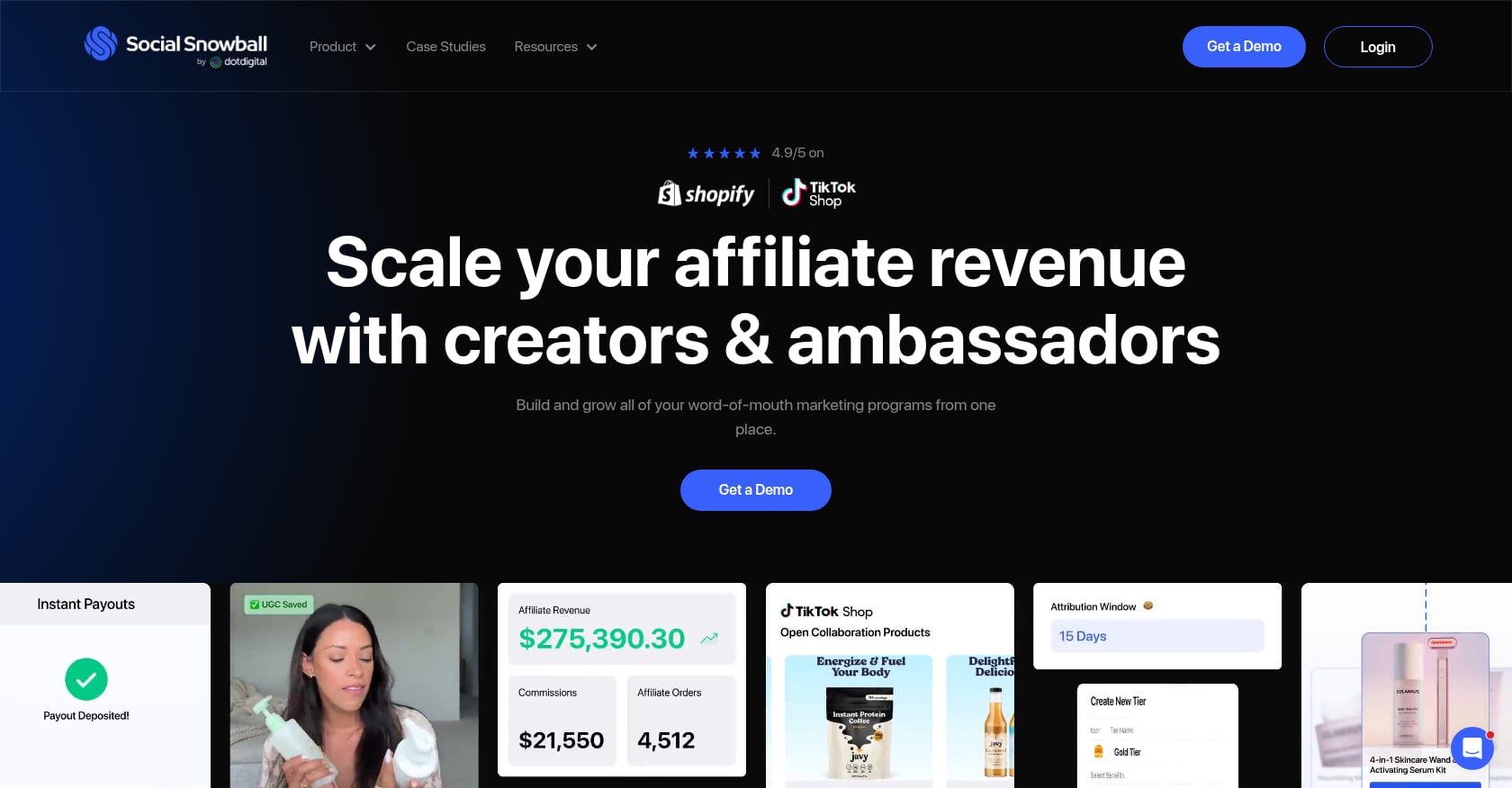
Best for: DTC brands on Shopify wanting to manage TikTok Shop and DTC affiliates from one platform.
Social Snowball is a SaaS tool, not a managed service. It provides a unified affiliate profile across TikTok Shop and your Shopify store, milestone-based commission escalation, and a content library for managing creator assets. Multiple users have praised its ease of use, with one calling it “the best affiliate marketing app.”
Key capabilities:
Unified affiliate profiles across TikTok Shop and DTC
Milestone-based commission escalation (automated tier increases)
Content library management
Shopify-native integration
Tradeoffs:
Software only. You still need to do strategy, outreach, and relationship management yourself
No managed creator recruitment or sample fulfillment
Limited value for brands not on Shopify
Best for brands with internal marketing capacity to run the program day-to-day
6. Euka
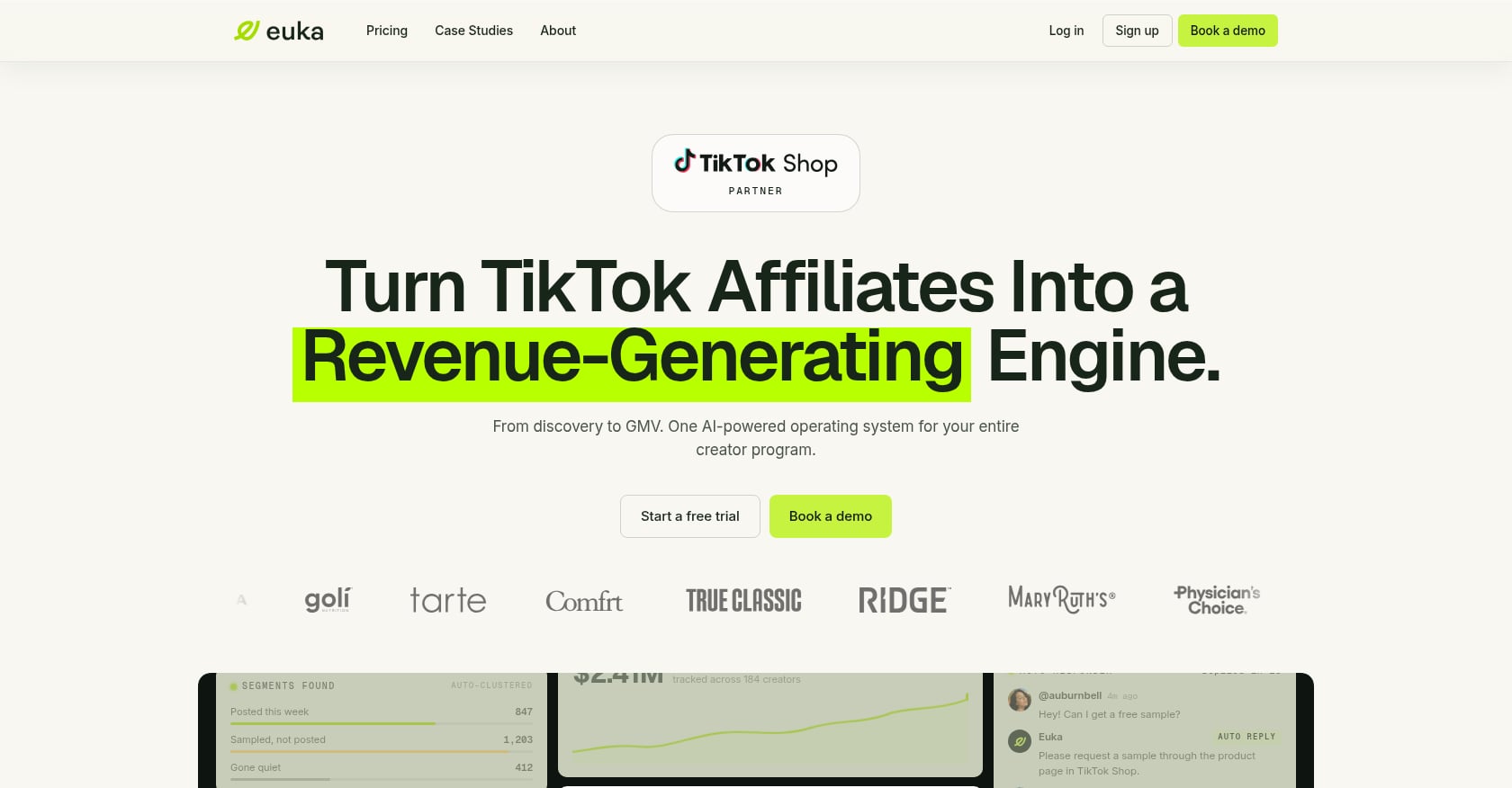
Best for: Brands that need automated outreach and sample tracking at massive scale.
Euka is an AI-powered creator CRM built for volume. It offers natural-language and visual creator search, dynamic audience segments, and automated outreach agents. One brand using the platform reported going “from a dozen creators we hand-managed to two thousand.”
Key capabilities:
AI-driven creator discovery (natural language and visual search)
Dynamic segmentation for targeting
Automated outreach sequences
Sample tracking and management
Tradeoffs:
Platform only, with no strategic consulting or commission optimization
The automation helps with recruitment volume but doesn’t solve creator retention
Requires in-house affiliate expertise to interpret data and make strategy decisions
Relatively new entrant, so track record is still developing
7. Blue Wheel
Best for: E-commerce brands where TikTok Shop is central to their revenue strategy.
Blue Wheel’s TikTok Shop management services are led by former TikTok team members, which gives them inside knowledge of platform mechanics and algorithm behavior. They cover creator matching, Shop Ads management, and full-funnel TikTok commerce.
Key capabilities:
TikTok Shop management from former TikTok insiders
Creator matching and affiliate coordination
Shop Ads management and optimization
Full-funnel commerce strategy
Tradeoffs:
Affiliate is one piece of a comprehensive TikTok Shop operation, not the primary focus
Less depth in affiliate economics (commission testing, incrementality measurement) than affiliate-specialist agencies
Stronger on content and paid amplification than on creator-level profitability reporting
8. House of Marketers
Best for: Fashion, beauty, and lifestyle brands prioritizing creator relationships over affiliate economics.
Co-founder Inigo Rivero worked at TikTok EMEA before launching House of Marketers, which gives the agency genuine platform pedigree. The team of 75+ operates across multiple regions. Beauty of Joseon reportedly saw 500% year-over-year sales growth working with them.
Key capabilities:
Global creator relationships with platform insider knowledge
Campaign strategy for fashion, beauty, and lifestyle categories
Multi-region execution
Strong creative direction
Tradeoffs:
Influencer-first, not affiliate-first. Flat-fee awareness campaigns may take priority over commission optimization
Less focus on incrementality measurement and economic modeling
Better for brands prioritizing reach and brand building than pure performance economics
9. AFM Agency
Best for: Consumer brands wanting a TikTok-first partner with deep platform specialization.
AFM Agency is built around TikTok. Their services span TikTok Shop management, affiliate management, creator video campaigns, daily live shopping, and creator live events. For brands that want a partner living and breathing TikTok every day, AFM’s specialization is the draw.
Key capabilities:
TikTok Shop management and setup
Affiliate program management
Creator video campaign production
Daily live shopping and creator live events
Tradeoffs:
TikTok-only focus, which means no cross-channel affiliate coordination with Amazon or DTC
Less established track record compared to larger agencies
May not have the broader partnership ecosystem expertise that brands scaling across channels will eventually need
10. In-House Team
Best for: Brands with internal talent willing to invest six or more months building the muscle.
Running TikTok Shop affiliates in-house gives you complete control over creator relationships, commission structures, and brand messaging. The tool stack typically includes TikTok Seller Center plus creator analytics platforms (Kalodata, FastMoss) and outreach tools.
Key capabilities:
Full control over strategy, execution, and economics
Direct creator relationships
No agency fees
Institutional knowledge stays in-house
Pricing: Tool subscription costs only (analytics platforms, outreach tools). Headcount is the real cost.
Tradeoffs:
Most in-house TikTok Shop operations hit a ceiling and bring help in by month six
Requires hiring or training someone with affiliate-specific expertise, not just social media skills
Creator recruitment and retention at scale is extremely time-intensive
No existing creator network to activate from day one
For a deeper comparison of the agency vs. in-house decision across affiliate programs generally, the economics and tradeoffs map closely to TikTok Shop specifically.
Guarding Margins: Affiliate Fraud Prevention and Compliance
Scaling to hundreds of affiliate creators introduces operational vulnerabilities that can quietly destroy a brand's ROAS (Return on Ad Spend) and account health if left unmanaged.
1. Identifying and Preventing Affiliate Fraud
The automated nature of open sample fulfillment has given rise to systemic sample collection fraud, where accounts request free products with zero intention of posting content.
The Fix: Work with an agency or utilize an advanced CRM tool to vet applicants for historical fulfillment-to-video conversion rates. Never auto-approve sample requests on accounts exhibiting low engagement rates relative to follower counts.
Arbitrage Monitoring: Ensure your partner checks for malicious duplicate coupon code distribution on third-party coupon aggregators, which shifts organic store traffic into credited affiliate payouts.
2. Navigating Community Guidelines Violations
TikTok utilizes highly sensitive, automated moderation loops to flag video content. If an affiliate creator uses prohibited phrases, unverified health claims, or copyrighted audio, the platform issues a Community Guidelines strike.
When a creator's video is shadowbanned or suppressed due to a guideline infraction, your associated product link loses visibility instantly.
An expert management partner must preemptively distribute sound legal and compliance briefs to your creator network, detailing forbidden claims and mandatory FTC disclosures (#Ad or #PaidPartnership) to safeguard both the video's reach and your shop's overall standing.
How to Choose: A Decision Framework by Brand Stage
The right option depends on where your TikTok Shop program sits today.
Under $50K monthly GMV: Start with TikTok’s native Affiliate Center. Layer in a SaaS tool like Social Snowball or Euka once you’ve validated product-market fit and need to scale outreach. Total monthly investment: tool subscription costs only.
$50K to $100K monthly GMV: This is the awkward middle. You’re generating enough volume that manual management breaks down, but the margin may not support a premium agency. A SaaS platform plus a freelance affiliate manager (or fractional hire) bridges the gap.
$100K+ monthly GMV: Managed services become the right call. The question is whether you need an affiliate operator (Hamster Garage) or a full TikTok Shop operations partner (Pattern, Blue Wheel). If affiliate is your primary growth lever, and the data says it drives 42% of GMV for the platform overall, an affiliate-first partner will outperform a generalist.
The critical question at every stage: do you need someone who understands performance-based creator marketing and commission economics, or do you need a content production shop? They’re different skills, different teams, and different results.
Commission Strategy Essentials for Brands
Setting the right commission rates is one of the highest-impact decisions in your TikTok Shop affiliate program. Get it wrong and you either bleed margin or fail to attract creators.
Open Collaboration rates: 10% to 15% is standard. This is your broad discovery rate. Going below 10% puts you at a serious disadvantage. Mid-tier creators (10K to 100K followers) are the volume play, with roughly 180,000 of them driving 29% of affiliate GMV at median earnings of just $680/month. They won’t promote products with single-digit commission rates when better options exist.
Targeted Collaboration rates: 18% to 30%. You’re paying a premium for proven performance, and it’s worth it. Targeted creators convert at 2x to 4x the rate of Open Collaboration.
Performance escalation tiers work. Structure them clearly: 12% for 0 to 10 sales, 15% for 11 to 50, 20% for 50+. This rewards creators who perform and gives them a reason to keep posting.
Plan rate changes 30 days out. Remember TikTok’s commission lock rule. Creators keep the original rate for 30 days after a decrease. Cutting rates impulsively will cost you more than you expect, both financially and in creator trust.
Commission rates vary significantly by category. Electronics sit at the low end (5% to 10%), while beauty commands the high end (20% to 30%). Set rates competitive to your category, not to some generic benchmark.
TikTok Shop US Fee Structure & Performance Benchmarks
The table below breaks down the true financial load and channel performance metrics required to accurately forecast your affiliate program's net margins.
Component / Metric | Standard Rate / Benchmark | Operational Impact on Brand Margins |
Standard Referral Fee | 6% of order value | Unified platform fee; covers both marketplace commission and payment processing. |
Specialty Categories | 5% (Jewelry & Collectibles) | Reduced tier for high-ticket or specialty pre-owned goods over $10,000. |
Refund Administration Fee | 20% of original referral fee | Capped at $5/SKU. TikTok retains this processing fee even when a customer returns an item. |
Open Collaboration Conv. Rate | 2% to 4% | Baseline conversion for organic discovery via the marketplace engine. |
Targeted Collaboration Conv. Rate | 8% to 12% | High-intent conversion driven by creator-audience product fit. |
Rate Change Lag (Open Collab) | 30 Days | Grace period protecting creators; rate cuts take 30 days to fully transition. |
Rate Change Lag (Targeted Collab) | 5 Days | Accelerated transition window for private, invite-only agreements. |
The Creator Economics Brands Need to Understand
Knowing what creators earn helps you set competitive offers and understand who you’re recruiting.
Active TikTok Shop creators average $2,100 per month. That’s the median, not the mean. The distribution is extremely skewed: the top 10% earn $45,000+ monthly, while the bottom 50% earn under $400. The top 200 creators alone drive 31% of all affiliate GMV.
This concentration means two things. First, landing a top-tier creator can transform your program overnight. Second, you almost certainly won’t, at least not at the start. The practical strategy is building a network of 30+ mid-tier creators and expanding from there.
One more number worth internalizing: TikTok Shop affiliate links see a 5.2% engagement rate, which is 160% higher than Instagram’s affiliate links. The platform’s algorithm surfaces commerce content more aggressively than any competitor.
FAQ
How much does TikTok Shop affiliate management cost?
Your total cost also includes the commissions themselves (10% to 30%), TikTok’s 6% unified referral fee, sample costs, and return administration fees.
What commission rate should brands offer TikTok Shop affiliates?
Most brands set Open Collaboration rates between 10% and 15%, with Targeted Collaboration rates at 18% to 30%. The right rate depends on your category, margins, and competitive landscape. Beauty brands typically pay higher rates than electronics brands. Going below 10% will make it difficult to attract quality creators.
How many creators does a brand need for a successful TikTok Shop affiliate program?
Analytics practitioners recommend a minimum of 30 mid-tier creators to build a diversified network and spread risk. Single-creator dependency is the most common margin-killing mistake. At scale, agencies manage 50 to 500 creators simultaneously for a single brand.
What’s the difference between a TikTok Shop agency and an affiliate agency?
A TikTok Shop agency typically handles everything: paid ads, organic content, live shopping, and affiliates. An affiliate agency specializes in the creator commission model, including recruitment, commission strategy, retention, and economics. If affiliate creators drive 42% of TikTok Shop GMV, having a specialist manage that channel often produces better results than bundling it with content production.
How is TikTok Shop affiliate different from Amazon Associates?
Both are performance-based, but TikTok Shop affiliates create video content that drives discovery and purchase in one session. Amazon Associates typically link from external content (blogs, YouTube) to Amazon product pages. TikTok’s model is native commerce, where the content and the storefront exist on the same platform. Many brands run both programs simultaneously. For brands also managing Amazon affiliate programs, coordination between channels prevents commission waste and captures halo effects.
Why do most TikTok Shop affiliate programs stall?
The primary reason is the gap between recruitment and activation. Brands recruit hundreds of creators but lack systems for onboarding, sample fulfillment, communication, and performance tracking. The result: 58% creator churn within 90 days. Programs that invest in retention (escalating commissions, regular communication, sample management) dramatically outperform those that treat recruitment as the finish line.
Can I run TikTok Shop affiliates with just the native tools?
Yes, but with limitations. TikTok’s Affiliate Center handles basic collaboration setup and commission management. It won’t do outbound recruitment, sample logistics, profit-level analytics, or creator retention automation. Most brands using only native tools hit a ceiling around 20 to 30 active creators.
Ready to build a TikTok Shop affiliate program that actually scales? Contact Hamster Garage to discuss how affiliate-first management can turn your creator channel into a profitable growth engine.
Latest Articles

.svg)


























































.png)


.png)
.png)
.png)

.png)
.png)
.png)


.avif)

.svg)
